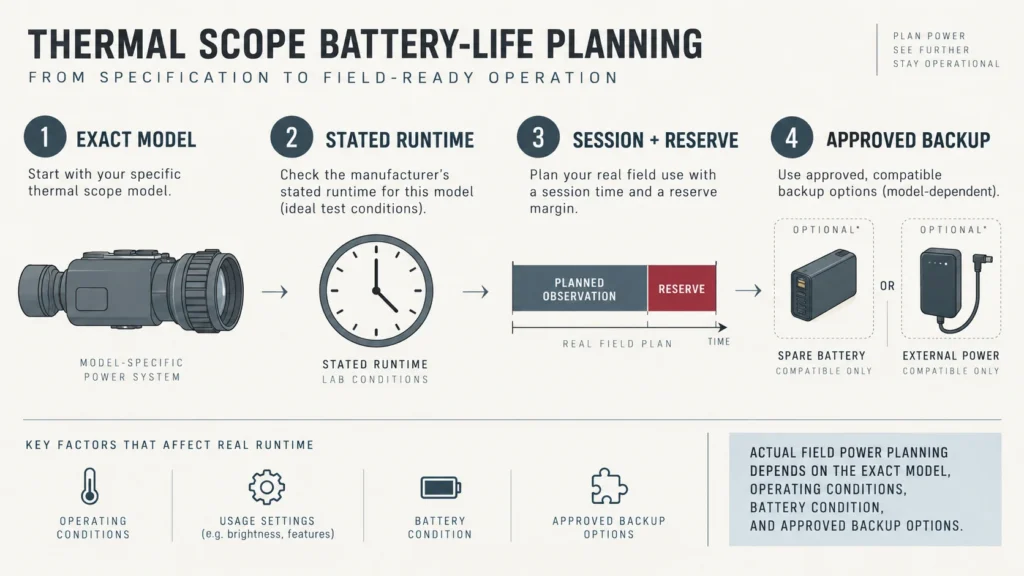
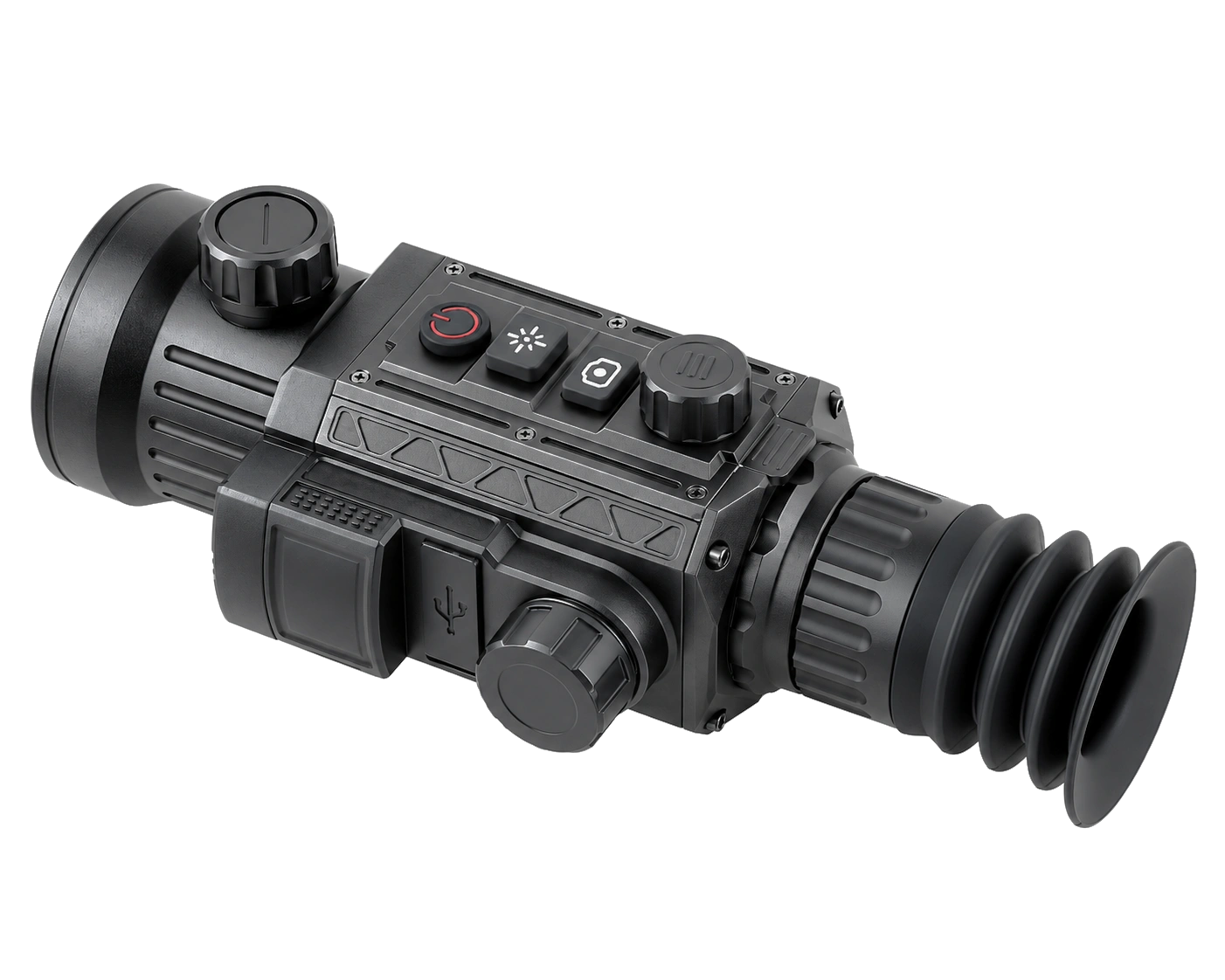
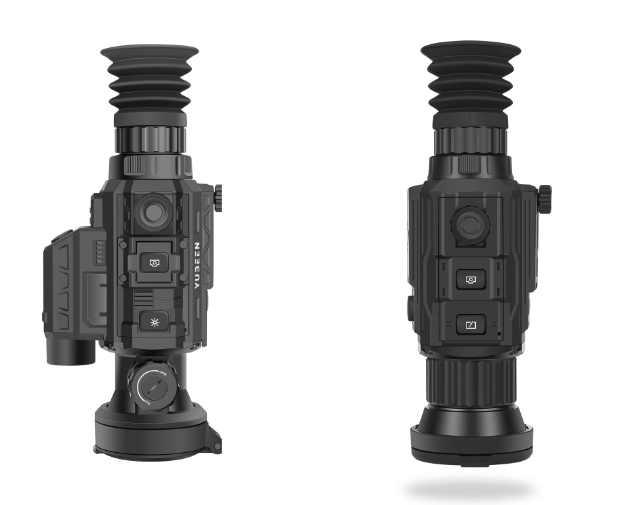
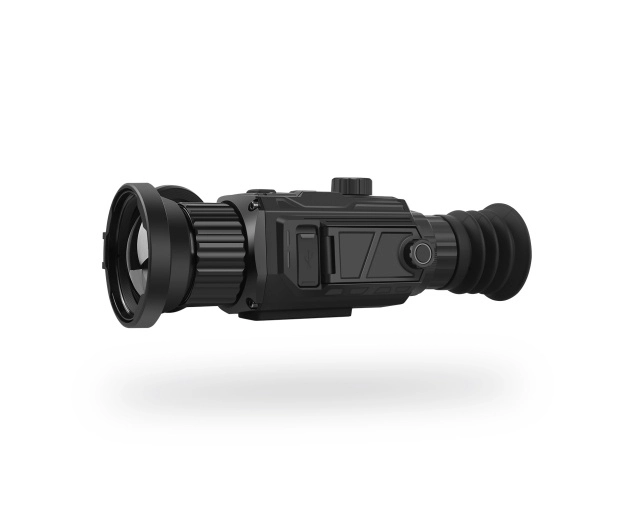
Thermal scope battery life is best treated as a power plan, not as a single number to memorize. The usable time in a session depends on the exact model, its stated operating figure, the features in use, the environment, and the condition of the battery. Start with the runtime specified for the device, then build in a practical reserve with approved power accessories. That approach is more useful than assuming every thermal scope will run for the same number of hours.
For a long observation session, the goal is simple: know the power source you are carrying, know how the device is meant to be charged, and know whether any optional external power source is expressly supported. A clear plan helps prevent an avoidable interruption when continuous viewing matters.
Quick answer: Use the exact model’s stated operating time as the starting point, not a universal promise. Plan a reserve with an approved spare battery or a manufacturer-confirmed external option. USB charging alone does not establish compatibility with every power bank or cable, so verify the model documentation before adding accessories.
Start with a model-specific runtime figure
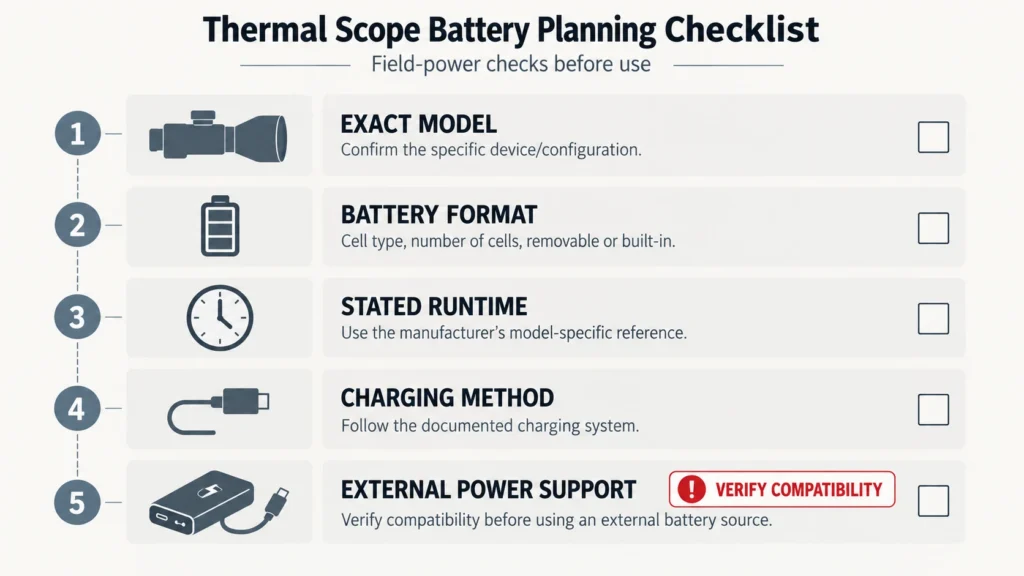
A runtime figure has value only when it is tied to the right configuration. Before comparing products or accessories, check the battery type, whether it is removable, the stated observation time, the charging method, and any documented external-power capability. Those details establish what a sensible backup plan looks like.
Planning item
What to check
Why it matters
Exact model
The model name and current configuration
Similar-looking scopes can use different power systems.
Battery format
Cell type, number of cells, and whether it is removable
This affects the type of spare that can be used.
Stated operating time
The maker’s stated observation-time figure and conditions
It is the starting point for estimating a session.
Charging method
The approved charging method and charger
It helps avoid an incompatible charging setup.
External-power support
A specific statement in the product documentation
It prevents assumptions based on a connector alone.
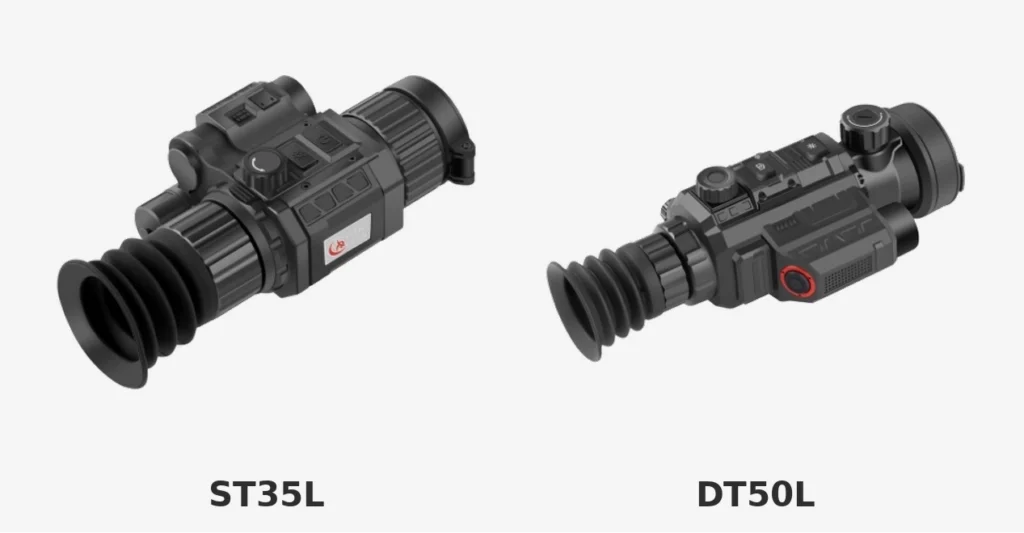
ST35L power details
For the ST35L configuration discussed here, the power system uses one removable protected 18500 lithium battery rated at 2,400 mAh. Its stated reference is 5 hours of continuous observation, and it supports USB charging.
Specification
ST35L stated detail
Battery
One removable protected 18500 lithium battery
Battery capacity
2,400 mAh
Observation-time reference
5 hours of continuous observation
Charging
USB charging
Use that five-hour figure as a planning reference for this configuration. It does not mean every thermal product, setting, temperature, or session will produce the same operating time. When comparing current options, start with the YUBEEN thermal imaging rifle scope range and confirm the power details for the exact model under consideration.
What changes thermal scope battery life in real use?
Thermal scope battery life can change when the way a device is used changes. Continuous viewing, display brightness, recording, wireless connections, and other active functions can place different demands on the system. Ambient temperature and the condition of a rechargeable cell can also influence the time available in a session.
That is why a stated runtime should be paired with a reserve rather than used as the entire plan. A short session may need only the installed battery. A longer outing may call for an approved spare, a confirmed charging opportunity, or a documented external-power option.
Build a power plan for the whole session
Estimate the complete viewing window. Include setup, observation time, and the time needed after the main viewing period. A plan based only on the central task can leave too little margin.
Choose the approved backup. If the device uses a removable battery, a compatible spare can be simpler than changing the device’s power arrangement. Keep the exact model and approved battery format in view.
Keep charging within the documented system.CPSC Batteries describes a system approach to battery safety in which the battery, charger, and end product are considered together. Follow the manufacturer’s instructions for charging, storage, and replacement parts.
Decide on external power only after confirming compatibility. A power bank may be useful for some devices, but only when the product documentation identifies an approved way to use it.
When an external battery pack for a thermal scope makes sense
An external battery pack for a thermal scope is an option only when the manufacturer documents support for that exact model. A USB charging port by itself does not tell you whether the port accepts external operating power, which input is permitted, or which cable and pack are suitable.
Before relying on an external source, confirm all of the following in the relevant product documentation:
the exact model supports external power during operation;
the required input specification and connection method are stated;
the manufacturer identifies compatible accessories or gives clear approval criteria; and
the setup preserves the product’s intended protection and handling requirements.
If those points are not clear, do not treat a generic power bank as a substitute for the specified battery arrangement. A compatible spare battery and the approved charging method are usually the more straightforward plan.
How to evaluate a thermal scope battery pack
When evaluating a thermal scope battery pack or replacement battery, first confirm which power format the exact model uses. A single removable battery, a built-in battery pack, and an external power accessory are different power arrangements and should not be treated as interchangeable.
Decision question
A useful answer
Is it made for the exact model?
The model documentation identifies the cell or accessory as compatible.
Does it cover the planned session?
The stated runtime plus a reserve matches the expected viewing window.
How is it charged?
The product manual identifies the charging method and approved charger.
Is external power necessary?
The session length justifies it and the product supports it explicitly.
Keep power planning connected to the overall scope choice
Power is one part of a broader equipment decision. It should be considered alongside image performance, controls, recording needs, physical size, and the conditions in which the scope will be used. For model comparison, the wider YUBEEN product range is a useful place to separate current configurations before choosing batteries or accessories.
This keeps the power plan connected to the actual product, rather than to a generic accessory label.
FAQ
How long should thermal scope battery life be for an evening outside?
There is no single number that fits every device or session. Start with the exact model’s stated observation time, then allow a reserve for the duration, functions, temperature, and condition of the battery. The ST35L reference in this guide is 5 hours of continuous observation; use it as a starting point for that configuration rather than a universal runtime.
Can I use an external battery pack for a thermal scope?
Use an external battery pack only when the manufacturer confirms that the exact model supports it and specifies the approved connection method. A matching connector or a USB charging function is not enough evidence by itself. If the documentation does not approve external operating power, choose the specified battery and charging arrangement instead.
Does USB charging mean a thermal scope accepts external power?
No. USB charging describes a charging method. It does not automatically establish that the device can operate from every external battery source. Check the current model documentation for a separate statement about external operating power before selecting an accessory.
What should I review before buying a thermal scope battery pack?
Check the exact scope model, battery type, capacity reference, stated runtime, charging method, and any written compatibility statement for external power. If any part is unclear, use the manufacturer’s support channel before purchasing a replacement or accessory.
Plan power before you leave
Thermal scope battery life becomes easier to judge when it is tied to the exact device and the complete session. Start with the stated runtime, carry only approved backup options, and treat any external-power arrangement as model-specific. For help comparing current configurations or confirming product details, contact YUBEEN before finalizing an accessory choice.
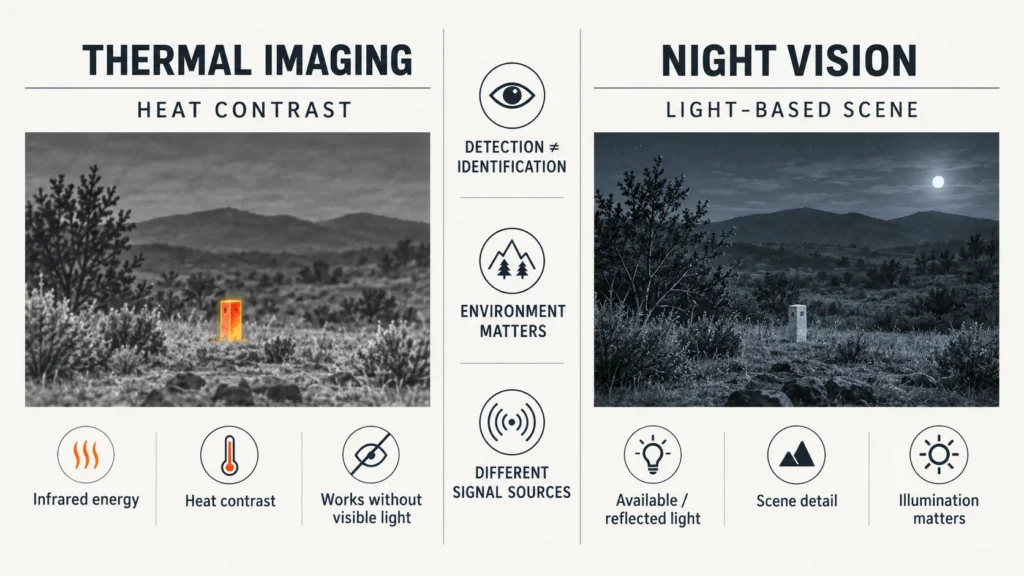
Thermal scope vs night vision comparisons are most useful when they begin with the type of information each technology reveals in real conditions. On a dark trail or a moonless field, the first useful question is not which device is more advanced. It is what information will be hardest to see. A thermal scope turns heat contrast into a visible image, while night vision preserves a light-based view of the scene. That difference changes the experience: thermal can bring a warm subject out of a confusing background, while night vision can make branches, terrain, and man-made objects easier to interpret when enough light reaches them.
The choice is not a contest to win. Both technologies have limits, but the factors that affect them are not identical. Thermal performance depends strongly on thermal contrast and environmental conditions, while night vision depends more on available illumination. Weather, vegetation, subject size, focus, and physical obstructions can also affect practical use. The better option is the one that solves the first visibility problem in the conditions you actually expect.
Quick answer: Thermal is usually the stronger starting point when locating a heat signature in very low or no visible light is the first problem. Night vision is often better for a familiar, light-based view of terrain and object detail when usable illumination is present. Weather, scene conditions, vegetation, subject size, and focus can still affect practical performance.
Start With the Signal, Not the Marketing Label
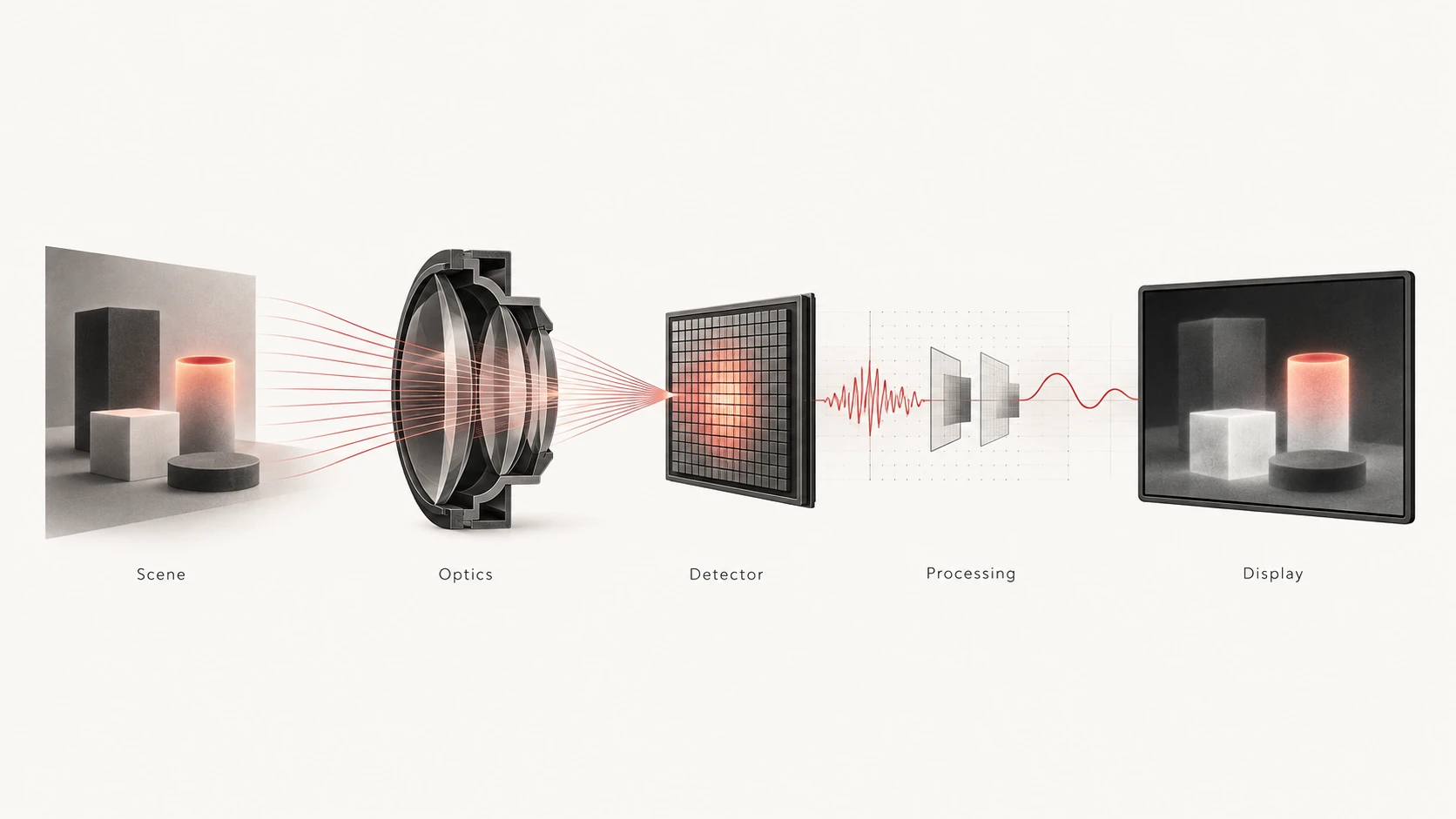
A thermal scope converts differences in infrared energy into a visible image. Night vision forms an image from available or reflected light. Depending on the system, that light may come from ambient illumination or an infrared illuminator, while the image is produced through image intensification or a digital sensor. The two systems therefore rely on different types of scene information.
Thermal does not need moonlight to form a heat-based image. That can be valuable when the environment is dark and a warm object does not stand out visually. But a bright thermal shape is not automatically a detailed description of the subject. Heat contrast changes with surface temperature, background conditions, distance, and the amount of the subject that is visible.
Night vision, by contrast, can retain a more familiar arrangement of edges, textures, and light-and-dark relationships. With adequate illumination, that can help a user understand where paths, branches, fences, equipment, and other scene features sit around the subject. The trade-off is that the light reaching the scene matters much more.
What Changes in a Real Night Scene?
When ambient light falls away
As usable light decreases, thermal and night vision stop feeling interchangeable. A thermal device can still present heat contrast when the scene looks almost black to the unaided eye. A night-vision device may need more ambient light or an appropriate infrared illuminator, depending on its design.
That does not mean thermal contrast is fixed. After a warm day, rocks, soil, vegetation, and structures can retain heat. When foreground and background temperatures move closer together, the difference between them can become more subtle. Low NETD can help reveal smaller thermal differences when test conditions are comparable, but scene conditions still determine how useful the result is.
When scene context matters
Finding a warm shape and understanding the surrounding scene are separate tasks. Night vision may provide more natural visual context when light is available, especially where texture and edge definition matter. Thermal may instead prioritise the contrast between a heat signature and its background.
Neither output should be treated as a shortcut to certainty. Detection means noticing a qualifying heat source or visual presence. Recognition means assigning a broad class. Identification requires enough detail to confirm the specific subject needed for a decision. One specification or one image mode cannot collapse those steps into the same claim.
In rain, fog, and physical obstruction
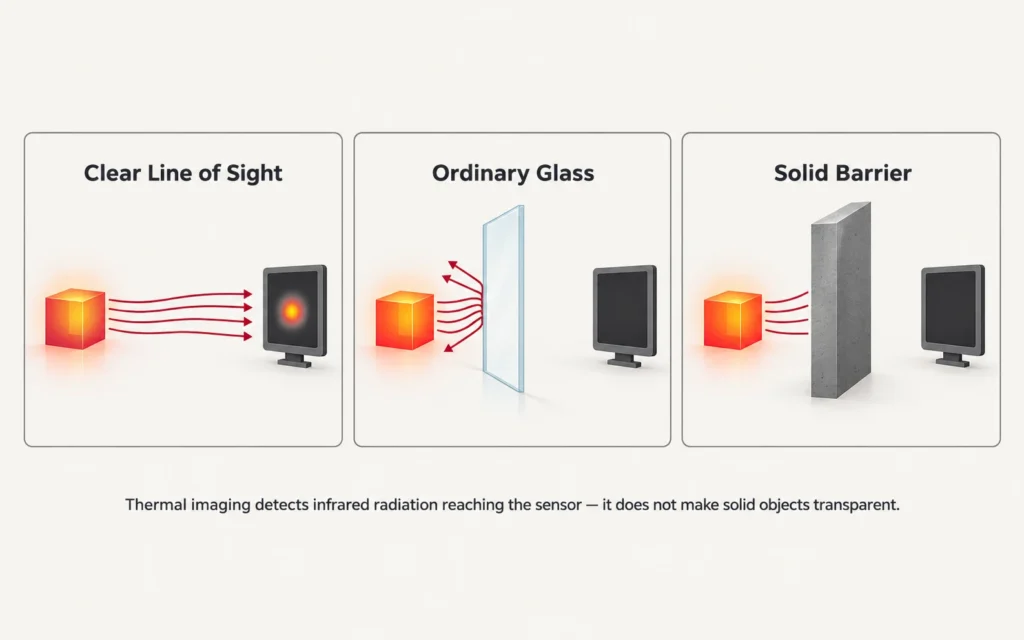
Poor conditions change both technologies, but not in exactly the same way. Rain, fog, humidity, low thermal contrast, and solar heating can reduce useful thermal separation. Low ambient light, glare, and reflective surfaces can also complicate a night-vision view. Dense foliage and solid objects can obstruct both technologies. Ordinary glass generally blocks long-wave thermal imaging, while night-vision performance through glass depends on the system, lighting, reflections, and use of IR illumination.
Thermal Scope vs Night Vision: Comparison in Practice
Real-use question
Thermal scope
Night vision
What forms the image?
Infrared heat contrast from the scene.
Reflected light captured through image intensification or a digital sensor; some systems use IR illumination when ambient light is insufficient.
What happens in very low visible light?
It can still form a heat-based image without visible light.
The result depends more on available light or suitable IR illumination.
What is often easier to notice first?
A heat signature that contrasts thermally with the background.
Terrain shape, edges, surface texture, and object context when the scene is illuminated.
What can reduce the result?
Low thermal contrast, humidity, rain, fog, solar heating, target size, focus, and obstruction.
Very low light, glare, reflective surfaces, illumination quality, focus, and obstruction.
What should not be assumed?
That detection equals recognition, identification, or a usable distance for every task.
That a familiar-looking image remains equally clear as light falls away.
The table is a starting point, not a substitute for matching a device to local laws, responsible use, and the actual environment. A product category page such as YUBEEN’s thermal imaging rifle scope rangecan help narrow the thermal side of the comparison, but the technology choice still comes first.
Choose by the First Decision You Must Make
Do you first need to notice heat in near-total darkness?
If the first obstacle is locating a heat signature when there is little or no visible light, thermal imaging is normally the more relevant starting point. It makes temperature contrast the core visual signal instead of waiting for the scene to be illuminated.
Do you first need a familiar view of the scene?
If the priority is reading terrain, vegetation, signs, equipment, and fine visual context, night vision may fit better when there is enough usable light. It can present a scene in a way that is closer to ordinary visual interpretation.
Will the environment move between both conditions?
Mixed settings deserve more thought than a one-word answer. A wooded area can shift from residual twilight to full darkness; a field can shift from cool ground to low thermal contrast after warming. Consider when you will observe, how much light is normally present, and which limitation arrives first.
Are you comparing numbers that answer different questions?
Avoid treating detector resolution, pixel pitch, NETD, lens size, base magnification, and digital zoom as if they measure the same thing. Digital zoom enlarges captured detector data; it does not add new native detail. Published detection distance is also only a detection claim. It does not establish recognition, identification, or a permitted use distance.
For a broader selection framework, YUBEEN’s thermal rifle scope buying guide is useful once you know that a thermal-first approach fits your conditions.
Where the ST35L Fits a Thermal-First Use Case
For users who decide that heat contrast is the first problem to solve, the YUBEEN ST35L is a concrete thermal example. The ST35L is specified with a 384 × 288 uncooled detector, 12 μm pixel pitch, 35 mm F1.0 objective lens, 50 Hz frame rate, 3.0× base magnification, and a 7.5° × 5.7° field of view. These specifications describe how the scope forms and presents a thermal image; they do not make it behave like a night-vision device.
ST35L characteristic
What it helps you evaluate
384 × 288 detector and 12 μm pixel pitch
The native thermal image matrix and pixel spacing, not a promise of subject identification.
35 mm F1.0 objective and 3.0× base magnification
The starting magnification before digital zoom is applied.
50 Hz thermal-module frame rate
How often the thermal module updates image data, rather than the display’s resolution.
NETD ≤20 mK (25 °C, F/1.0)
Describes thermal sensitivity under the stated test conditions; it is not a stand-alone measure of overall image quality.
3,500 m human-target detection distance
A stated human-target detection figure; Recognition is 875 m and Identification is 438 m.
YUBEEN develops own-brand thermal imaging and optical products for international markets. Within that range, the ST35L is relevant when the goal is to begin with a heat-based view and then interpret the result carefully against the terrain, weather, and task at hand. Its stated IP66 protection rating can inform environmental planning, but it does not mean weather leaves image quality unchanged.
A Short Decision Checklist Before You Choose
Is the first limitation a lack of visible light, or a lack of scene detail?
Do you need to find heat contrast first, or interpret a light-based scene first?
How often will humidity, rain, fog, solar heating, or dense vegetation affect the view?
Which model-specific figures are native image specifications, and which are conditional performance statements?
Have you kept detection, recognition, identification, and any distance-related decision separate?
When those answers point to thermal, compare the relevant models through the YUBEEN product range rather than choosing from a single headline number.
Conclusion: Choose the Image That Solves the Earliest Problem
Thermal vs night vision is best decided by the first visibility problem you expect to face. Thermal is often the better match when heat contrast must remain visible with little or no ambient light. Night vision can be the better match when the scene itself needs to stay visually familiar and enough illumination is available. In either case, weather, background conditions, subject size, focus, and obstruction still set practical limits.
If you want to discuss the ST35L or compare a thermal-first setup with your intended environment, contact YUBEEN for model-specific guidance.
FAQ
Is a thermal scope better than night vision in total darkness?
Thermal is often the stronger starting point in total darkness because it forms an image from heat contrast rather than visible light. That advantage does not remove other limits: low thermal contrast, humidity, weather, subject size, focus, and obstruction can still reduce the usefulness of the image.
Can thermal imaging identify what a heat signature is?
Not by itself in every condition. Thermal imaging can help detect a heat signature, but detection is different from recognition and identification. Distance, target size, image contrast, background temperature, weather, focus, and the amount of visible subject detail all influence what can be concluded responsibly.
Does higher digital zoom make a thermal scope see farther?
No. Digital zoom enlarges the data already captured by the detector; it does not add new native detector information. At higher zoom levels, perceived detail can decrease. Evaluate base magnification, detector resolution, lens, field of view, and real operating conditions together.
How do rain, glass, and dense vegetation affect thermal scopes?
Rain, fog, humidity, and low thermal contrast can reduce thermal performance. Ordinary glass and solid objects block the thermal view, while vegetation can hide part or all of a subject. Thermal imaging is a heat-contrast tool, not a way to bypass physical obstructions or weather limits.
To match a thermal scope to your rifle correctly, start with mechanical compatibility, mounting geometry, recoil limits, clearance, and overall balance.The scope also has to fit the rifle physically, remain compatible with the mounting system, tolerate the expected recoil environment, and provide a field of view that suits the way the equipment will actually be used.
A better selection process starts with the rifle and the intended use, then works outward to the thermal specifications. Mounting interface, available rail space, size, weight, base magnification, field of view, detector resolution, lens configuration, power requirements, and optional features all affect whether a thermal scope feels balanced and practical once installed.
Start With the Rifle Before Comparing Thermal Specifications
A thermal scope may perform well on a specification sheet and still be a poor match for a particular setup. Before comparing detector resolution or thermal sensitivity, confirm the physical and mechanical requirements of the rifle and mounting system.
Check the Mounting Interface and Available Space
Start by identifying the actual mounting interface on the rifle and the mount supplied or recommended for the thermal scope. Picatinny, Weaver, proprietary bases, and adapter systems are not automatically interchangeable.
Available space matters as well. A scope must fit without interfering with nearby controls, the charging or battery compartment, or other equipment already installed on the platform. The position of the eyepiece and objective housing can also affect how naturally the user can access the controls.
If an adapter is required, treat the adapter as part of the complete system. Every additional interface changes height, spacing, weight, and potentially repeatability.
Confirm the Recoil and Shock Rating
Do not choose a thermal scope for a rifle based only on caliber labels such as “small caliber,” “mid caliber,” or “magnum.” Different platforms can produce different recoil characteristics, and the durability of the optic depends on its actual mechanical design and verified shock rating.
The safer method is to compare the scope manufacturer’s published recoil or shock specification with the requirements of the intended platform. The mount must also be suitable for the same application; a strong optic cannot compensate for an unsuitable or improperly installed mounting interface.
Check Clearance and Viewing Position
Physical compatibility includes more than whether the mount attaches to the rail.
Check the overall length of the thermal scope, objective housing, eyepiece position, battery access, control layout, and the amount of usable mounting space. The viewing position should remain comfortable in the normal operating posture without forcing an awkward head position.
For installation and tightening requirements, always follow the instructions supplied by the scope and mount manufacturers rather than applying a generic torque value.
Match the Thermal View to Your Typical Distance and Terrain
Once physical compatibility is confirmed, the next question is what type of image the scope needs to provide.
A thermal scope used across open terrain may benefit from a different starting view than one used where subjects appear at shorter distances or move through tighter surroundings.
Base Magnification and Field of View Work Together
Base magnification determines how large a distant subject appears before digital zoom is applied. Field of view determines how much surrounding area remains visible at the same time.
Higher base magnification can make a distant subject occupy more of the display, but it normally gives the user less surrounding area for scanning and following movement. Lower base magnification generally provides a wider starting view.
Neither is automatically better. The correct balance depends on typical observation distance, target size, terrain, and how often subjects are moving rather than stationary.
Detector Resolution and Lens Design Shape Usable Detail
Detector resolution determines how many thermal pixels are available to form the original image. A higher-resolution detector can provide more spatial information, especially when the rest of the optical system is capable of using that information effectively.
Lens focal length also changes the starting view. A longer focal length generally provides a narrower field of view and greater apparent image scale when detector size is held constant.
These specifications therefore need to be considered together. Resolution alone does not determine useful range, and a larger lens does not automatically make one scope a better match than another.
Treat Digital Zoom as Enlargement, Not New Detail
Digital zoom enlarges information that has already been captured by the detector. It can make a subject easier to view on the display, but it does not create additional native thermal pixels.
For that reason, users who expect to rely heavily on higher zoom settings should look first at the original detector resolution, lens configuration, focus quality, and field of view rather than comparing maximum digital-zoom numbers alone.
Consider Size, Weight, and Overall Balance
Thermal scopes contain detectors, processors, displays, batteries, and in some models laser rangefinders or other integrated systems. These components affect both dimensions and weight.
A lighter and more compact unit can be easier to carry for longer periods and may preserve a more familiar balance. A larger system may offer a different optical configuration or additional functions, but the extra mass still becomes part of the complete setup.
There is no universal weight threshold that defines a good match. Instead, consider the combined weight of the scope and mount, where that weight sits on the rifle, whether the equipment is normally carried for long periods, and whether the platform is commonly used with external support.
The best specification sheet is not useful if the completed system becomes unnecessarily awkward for its intended use.
Decide Which Integrated Features You Actually Need
Modern thermal scopes may include laser rangefinding, recording, wireless connectivity, picture-in-picture viewing, multiple image palettes, stored profiles, or ballistic-related functions.
These features can be useful, but they should not replace the basic compatibility checks.
An Integrated LRF Adds Direct Distance Information
A laser rangefinder can be valuable when knowing the distance to a subject is important and estimating distance from the thermal image alone would be unreliable.
An integrated LRF also reduces the need to use a separate ranging device. However, it may add cost, weight, controls, and additional power requirements.
Choose it because the ranging function fits the intended workflow, not simply because an LRF-equipped model has a longer feature list.
Ballistic Functions Should Match the User’s Workflow
Some thermal scopes include ballistic-related tools designed to work with range and other configured information.
Their value depends on the exact implementation and on correct setup. They should be treated as an additional information tool rather than a substitute for proper equipment setup, verified zero, reliable ammunition data, and responsible judgment.
Before choosing a model for this feature, check exactly what information the system requires and which functions are supported by that specific product.
Recording and Connectivity Are Workflow Features
Video recording, image capture, wireless transfer, and app connectivity can be useful for reviewing observations, documenting field use, or sharing media.
Users who rarely use those functions may prefer to prioritize size, battery life, image performance, or controls instead.
A feature is only valuable when it supports the way the equipment is actually used.
Use a Compatibility Checklist Before Choosing a Model
Instead of starting with a product name, compare the complete system requirement.
Factor
What to Check
Why It Matters
Mounting interface
Rail, base, mount and adapter compatibility
Determines whether the scope can be installed correctly
Available space
Scope length, mount footprint and nearby equipment
Prevents physical interference
Recoil compatibility
Published optic and mount shock ratings
Helps protect reliability and zero retention
Size and weight
Scope plus mount, not scope alone
Affects handling and balance
Base magnification
Starting image scale
Affects distant detail and close-range usability
Field of view
Published angular or linear FOV
Affects scanning and tracking
Detector and lens
Resolution, pixel pitch, focal length and focus
Shapes original thermal image information
Power
Battery type, runtime and external-power options
Affects practical operating time
Integrated features
LRF, recording, connectivity and software functions
Should match actual requirements
This process prevents a common mistake: choosing the most impressive individual specification instead of choosing the most suitable complete configuration.
Set Up and Verify the Complete System Before Field Use
Even a well-matched scope still needs to be installed and checked correctly.
Follow the Mount Manufacturer’s Installation Requirements
Use mounting hardware that is specifically compatible with the rail and optic. Keep mounting surfaces clean and follow the supplied tightening sequence and torque specifications.
Avoid assuming that one torque value applies to every mount. Different hardware, screw sizes, and materials can require different settings.
Verify Zero After Installation or Reinstallation
After installation, verify the system at a suitable controlled range before relying on it in the field.
If a quick-detach mount is used, do not automatically assume perfect return-to-zero after every removal and reinstallation. Repeatability depends on the design, installation, rail interface, and condition of the hardware.
Checking the system removes uncertainty.
Adjust Focus and Image Settings for the Actual Environment
Thermal image quality also depends on correct setup. Adjust focus for the real observation distance and use brightness, contrast, palette, calibration, or image-enhancement settings according to the product manual and conditions.
A setting that works well on a cold night may not provide the same result when the background temperature is much closer to the temperature of the subject.
How to Compare Yubeen Thermal Scope Configurations
Yubeen thermal imaging scopes are available in different detector, lens, housing, ranging, and feature configurations. The most useful way to compare them is not to assign one model permanently to a particular caliber or rifle type.
Instead, filter the options in this order:
Confirm mount and recoil compatibility.
Compare physical dimensions and total installed weight.
Choose the base magnification and field of view for the expected terrain and distance.
Compare detector, lens, thermal sensitivity, and focusing specifications.
Decide whether integrated LRF, recording, connectivity, or ballistic-related functions are necessary.
Confirm battery configuration, operating controls, warranty terms, and service support.
This keeps the comparison tied to real requirements rather than broad labels such as “entry-level,” “mid-tier,” or “long-range.”
A longer-format thermal riflescope such as the Y65L illustrates why physical configuration matters alongside imaging specifications. Overall length, lens system, controls, mount position, and weight all become part of the installed setup. A compact thermal scope may solve a different set of priorities.
The correct choice is therefore the model whose complete configuration matches the intended platform and use—not simply the model with the largest number on one line of the specification sheet.
Final Thoughts
Matching a thermal scope to a rifle is a system-level decision.
Start with mounting compatibility, available space, recoil requirements, size, and balance. Then compare base magnification, field of view, detector resolution, lens configuration, thermal sensitivity, and power. Only after those fundamentals are clear should optional features such as integrated LRF, recording, wireless connectivity, or ballistic tools decide between otherwise suitable models.
A well-matched setup is not necessarily the largest, lightest, highest-resolution, or most feature-rich option. It is the configuration whose mechanical fit, image characteristics, controls, and features make sense together for the way the equipment will actually be used.
FAQ
Can any thermal scope be mounted on any rifle?
No. Compatibility depends on the rifle’s mounting interface, the scope mount, available rail space, physical clearance, and the recoil or shock rating of both the optic and mounting hardware. Check the specifications of the complete system before installation.
Does a larger thermal sensor or objective lens always make a scope a better match?
No. Higher detector resolution can provide more original image information, while lens focal length affects image scale and field of view. Size, weight, typical distance, terrain, focus requirements, and the rest of the optical system also matter. A larger specification is not automatically the better choice.
Should I choose a fixed mount or a quick-detach mount?
It depends on how the equipment will be used. A fixed mount may suit a setup that normally stays assembled, while a compatible quick-detach system can be useful when the optic needs to be removed or transferred. In either case, follow the manufacturer’s installation instructions and verify zero after installation or reinstallation.
Does rifle caliber alone determine which thermal scope I should choose?
No. Caliber alone is too simple a way to select an optic. Verify the scope’s published recoil rating and mounting requirements, then consider physical fit, weight, field of view, magnification, image performance, and the features required for the intended use.
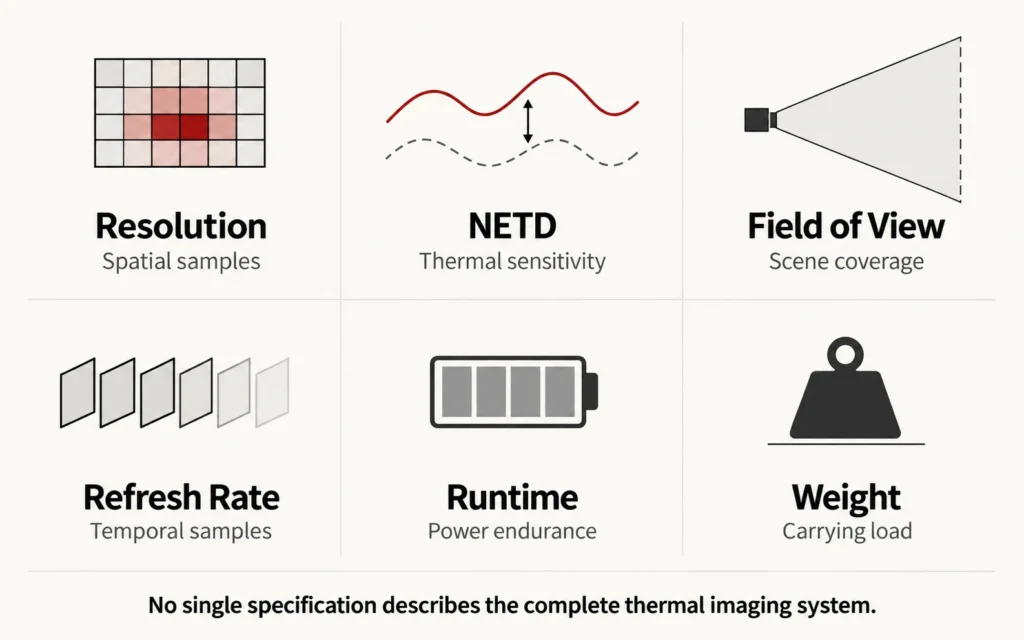
Choosing a thermal imaging scope is not about finding the largest number on a specification sheet. Detector resolution, NETD, pixel pitch, lens design, field of view, magnification and refresh rate describe different parts of the imaging system, while battery life, size, weight and controls determine how practical that system is to use.
The specifications also interact. A longer focal length can provide a narrower field of view for distant observation, but it reduces the amount of surrounding scene visible at once. A higher detector resolution provides more native spatial samples, but it does not automatically mean better thermal sensitivity. A low NETD value can help preserve subtle temperature differences, but it does not tell you how many pixels are available across a distant target.
The right approach is therefore to begin with the intended use and then identify which specifications support it.
If you are new to the technology itself, our thermal imaging for beginners guide explains how a thermal detector forms an image before you begin comparing individual specifications.
Start With the Use Case, Not the Specification Sheet
Before comparing products, define the conditions in which the device will actually be used.
Ask:
How far away are the subjects you normally need to observe?
How large are those subjects?
Do you need a wide scene for scanning, or a narrower view for more distant observation?
Will the device or subject move frequently?
How long does the device need to operate before charging or replacing batteries?
How important are overall weight and size?
Do you need integrated ranging, recording or other workflow functions?
What environmental conditions are realistic for your use?
These questions help determine which specifications deserve the most weight.
A specification can be objectively impressive and still be poorly matched to a particular application.
Detector resolution describes the number of sensing elements in the thermal focal plane array.
Common formats may be expressed as values such as:
256 × 192
384 × 288
640 × 512
These numbers represent native thermal detector samples, not display pixels.
A 384 × 288 detector contains:
110,592 native detector elements
A 640 × 512 detector contains:
327,680 native detector elements
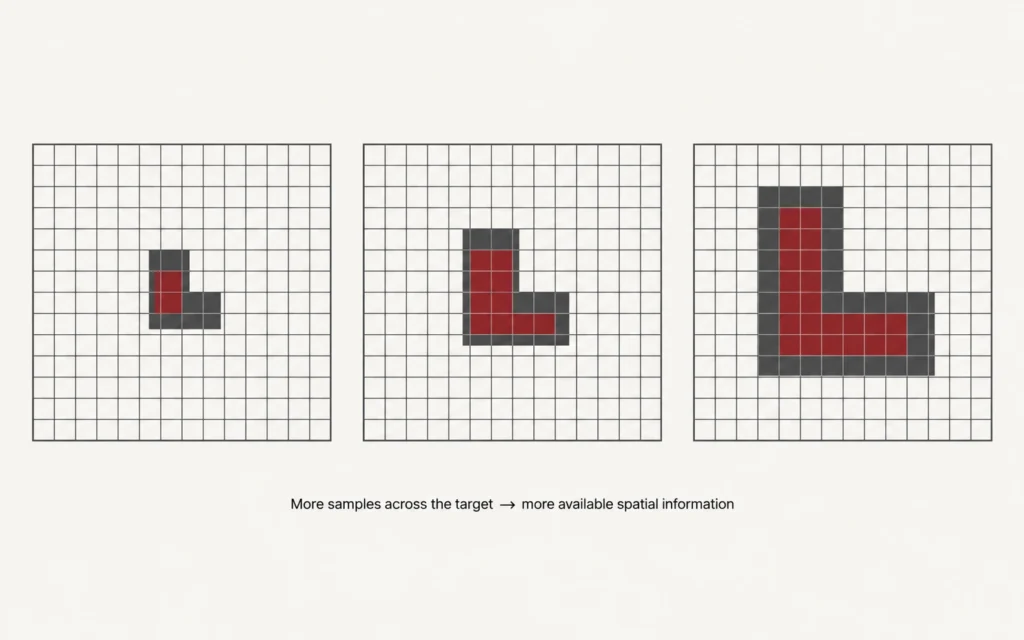
Under comparable optical conditions, having more detector elements can place more native samples across objects in the scene. This can help preserve shape, boundaries and smaller spatial details.
Higher detector resolution can therefore be especially useful when the subject occupies only a small portion of the total image.
However, resolution is not a complete measure of image quality. Optical quality, field of view, thermal sensitivity, focus, processing and atmospheric conditions all affect the final result. Teledyne FLIR likewise notes that detector resolution is only one part of thermal-system performance; sensitivity, optics, calibration and processing also matter.
Do Not Confuse Detector Resolution With Display Resolution
A high-resolution OLED or LCD does not increase the number of thermal measurements collected by the detector.
For example, if a thermal detector produces 384 × 288 native samples and the resulting image is shown on a higher-resolution display, the display can present the interface and processed image more smoothly, but the detector remains 384 × 288.
Similarly:
Detector resolution = thermal measurement grid
while:
Display resolution = presentation grid
Both matter to the user experience, but they are not interchangeable.
NETD: Thermal Sensitivity Is Different From Resolution
NETD stands for Noise Equivalent Temperature Difference and is normally expressed in millikelvin, or mK.
In simplified terms, it describes how small a temperature difference a thermal imaging system can distinguish relative to its noise under specified test conditions.
A lower NETD value generally represents greater thermal sensitivity under comparable conditions. FLIR describes lower NETD as the ability to distinguish smaller thermal differences.
But several cautions are important.
First, NETD is not resolution.
A 640 × 512 detector does not automatically have lower NETD than a 384 × 288 detector.
Second, NETD values should be compared with their test conditions. Lens f-number can affect system sensitivity, which is why thermal-system NETD values are often specified or normalized with a stated f-number.
Third, lower NETD does not override every other characteristic of the system. Focus, lens transmission, processing and the thermal contrast of the actual scene still affect what the user sees.
For buying decisions, treat detector resolution and NETD as two separate questions:
How much spatial information is sampled?
How effectively can the system distinguish small thermal differences?
Pixel Pitch: Useful, but Never Read It Alone
Pixel pitch describes the physical spacing between neighboring detector elements.
Values such as 12μm and 17μm are therefore geometrical specifications. They are not detector resolutions and they are not NETD values.
Smaller pixel pitch can permit finer angular sampling with a given focal length and can support more compact detector and optical-system designs. But the final result depends on detector architecture, resolution, lens design and signal processing.
This means:
12μm does not automatically mean higher resolution;
12μm does not automatically mean lower NETD;
12μm does not automatically mean longer detection range.
Pixel pitch becomes more meaningful when read together with lens focal length, detector resolution and field of view.
Lens Focal Length and Field of View Must Be Compared Together
The lens determines how infrared energy from the scene is projected onto the detector.
One of the most important results is field of view, or FOV.
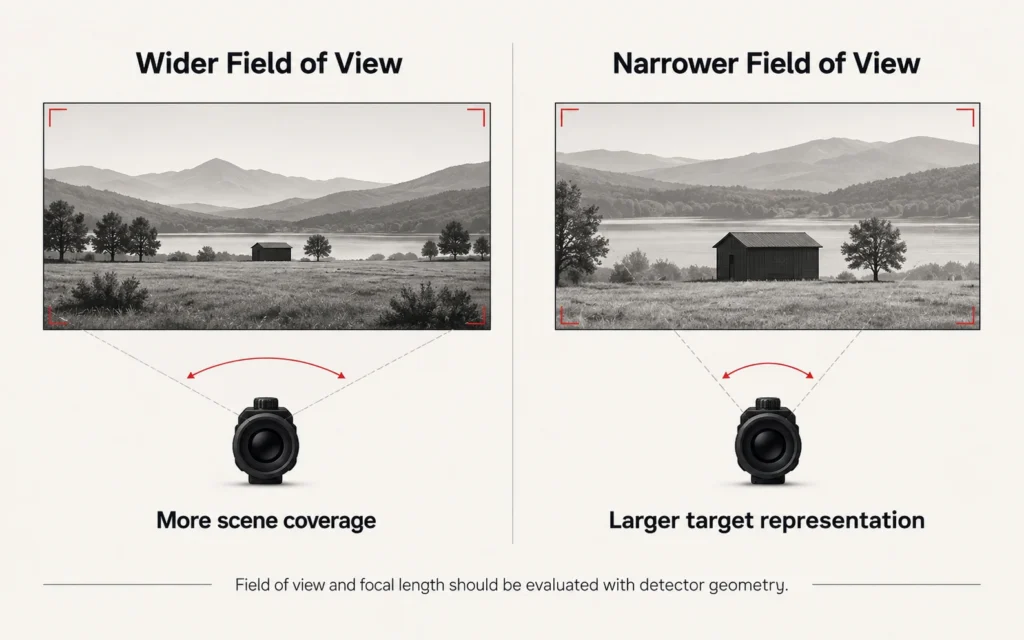
A wider field of view shows more of the scene at once. This can make scanning and locating subjects easier.
A narrower field of view covers less of the scene, so a distant object occupies a larger part of the image.
In general, with the same detector, shorter focal lengths produce a wider field of view while longer focal lengths produce a narrower field of view. FLIR’s thermal-optics guidance describes focal length, FOV and IFOV as directly connected design variables.
Neither is universally better.
A Wider Field of View Is Useful When:
the expected working distance is shorter;
subjects may appear anywhere across a broad area;
fast scanning matters;
situational awareness matters more than making a distant target occupy more of the frame.
A Narrower Field of View Is Useful When:
expected observation distances are longer;
a smaller section of the scene needs closer inspection;
putting more available detector samples across a distant object is important.
Real thermal systems demonstrate this trade-off: changing focal length can produce very different scene coverage even when the underlying detector remains the same.
Base Magnification Is Only Part of the Viewing Geometry
Thermal scope magnification should not be considered separately from detector size, pixel pitch, focal length and field of view.
A higher base magnification makes objects appear larger from the starting view, but normally provides less surrounding scene.
A lower base magnification generally provides a wider initial view, which may make scanning easier.
The correct choice depends on normal observation distance and how quickly the user needs to move between scanning and closer inspection.
For a detailed treatment of this trade-off, see our guide to thermal scope magnification.
Digital Zoom Does Not Increase Native Detector Resolution
Digital zoom enlarges the image data already produced by the detector.
It does not add physical detector elements.
As digital zoom increases, each native detector sample is displayed over more screen area. Image-processing techniques such as interpolation or super-resolution can improve presentation, but the physical detector information does not increase.
This is why native detector resolution, base magnification and field of view should be evaluated before treating the maximum digital-zoom number as a major purchasing advantage.
IFOV Helps Connect the Detector to the Lens
Instantaneous Field of View, or IFOV, describes the angular portion of the scene represented by an individual detector pixel.
In simplified geometry:
IFOV ≈ pixel pitch ÷ focal length
This makes IFOV useful because it connects two specifications that are often advertised independently.
A smaller IFOV means an individual detector element covers a smaller angle of the scene.
As distance increases, however, that angular area corresponds to an increasingly large physical area on the target plane.
This is one reason target size, distance, detector geometry and focal length must all be considered together rather than using one specification to predict performance.
Refresh Rate: How Often Is a New Thermal Frame Produced?
Frame rate or image frequency describes how often the system produces new thermal frames.
For example:
30 Hz ≈ one new frame every 33.3 ms
50 Hz ≈ one new frame every 20 ms
60 Hz ≈ one new frame every 16.7 ms
Higher frame rates provide more temporal samples of moving scenes.
This can make panning and moving subjects appear more continuous.
But refresh rate does not increase detector resolution.
A 384 × 288 detector running at 60 Hz remains a 384 × 288 detector. Likewise, a 640 × 512 detector at a lower frame rate still contains more native spatial samples.
This distinction is covered in more detail in our article on thermal imaging FPA and refresh rate.
For selection purposes, ask how much motion is actually involved in your use. Higher frame rate can matter significantly in dynamic scenes, but it should not automatically outweigh resolution, field of view or sensitivity in applications where motion is limited.
Detection, Recognition and Identification Are Not the Same Distance
A long detection-range number is easy to notice on a specification sheet, but it is often one of the most misunderstood specifications.
Detection means noticing that a relevant object or thermal signature is present.
Recognition requires enough information to classify what kind of object is present.
Identification requires still more information to distinguish the object at the level required for the specific task.
These distances are not interchangeable.
DRI performance depends on the number of resolved samples across the subject, but also on subject dimensions, thermal contrast, atmosphere, optics, detector sensitivity, processing, display conditions and the criteria used for the test or model. Teledyne FLIR specifically cautions that DRI estimates should be treated as planning approximations rather than universal fixed thresholds.
Therefore, when a thermal scope lists a detection distance, check:
what target was used;
what target dimensions were assumed;
whether the number is calculated or field-tested;
what atmospheric assumptions were used;
whether the figure refers to detection, recognition or identification.
Never treat a detection-range figure as a guaranteed identification distance.
The dedicated DRI article on the Yubeen site is still undergoing its second technical audit, so this page should not link to it until that review is complete.
Weather and Thermal Contrast Can Change Practical Performance
Thermal imaging does not require visible illumination, but that does not mean atmospheric conditions are irrelevant.
The detector must still receive infrared radiation from the scene.
Humidity, rain, fog and atmospheric path length can reduce the infrared signal reaching the sensor, while low target-to-background temperature contrast can make objects harder to distinguish.
Physical obstructions such as dense vegetation also remain physical obstructions.
Therefore avoid interpreting claims such as:
“sees through fog,”
“sees through vegetation,”
or “works the same in every weather condition”
literally.
Thermal imaging can remain useful in many difficult visibility conditions, but practical image quality and range depend on the scene and atmosphere.
Focus and Calibration Affect More Than the Headline Specifications
Even a high-resolution thermal detector can produce a poor image if the optical system is not properly focused.
Focus affects how effectively the lens projects spatial detail onto the detector.
Calibration and non-uniformity correction also matter because microbolometer arrays contain individual detector elements whose outputs must be corrected to produce a uniform image.
The most useful product comparison is therefore not simply:
LRF and Other Integrated Features Should Be Evaluated Separately
An integrated laser rangefinder can reduce the need to use a separate ranging device and can make distance information available directly within the viewing workflow.
That can be valuable.
But LRF capability does not improve native detector resolution, NETD or optical quality.
When evaluating a rangefinder-equipped thermal scope, check the current product specification for:
stated ranging capability;
display workflow;
measurement units;
how the range value is presented;
whether additional functions depend on the range reading.
Do not assume that the presence of an LRF automatically means a product has ballistic calculation, automatic compensation or any particular software feature.
Those functions must be confirmed independently for the exact model.
The same principle applies to:
picture-in-picture;
recording;
internal storage;
Wi-Fi;
Bluetooth;
app connectivity;
recoil-activated recording;
ballistic functions;
AI-assisted enhancement.
They can improve workflow, but they should not be confused with the thermal imaging core.
Battery Runtime, Power Architecture and Field Use
Battery specifications deserve more attention than they often receive.
A thermal scope operates an infrared detector, processing electronics and a display, and may also power recording, wireless connectivity, an LRF or other functions.
Published runtime should therefore be read together with its test conditions.
Real operating time can vary with:
ambient temperature;
display brightness;
wireless functions;
recording;
rangefinder use;
processing mode;
battery age and condition.
When comparing products, also check whether the battery is:
integrated;
replaceable;
proprietary;
or based on a commonly available cell format.
For long periods away from charging, the battery system can matter as much as the maximum laboratory runtime figure.
Size and Weight Matter After the First Few Minutes
Dimensions and weight are easy to overlook when comparing detector specifications.
They become much more noticeable after extended carrying, repeated mounting or long observation sessions.
A heavier or larger thermal scope may be justified if the additional size supports the optical system, battery arrangement or features you actually need.
But extra specifications have little value if they create a device that is poorly matched to your intended setup.
Compare:
device weight;
whether the published weight includes batteries;
overall dimensions;
mounting arrangement;
battery weight;
and the total configuration rather than the main unit alone.
Durability Ratings Need Their Test Conditions
Environmental and mechanical ratings can matter for field equipment, but avoid vague labels such as “military-grade” unless a clearly identified test standard supports the statement.
For the exact product, confirm:
IP rating;
specified water and dust protection;
shock or recoil rating where applicable;
operating-temperature range;
storage-temperature range where published.
Do not assume these values are identical across an entire product family.
And do not treat durability ratings as image-quality specifications.
For practical ownership issues such as mounting, battery management and handling, see our guide to thermal scope reliability.
Which Specifications Should You Compare First?
A useful way to organize the decision is:
Question
Specification to check
What it primarily tells you
How much native spatial detail is available?
Detector resolution
Number of thermal detector samples
How well can small thermal differences be separated?
NETD
Thermal sensitivity under stated conditions
How much of the scene is visible?
Field of view
Scene coverage
How is angular sampling determined?
Pixel pitch + focal length / IFOV
Detector-to-lens geometry
How large does the scene appear initially?
Base magnification
Starting viewing scale
How smoothly are moving scenes updated?
Sensor frame rate
Temporal sampling
How far might a target be detected?
DRI data + test assumptions
Task-dependent range estimate
Is distance measurement integrated?
LRF specification
Ranging workflow
How long can the system operate?
Runtime + battery architecture
Power practicality
How manageable is the complete setup?
Dimensions + weight
Portability and handling
What environmental exposure is supported?
IP / shock / temperature ratings
Product durability
The important point is that no single row replaces the others.
A Practical Order for Comparing Thermal Scopes
When you have several models in front of you, compare them in this order.
Define normal working distance and subject size. This determines whether broad scene coverage or finer distant sampling matters more.
Compare native detector resolution. Ignore display resolution at this stage.
Compare the lens and field of view. Resolution without viewing geometry is incomplete.
Check pixel pitch and IFOV where available. Use them to understand angular sampling.
Compare NETD under stated conditions. Do not assume resolution and sensitivity rise together.
Check base magnification before digital zoom. Maximum digital zoom should not drive the decision.
Compare sensor frame rate. Give it more weight when motion is an important part of the use case.
Review DRI figures carefully. Check target and test assumptions rather than comparing only the largest distance.
Evaluate LRF and workflow functions. Decide whether they solve a real need rather than adding features you will not use.
Check runtime, batteries, weight and dimensions. These determine whether the system remains practical over a full period of use.
Confirm environmental ratings. Use the current specification for the exact model.
Finally compare image processing and secondary features. These matter, but they should complement—not replace—the underlying detector and optical system.
What Should You Verify Before Buying?
Before making a final decision, confirm that the information you are comparing belongs to the exact current model and configuration.
Check:
native detector resolution;
pixel pitch;
NETD and stated test conditions;
objective focal length and f-number;
field of view;
base magnification;
sensor frame rate;
detector versus display resolution;
DRI target and calculation or test conditions;
LRF specification if fitted;
battery configuration and runtime conditions;
weight and whether batteries are included in that figure;
dimensions;
IP rating;
shock or recoil rating if relevant;
operating-temperature specification;
recording, storage and connectivity functions if needed.
Also confirm applicable local regulations for the intended use and market.
If a specification sheet does not make clear whether a number belongs to the detector, display, optics or software output, ask before comparing it with another product.
Choose the System, Not the Biggest Number
A good thermal imaging scope is a balanced system.
Detector resolution supplies spatial samples.
NETD describes thermal sensitivity under specified conditions.
Pixel pitch and focal length influence angular sampling.
Field of view controls scene coverage.
Frame rate controls temporal sampling.
The lens determines how infrared energy reaches the detector.
Processing affects how the detector output is corrected and presented.
And the battery, controls, size and weight determine whether the system works practically in the field.
The best choice is therefore not the scope with the largest number in every column. It is the configuration whose detector, optics, viewing geometry, power system and workflow best match the intended use.
You can compare the current Yubeen thermal imaging range after identifying those priorities, rather than choosing a model from one specification alone.
FAQ
What Is the Most Important Specification When Choosing a Thermal Imaging Scope?
There is no single specification that is most important in every situation. Start with normal observation distance, target size and required field of view, then compare detector resolution, optics, NETD and frame rate in that context.
Is 640 × 512 Always Better Than 384 × 288?
A 640 × 512 detector contains more native detector elements and can provide more spatial samples, but that does not automatically make the complete device better for every application. Field of view, lens design, NETD, magnification, weight and other characteristics still matter.
Is Lower NETD Always Better?
Under comparable measurement conditions, lower NETD generally indicates greater thermal sensitivity. However, NETD does not describe detector resolution, field of view or optical quality, so it should not be used as the only measure of overall image performance.
Should I Choose the Longest Detection Range?
Not automatically. Detection is only one DRI task, and the quoted result depends on target size, optics, atmosphere, sensitivity, processing and the model or test conditions used. A large detection figure is not the same as recognition or identification distance.
Does Higher Digital Zoom Mean a Better Thermal Scope?
No. Digital zoom enlarges existing detector data and does not increase the detector’s native pixel count. Consider native detector resolution, base magnification and field of view before comparing maximum digital zoom.
Do I Need an Integrated LRF?
It depends on whether direct distance measurement improves your workflow. An integrated LRF can be convenient, but it is separate from thermal image quality and does not by itself prove the presence of ballistic or other software functions.
Thermal scope detection range describes only the distance at which a target may become detectable; recognition and identification require progressively more spatial information.
This is why a single statement such as “detection range: 1,800 m” cannot answer the broader question of how far a thermal imaging scope can actually provide useful information.
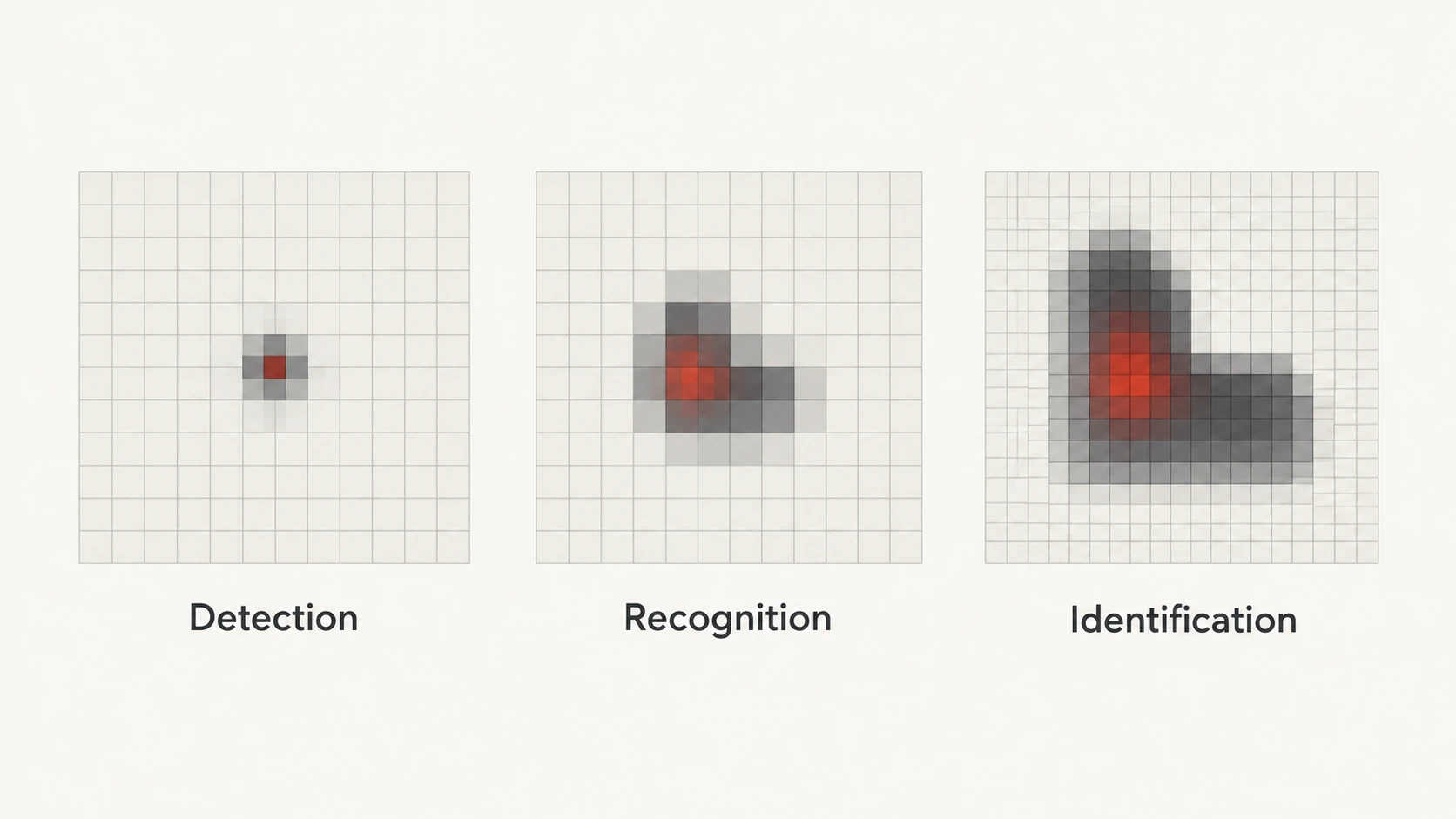
Thermal imaging performance at distance is normally discussed in terms of three different tasks: detection, recognition, and identification, often abbreviated as DRI. Each requires a different amount of useful target information.
The distance at which those tasks can be completed depends not only on the detector, but also on the target, optics, field of view, thermal contrast, atmosphere, image processing, and the criteria used to define success.
The word “see” is too broad to describe useful thermal range accurately.
At long distance, a target may occupy only a very small number of detector samples. That may be sufficient to reveal the presence of a thermal anomaly, while providing too little structural information for reliable classification.
As the target occupies more useful image samples, more information about shape and structure becomes available.
This leads to the three DRI tasks.
Detection: Is Something There?
Detection is the least demanding of the three tasks.
The goal is to determine that a relevant object or thermal signature is present in the scene.
At this stage, the image may provide very little information about exactly what the object is.
A detectable thermal signature should therefore not be treated as a recognizable or identifiable target.
Recognition: What General Type of Object Is It?
Recognition requires more useful spatial information.
The observer or algorithm must be able to classify the object into a meaningful category based on characteristics such as overall size, shape, movement, or thermal structure.
For example, recognition might distinguish one broad object class from another without providing enough detail to determine a specific identity.
Identification: Is There Enough Detail for the Required Decision?
Identification is the most demanding DRI task.
The image must contain enough usable information to distinguish the specific object or characteristics required by the application.
What counts as “identified” depends on the task.
Identification is therefore not a universal visual threshold. A requirement to distinguish between two broad categories is different from a requirement to distinguish between visually similar objects.
Modern DRI modeling reflects this by associating different task difficulties with different probabilities of successful discrimination rather than treating identification as one fixed distance.
Detection, Recognition, and Identification Are Different Range Claims
The three terms should never be used interchangeably.
DRI task
Main question
Amount of useful target information
Detection
Is a relevant object present?
Lowest
Recognition
What general type or class is it?
More
Identification
Is there enough detail for the required distinction?
Highest
A manufacturer may therefore quote a detection distance that is much longer than its recognition or identification distance for the same target and optical configuration.
That is not contradictory.
It simply reflects the increasing amount of information required as the task becomes more demanding.
This is why a headline maximum detection range should not be read as the distance at which the target can be confidently identified.
Why There Is No Universal Thermal Detection Distance
A thermal imaging system does not have one absolute “maximum distance” that applies to every object.
Consider two targets at the same range.
One may be large and thermally distinct from its background. The other may be much smaller or have very little temperature contrast with its surroundings.
The first can occupy more useful detector samples and produce a stronger thermal signal even though both are at exactly the same distance.
Practical DRI range therefore depends on the combination of:
target size;
target critical dimension;
target-to-background thermal contrast;
atmospheric transmission;
detector resolution;
pixel pitch;
lens focal length;
field of view;
optical quality;
thermal sensitivity;
focus;
image processing;
display conditions;
observer or algorithm performance.
Teledyne FLIR similarly notes that DRI results vary with environment, camera sensitivity, system setup and operator performance, and are normally associated with a probability of accomplishing the specified task rather than a guaranteed range.
Pixels on Target: The Geometric Basis of DRI
One of the most important concepts behind DRI is pixels on target.
A distant target projects an angular size through the lens onto the detector.
If the target occupies very few detector samples, only limited spatial information is available.
As more detector samples span the target’s relevant dimension, progressively more shape information can potentially be resolved.
This is why higher detector resolution can improve DRI capability when the optical configuration and other conditions are comparable: more detector samples may be available across the target.
But detector resolution alone is not enough.
A 640 × 512 detector behind a very wide field of view can distribute those pixels over a large scene, while the same detector behind a narrower field of view can place more of those samples across a distant object.
These relationships explain why pixel pitch, focal length and target size all influence spatial sampling.
They are useful for understanding the geometry, but real DRI models also account for factors such as optics, modulation transfer, noise, atmosphere, processing, and task probability.
The detector also needs sufficient signal relative to noise to preserve useful temperature differences within the scene.
NETD, or Noise Equivalent Temperature Difference, is commonly used to describe thermal sensitivity under specified conditions.
Lower NETD generally indicates that smaller thermal differences can be distinguished when measurement conditions are comparable.
This can matter when the target and background have similar temperatures.
But NETD does not directly specify DRI range.
A device with strong thermal sensitivity can still have insufficient spatial sampling for a demanding identification task, while a high-resolution detector can still struggle when thermal contrast is weak.
Useful range depends on both spatial and thermal information.
Atmospheric Conditions Can Reduce Practical Range
Infrared radiation must travel through the atmosphere before it reaches the detector.
Humidity, fog, rain, snow and atmospheric path length can influence how much useful infrared information reaches the imaging system.
Background clutter and changing environmental temperatures can also reduce target contrast.
FLIR specifically identifies humidity, temperature, solar loading, precipitation, background clutter, camera sensitivity, system setup and operator experience among the variables that can influence practical DRI performance.
This means that a modeled or measured range under favorable conditions should not be treated as a guaranteed result in every environment.
Thermal imaging can remain useful when visible illumination is poor, but it does not “see through” atmosphere or physical obstructions without loss.
Thermal Contrast Changes With the Scene
A target does not generate the same level of thermal contrast against every background.
Its apparent separation can change with:
ambient temperature;
solar heating;
shade;
surface materials;
wind;
precipitation;
time of day;
target activity.
A large temperature difference can make detection relatively easy even when little structural detail is available.
A low temperature difference can make the same target harder to distinguish from the background.
This is another reason that DRI cannot be reduced to detector resolution or focal length alone.
Digital Zoom Does Not Increase Native DRI Information
Digital zoom enlarges detector data that has already been captured.
It does not increase the number of physical detector samples across the target.
For example, if a distant object occupies a small number of detector pixels, applying 4× digital zoom enlarges those samples on the display but does not turn them into four times as many native measurements.
FLIR makes the same distinction in thermal imaging: zoom can enlarge displayed pixels without increasing the underlying spatial measurement capability.
Image interpolation or AI-based super-resolution may improve presentation or reconstruction, but those functions should still be separated from native detector sampling.
Base Magnification Does Not Tell the Whole Range Story
Base magnification is useful because it describes the starting viewing scale of the system.
However, two thermal scopes with the same quoted base magnification can still have different:
detector resolutions;
pixel pitches;
fields of view;
lens designs;
NETD;
image processing.
Similarly, a system with higher quoted magnification is not automatically capable of better identification at distance.
Always compare magnification with detector geometry and field of view rather than as an isolated range specification.
Johnson-Style DRI Models Are Estimates, Not Guarantees
Johnson-style criteria and later target-task-performance models are widely used to estimate the probability that an imaging system can support detection, recognition or identification of a defined target.
They are useful engineering tools because they connect target size and task difficulty with the spatial information delivered by the imaging system.
But a modeled DRI result is not a promise that every observer will accomplish the same task at exactly that distance.
Modern modeling can include factors such as:
target critical dimension;
target contrast;
optics;
sensor modulation transfer;
signal-to-noise performance;
atmosphere;
display;
observer or algorithm performance;
task difficulty;
required probability of success.
For example, FLIR describes DRI predictions using task-performance metrics associated with a specified probability, while emphasizing that operational performance should be validated for the real mission and conditions.
For that reason, this article does not reduce detection, recognition and identification to one universal set of fixed pixel thresholds.
How to Read a Manufacturer’s DRI Specification
Before comparing two quoted range figures, check how each one was produced.
Identify the task. Is the number for detection, recognition, or identification?
Identify the target. What target type and physical dimensions were assumed?
Check the critical dimension. Which width, height, or feature was used in the calculation?
Check the optics. Which focal length and field of view apply to the quoted result?
Check the detector configuration. Resolution and pixel pitch influence spatial sampling.
Check the probability criterion. Is the number associated with a modeled probability of completing the task?
Check environmental assumptions. Atmosphere and thermal contrast affect practical range.
Check whether the value is modeled or field-tested. The two should not automatically be treated as equivalent.
Check processing assumptions. Determine whether the result includes specific enhancement or processing modes.
Compare like with like. A detection figure for one target should not be compared directly with an identification figure for another.
If these assumptions are not available, treat the quoted range as a broad reference rather than a universal performance guarantee.
What Matters Most for Long-Range Thermal Observation?
If useful information at distance is the priority, evaluate the complete system.
Start with:
native detector resolution;
pixel pitch;
focal length;
field of view;
IFOV where available;
NETD;
optical quality;
focus;
image-processing behavior.
Then consider the actual target and environment.
A device intended mainly for broad-area scanning may reasonably prioritize field of view.
A device intended for more distant observation may prioritize finer angular sampling.
A current Yubeen thermal imaging scope. Practical DRI performance depends on the complete detector, optical, environmental, and processing configuration.
Detection Range and LRF Range Are Different Specifications
A thermal detection-range figure and a laser rangefinder specification describe two different systems.
Thermal detection refers to the imaging system’s ability to reveal a relevant thermal target.
An LRF measures distance using its own ranging process.
The fact that a thermal image can detect an object does not guarantee that an integrated LRF can obtain a valid range from that same object at the same distance.
Likewise, the presence of an LRF does not improve the native detector resolution or NETD.
If a product includes an LRF, evaluate its current ranging specification separately from its thermal DRI performance.
Do not assume that an LRF also means the device includes ballistic calculation or automatic aiming correction. Those functions must be confirmed independently for the exact product.
A Useful Range Is the Range at Which the Required Task Can Be Completed
The most useful question is not:
“How far can this thermal scope see?”
It is:
“At what distance can this system provide enough information for the task I actually need?”
For simple detection, the required information may be limited.
Recognition requires more.
Identification requires still more.
And every quoted distance depends on the target and the conditions used to define it.
That is why a thermal imaging system should be selected from its detector, optics, sensitivity, field of view and intended application—not from the largest range number in a specification table.
Once those requirements are clear, you can compare the current Yubeen thermal imaging range using the specifications of the exact current models.
FAQ
Is Thermal Detection Range the Same as Identification Range?
No. Detection only requires enough information to determine that a relevant target is present. Identification requires substantially more usable spatial information for the specific distinction being made.
Does a Higher-Resolution Detector Increase DRI Range?
It can improve spatial sampling when optics, field of view and other conditions are comparable, which may improve DRI performance. It does not by itself guarantee a specific range because optics, contrast, atmosphere, sensitivity and processing also matter.
Can Digital Zoom Increase Detection or Identification Range?
Digital zoom enlarges the detector data already captured and does not create additional native detector samples. It may make the displayed image easier to inspect, but maximum digital zoom should not be treated as a direct increase in native DRI capability.
Does Lower NETD Mean a Longer Detection Range?
Not automatically. Lower NETD generally indicates better thermal sensitivity under comparable conditions, which can help when thermal contrast is low. DRI range also depends on spatial sampling, optics, target size, atmosphere and other factors.
Can Thermal Imaging See Through Fog or Vegetation?
Not in the literal sense. Atmospheric moisture and physical obstruction can reduce the infrared information reaching the detector. Thermal imaging may remain useful under some difficult visibility conditions, but performance is not unaffected by fog, rain, humidity or dense vegetation.
Is an LRF Range the Same as Thermal Detection Range?
No. The LRF and thermal imaging system perform different tasks. Their maximum useful ranges should be checked independently for the exact product.
What can thermal imaging see that the human eye cannot? The answer begins with the fact that thermal imaging and human vision detect different parts of the electromagnetic spectrum.
The human eye depends on visible light reaching the retina. When visible illumination becomes very weak, much of the information we normally use to distinguish shape, color, texture, and background disappears.
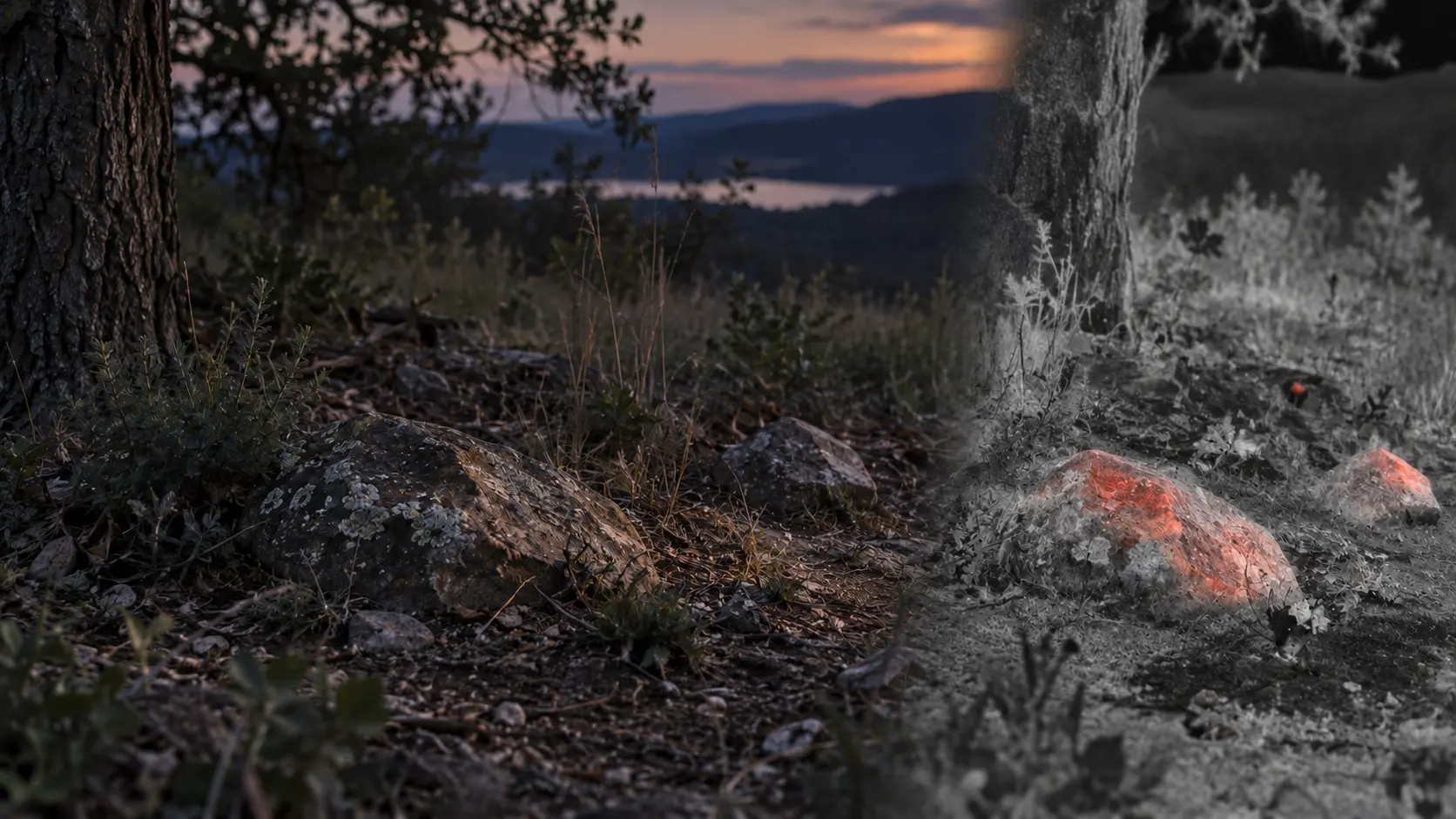
Thermal imaging works from a different part of the electromagnetic spectrum. A thermal detector responds to infrared radiation reaching the sensor and converts differences in that signal into an image that can be displayed to the user.
That allows a thermal imaging scope to reveal thermal contrast that the unaided human eye cannot perceive.
But this capability has clear limits. Thermal imaging is not X-ray vision. It does not automatically see through walls, ordinary glass, dense vegetation, or other solid barriers, and a detectable heat signature is not automatically an identifiable target.
Why Thermal Imaging Reveals Information the Human Eye Cannot See
The human eye is optimized for visible light.
A thermal detector is designed to respond to infrared radiation instead.
Objects in ordinary environments emit infrared energy according to their temperature and surface properties. Thermal imaging converts variations in that radiation into a visible representation such as grayscale or a selected color palette.
This means the user is not literally “seeing heat” with the eye.
The imaging system is translating infrared differences into a display that human vision can interpret.
That distinction matters because thermal appearance depends on more than temperature alone.
Surface emissivity, reflections, atmosphere, optics, detector sensitivity, processing, and viewing geometry all influence the resulting image.
Thermal Imaging Can Work in Complete Darkness
One of the clearest differences between thermal imaging and normal human vision is that thermal imaging does not require visible illumination to form an image.
A scene does not need:
sunlight;
moonlight;
visible artificial lighting;
a flashlight.
If sufficient infrared contrast reaches the detector, a thermal image can be produced even when the scene appears completely dark to the human eye.
This makes thermal imaging fundamentally different from ordinary visible-light optics and digital night vision systems that depend on reflected light.
Darkness itself, however, does not guarantee a strong thermal image.
If the target and background have similar thermal signals, contrast can still be weak.
Thermal Contrast Can Reveal an Object That Blends Into the Visible Background
An object can be difficult to notice in visible light because its color, texture, or pattern resembles the background.
Thermal imaging does not evaluate that visible camouflage in the same way.
If the object’s infrared signal differs sufficiently from the surrounding scene, the thermal detector may reveal a contrast boundary even when the object is visually difficult to distinguish.
This is why thermal imaging can sometimes make a subject stand out against:
vegetation;
soil;
rocks;
structures;
dark backgrounds.
But this does not mean thermal imaging defeats every form of concealment.
If the target is physically blocked by dense vegetation, a wall, tree trunk, rock, or another opaque object, the detector cannot simply recover the hidden image behind it.
Thermal contrast and physical line of sight are different issues.
Thermal Imaging Can Reveal Small Surface-Temperature Differences
Two surfaces can look nearly identical to the human eye while having different infrared characteristics.
Thermal imaging may display those differences as different brightness levels or palette values.
Depending on the scene, this can reveal:
warmer and cooler surface regions;
differences caused by sunlight and shade;
recently heated or cooling surfaces;
equipment or structures with different thermal states;
warm subjects against cooler surroundings.
The important word is surface.
Thermal imaging normally receives infrared radiation from the first relevant surface within its line of sight.
It does not automatically reveal the internal structure of an object.
A Thermal Image Is Not a Direct Temperature Map
Brightness or color in a thermal display should not automatically be interpreted as exact temperature.
Surface emissivity and reflected infrared radiation influence thermal appearance.
Highly reflective, low-emissivity surfaces can show infrared energy reflected from their surroundings rather than simply representing their own surface temperature. FLIR specifically notes that polished metals can behave strongly reflectively in thermal imaging.
For a thermal imaging scope, the practical lesson is:
bright does not always mean “hotter,” and dark does not always mean “colder.”
Unless a device is specifically designed and specified for radiometric temperature measurement, do not treat its display as a precision thermometer.
What Detection Actually Means
At long distance, a thermal imager may reveal that a thermal anomaly is present without providing enough information to determine exactly what it is.
That is detection.
The target might appear as only a small thermal signature.
Detection answers:
Is something relevant present?
It does not necessarily answer:
What exactly is it?
This is one of the most important distinctions in thermal observation.
Recognition Requires More Spatial Information
As more usable detector samples span the target, shape and movement can become easier to interpret.
Recognition means enough information is available to classify the object at a broader level.
The exact requirement depends on the task.
A general silhouette, dimensions, movement pattern, and thermal structure may all contribute.
But thermal contrast alone does not guarantee recognition.
Detector resolution, lens focal length, field of view, focus, atmosphere, target size, and distance still matter.
Identification Requires More Information Again
Identification is more demanding than detection or broad recognition.
The thermal image must contain enough reliable information for the distinction required by the task.
That may involve:
overall body shape;
characteristic features;
dimensions;
movement;
spatial detail.
The relevant threshold depends on what the user is trying to distinguish.
This is why one headline “detection range” should never be interpreted as an identification range.
Thermal imaging is frequently misunderstood as a form of see-through imaging.
It is not.
A conventional thermal imager normally receives infrared radiation from the surface facing the detector.
A wall can sometimes display a thermal pattern caused by conditions behind it—for example, heating, insulation differences, moisture, or another source that changes the wall’s surface temperature.
But that is different from seeing the hidden object itself.
FLIR makes the same distinction: thermal cameras do not see through walls; they can sometimes detect surface-temperature patterns influenced by conditions behind them.
Ordinary Glass Is Also a Major Limitation
A visible-light camera can normally look through a clear window.
A long-wave thermal imaging system behaves differently.
Ordinary glass does not act as a transparent thermal window in the way it does for visible light.
Instead, the thermal imager may primarily show:
the glass surface;
reflected infrared energy;
nearby thermal reflections.
This is why thermal observation through a closed vehicle or building window can produce a very different image from visible observation.
FLIR demonstrates this effect by showing that ordinary glass can behave almost like a reflective surface to a thermal camera.
Purpose-designed infrared optical materials are therefore used in thermal imaging systems rather than ordinary window glass.
Dense Vegetation Still Blocks Information
Sparse branches and leaves can sometimes leave gaps through which part of a thermal target remains visible.
That should not be described as “seeing through vegetation.”
The detector is receiving infrared information through the available gaps.
As vegetation becomes denser, progressively more of the target is physically obscured.
A thick tree trunk, dense foliage, earth, rock, or another solid barrier can completely hide the direct thermal signature behind it.
The technically accurate statement is:
thermal contrast can sometimes remain visible through gaps in sparse cover.
Not:
thermal imaging sees through brush or trees.
Fog, Rain, and Humidity Can Reduce What the Detector Receives
The atmosphere is also part of the imaging path.
Humidity, fog, rain, and distance can attenuate the infrared signal traveling from the target toward the detector.
Thermal imaging may outperform visible imaging in some light-fog or poor-visibility conditions, but that does not make atmospheric attenuation disappear.
FLIR notes that fog and rain can reduce thermal imaging range because water droplets scatter and absorb part of the infrared signal, with denser conditions producing greater losses.
The same detector can continue receiving infrared radiation during daylight.
But sunlight changes the thermal scene.
Ground, vegetation, buildings, rocks, and other materials heat at different rates, which can change target-to-background contrast over the course of the day.
Therefore:
thermal imaging can operate during daylight,
but:
thermal contrast does not necessarily remain identical from day to night.
Detector Resolution Determines How Much Spatial Information Is Available
Thermal sensitivity and spatial resolution are different characteristics.
Detector resolution tells you how many native thermal detector samples are available across the scene.
More native detector samples can provide more spatial information under comparable optical conditions.
But additional pixels do not automatically solve:
weak thermal contrast;
poor focus;
atmospheric attenuation;
physical obstruction;
unsuitable field of view.
A thermal imaging system therefore should never be judged from resolution alone.
Lens and Field of View Change What the Detector Samples
The thermal lens determines how the scene is projected onto the detector.
A wider field of view covers more surrounding area.
A narrower field of view places more of the available detector sampling across a smaller angular scene.
This changes how much spatial information can be available across a distant target.
The meaningful comparison is therefore not:
detector resolution alone
but:
detector + pixel pitch + lens + field of view + focus + sensitivity + processing.
Digital Zoom Does Not Reveal New Native Detail
Digital zoom enlarges data that the detector has already captured.
It does not create additional physical detector samples.
If a distant target occupies only a small number of native pixels, enlarging those pixels may make the image easier to inspect, but it does not recover information that the detector never recorded.
Processing techniques can improve presentation.
They still need to be separated from native detector resolution.
What Thermal Imaging Reveals Depends on the Complete Scene
The amount of useful information available in a thermal image depends on several factors working together:
Factor
What it affects
Target-to-background contrast
How strongly the target separates thermally
Detector resolution
Available native spatial samples
NETD
Sensitivity to small thermal differences
Lens / FOV
Angular sampling and scene coverage
Focus
Spatial detail reaching the detector
Distance
Target size within the detector image
Atmosphere
Infrared transmission
Surface emissivity
How surfaces emit and reflect infrared energy
Processing
How detector data are presented
This is why the question:
“What can thermal imaging see?”
does not have one universal distance or one universal level of detail.
A Real Thermal Product Applies These Principles as a System
A real thermal imaging scope combines detector, optics, processing, display, controls, power, and mechanical hardware.
The product image should be used here to connect the technical explanation to Yubeen’s actual thermal range.
It should not be used as proof of a specific detection, recognition, identification, NETD, ballistic, or weather-performance claim unless those values have been verified for the exact model.
The current YubeEN thermal imaging range can be compared after the intended distance, field of view, sensitivity, and environmental conditions are understood.
What Thermal Imaging Can—and Cannot—Reveal
A useful summary is:
Thermal imaging can:
reveal infrared contrast invisible to the human eye;
operate without visible illumination;
make thermally distinct objects easier to distinguish from some backgrounds;
reveal surface-temperature patterns that visible imagery does not show;
support detection and, when enough information is available, recognition or identification.
Thermal imaging cannot:
see through solid walls;
see directly through ordinary glass like a visible camera;
make dense physical cover transparent;
guarantee target identity from a weak heat signature;
create native spatial detail through digital zoom;
eliminate atmospheric attenuation;
guarantee the same image quality under every environmental condition.
Understanding both sides of that distinction is more useful than treating thermal imaging as “superhuman vision.”
FAQ
Can Thermal Imaging Work in Complete Darkness?
Yes. Thermal imaging does not require visible illumination. It forms an image from infrared differences reaching the detector.
Can Thermal Imaging See Through Walls?
No. A thermal imager normally detects the surface facing it. It may reveal a surface-temperature pattern influenced by something behind the wall, but it does not directly image the hidden object through the wall.
Can a Thermal Scope See Through Glass?
Ordinary glass is generally not transparent to the long-wave infrared energy used by common thermal imaging systems. The image may instead show the glass surface and thermal reflections.
Can Thermal Imaging See Through Vegetation?
Not literally. A thermal target may remain partially visible through gaps in sparse vegetation, but dense leaves, branches, trunks, and other solid cover can block the direct thermal signal.
Does a Bright Thermal Signature Mean the Object Is Definitely Hotter?
Not necessarily. Thermal appearance also depends on emissivity, reflection, palette settings, gain, and other factors. Reflective surfaces can display infrared energy from their surroundings.
Does Thermal Imaging Always Work Better at Night?
No. Thermal imaging can work during both day and night. Practical image quality depends on target-to-background thermal contrast, atmosphere, detector sensitivity, optics, and other conditions.
Thermal scope magnification is often misunderstood because a larger number can appear to promise longer range and more detail. In practice, magnification is only one part of a thermal imaging system. Base magnification, field of view, detector resolution, lens focal length, target size, focus, thermal contrast, and digital zoom all influence what the user can actually see.
For longer-distance observation, the goal is not to maximize magnification. The goal is to place enough useful thermal information on the display while retaining enough field of view to locate, follow, and interpret the subject. A well-balanced configuration can therefore be more useful than a scope with a larger maximum zoom number.
What Does Magnification Mean in a Thermal Scope?
Thermal scopes create an electronic image rather than presenting a purely optical image through conventional glass.
This makes it important to distinguish between base magnification and digital zoom.
Base magnification comes from the relationship between the detector size, lens focal length, and display system.
Digital zoom enlarges the image after the detector has already captured it.
These two forms of magnification should not be treated as equivalent.
Base Magnification Sets the Starting Image Scale
Base magnification determines how large the scene appears before digital zoom is applied.
A higher base magnification generally makes a distant subject occupy more of the display.
The trade-off is that the user usually sees less surrounding terrain.
This can be useful for longer-distance observation, but excessive starting magnification can make scanning and subject acquisition more difficult.
Digital Zoom Enlarges Existing Thermal Data
Digital zoom enlarges thermal information that has already been captured by the detector.
It can make a subject easier to inspect on the display, but it does not create new native thermal pixels.
For example, increasing digital zoom may make the image appear larger while individual detector pixels and processing artifacts become more visible.
Maximum digital zoom should therefore not be treated as the same thing as native image detail.
Base Magnification and Field of View Are a Trade-Off
Magnification and field of view are closely related.
For a given detector and lens configuration, a higher starting image scale usually means a narrower view.
A lower starting image scale usually means more of the environment remains visible.
Wider Field of View Helps With Scanning
A wider field of view can make it easier to:
scan large areas;
locate moving subjects;
maintain environmental awareness;
follow a subject as it changes direction;
observe multiple heat sources in the same scene.
This can be valuable in mixed terrain or when observation distances vary.
Narrower Field of View Provides More Image Scale
A narrower field of view places a smaller section of the environment across the detector.
This can make a distant subject appear larger within the image.
The configuration may be useful when the primary task involves observing smaller subjects at greater distances across relatively open terrain.
However, a narrow view can make initial scanning slower.
Neither configuration is universally better.
Lens Focal Length Has a Major Effect on Thermal Magnification
Focal length is one of the main optical factors that determines image scale and field of view.
For the same detector format:
a longer focal length generally produces greater apparent image scale and a narrower field of view;
a shorter focal length generally produces a wider field of view and less apparent image scale.
This means a 50 mm thermal lens should not automatically be described as “better” than a 35 mm lens.
They solve different viewing problems.
A longer focal length may suit longer-distance observation, while a shorter focal length may provide greater flexibility when scanning closer or mixed terrain.
Detector Resolution Determines How Much Native Detail Is Available
Magnification cannot be evaluated without detector resolution.
A higher-resolution detector contains more native thermal pixels.
That gives the system more spatial information to work with, assuming the lens, focus, processing, and thermal conditions are also suitable.
For example, a higher-resolution detector can retain more useful image information when digital enlargement is applied than a lower-resolution detector under otherwise similar conditions.
However, detector resolution alone does not determine usable range.
Detection, Recognition, and Identification Need Different Amounts of Detail
One of the biggest mistakes in long-distance thermal observation is treating a published detection figure as if it were an identification figure.
They are not the same.
Detection means noticing that a thermal source is present.
Recognition requires enough information to understand the general type of subject.
Identification requires more detail and context to make a confident determination.
A scope may detect a large heat source at a substantial distance while still providing far less detail than would be required for reliable identification.
Magnification can make the displayed image larger, but it does not remove the difference between these tasks.
Refresh Rate Affects Motion, Not Long-Range Detail
Refresh rate determines how frequently the thermal display updates.
A higher refresh rate can make moving subjects appear smoother and can improve comfort while panning.
It does not create additional detector resolution or increase optical image scale.
For longer-distance observation, refresh rate should therefore be considered alongside—not instead of—detector resolution, focal length, focus, and field of view.
How Much Thermal Scope Magnification Do You Actually Need?
There is no universal magnification number that works for every situation.
A better approach is to start with the observation environment.
Mixed Terrain
In mixed terrain, a wider starting field of view can be valuable.
A moderate base magnification may make it easier to scan areas where distance changes frequently.
Priorities often include:
wider field of view;
comfortable scanning;
manageable size and weight;
sufficient image detail;
flexible digital zoom.
Open Terrain and Longer Distances
Open terrain may justify more starting image scale.
A longer focal length and higher base magnification can help place more detector area on a distant subject.
The trade-off is reduced surrounding field of view.
Important factors include:
detector resolution;
focal length;
focus;
NETD;
atmospheric conditions;
image scale;
field of view.
Moving Subjects
When subjects move quickly, excessive base magnification can make them more difficult to locate and keep inside the field of view.
A wider starting view may be more practical even when some digital enlargement is used later.
The correct balance depends on whether the priority is scanning, tracking, or examining distant detail.
Use This Comparison Instead of Chasing Maximum Zoom
Requirement
More Useful Priority
What to Compare
Scan mixed terrain
Wider starting view
Field of view and base magnification
Observe smaller distant subjects
Greater image scale
Focal length and detector resolution
Preserve detail under digital zoom
More native information
Detector resolution
Low thermal contrast
Thermal sensitivity
NETD, optics and processing
Moving subjects
Easier tracking
Field of view and refresh rate
Poor weather
Better usable contrast
NETD, optics, atmosphere
Longer sessions
Practical operation
Weight, battery and controls
This type of comparison is more useful than simply choosing the product with the largest stated zoom multiplier.
An Integrated LRF Can Help at Longer Distances
Distance estimation can become difficult through a thermal display because familiar visible-light references may be limited.
An integrated laser rangefinder can provide direct distance information.
That can be useful when observing subjects at longer distances.
Practical rangefinding still depends on:
target size;
reflectivity;
atmosphere;
weather;
angle;
device specification.
An LRF helps reduce distance uncertainty, but it should not be described as eliminating every ranging limitation.
How to Compare Current Yubeen Thermal Scope Configurations
When comparing current Yubeen thermal scopes for longer-distance observation, do not start by asking which model has the largest zoom number.
Use this sequence:
define the typical observation distance;
define how much field of view is needed;
compare detector resolution;
compare lens focal length;
compare base magnification;
compare NETD;
check focus performance;
consider atmospheric conditions;
decide whether an integrated LRF is required;
compare dimensions and installed weight;
compare battery configuration and runtime;
confirm current durability and support information.
The correct configuration is the one that provides enough native image information and useful image scale without narrowing the field of view more than the application allows.
Final Thoughts
Thermal scope magnification should never be judged by the maximum zoom number alone.
Base magnification determines the starting image scale. Field of view determines how much surrounding environment remains visible. Focal length affects both. Detector resolution determines how much native thermal information is available. Digital zoom enlarges that existing information.
For longer-distance observation, the most useful configuration balances these factors rather than maximizing only one.
A thermal scope with moderate magnification, appropriate focal length, strong native detector resolution, reliable focus, and a suitable field of view can be more practical than a system that advertises a larger maximum zoom but provides less useful information.
FAQ
Is higher thermal scope magnification always better for long-range observation?
No. Higher magnification can make a distant subject appear larger, but it generally reduces field of view and may make scanning more difficult. Useful long-distance performance also depends on detector resolution, focal length, focus, NETD, atmosphere, and thermal contrast.
Does digital zoom increase thermal image resolution?
No. Digital zoom enlarges thermal information already captured by the detector. It can make the displayed subject larger but does not create additional native detector pixels.
Is a 50 mm thermal lens always better than a 35 mm lens?
No. For the same detector format, a longer focal length generally provides greater image scale and a narrower field of view. A shorter focal length generally provides a wider view. The better choice depends on distance, terrain, target size, and scanning requirements.
Does higher detector resolution allow more useful digital zoom?
Generally, a higher-resolution detector provides more native image information to work with, which can help preserve useful detail during digital enlargement. However, optics, focus, NETD, processing, and environmental conditions still influence the final image.
Is detection range the same as identification range?
No. Detection only indicates that a thermal source can be noticed. Identification requires substantially more shape and contextual information. A scope may detect a subject at a much greater distance than it can identify it confidently.
What matters most for longer-distance thermal observation?
The most important factors are the combination of detector resolution, lens focal length, field of view, base magnification, focus, NETD, target size, thermal contrast, atmosphere, and practical handling. No single specification defines useful long-range performance.
Choosing thermal scopes for night observation is not about finding the model with the longest detection-range figure or the highest digital zoom. A useful thermal scope needs to provide enough native image information, an appropriate field of view, practical magnification, reliable focus, suitable thermal sensitivity, and a physical configuration that fits the way the equipment will actually be used.
The right configuration also depends on terrain, typical observation distance, target size, weather, battery requirements, and whether features such as an integrated laser rangefinder are genuinely useful. For this reason, thermal scopes should be compared as complete imaging systems rather than ranked by one specification.
Yubeen is a thermal imaging and optical scope manufacturer based in Yiwu, China, with R&D and production focused on visual solutions for night, low-light, hunting, and outdoor observation use. Its product line is useful for buyers who need practical imaging quality, smart ballistic support, and OEM/ODM cooperation without turning the buying process into a long technical puzzle.
Why Thermal Imaging Works for Night Observation
Thermal imaging detects infrared energy rather than depending on visible illumination in the same way as a conventional camera.
That allows a thermal device to provide useful information in darkness, but the image still depends on temperature differences, atmospheric conditions, optics, focus, detector performance, and processing.
Thermal imaging therefore provides a different type of information from visible-light optics rather than simply producing a “brighter” version of the same scene.
Thermal Detection Does Not Depend on Visible Light
A thermal detector responds to infrared energy reaching the sensor.
This means a thermal scope can continue producing an image when visible illumination is very limited or absent.
However, darkness alone does not guarantee strong image contrast. If the subject and background are close in temperature, the thermal image can still become more difficult to interpret.
Thermal Contrast Reveals Different Information
A thermal image can make temperature differences stand out strongly against some backgrounds.
This can help the user detect a warm subject that would be difficult to notice using visible-light information alone.
The amount of useful contrast still changes with weather, humidity, background temperature, terrain, and the thermal characteristics of the subject.
Thermal Imaging Supports Observation in Low-Light Conditions
Thermal imaging can be valuable when the user needs to scan or observe an area after dark.
It should still be treated as an observation system rather than as a guarantee of identification.
A distant heat source may be detectable before enough shape and contextual detail is available to determine exactly what it is.
What Specs Should You Compare Before Buying?
A thermal scope specification sheet contains many numbers, but several factors deserve more attention than others.The most useful starting points are:
Detector resolution describes how many thermal pixels are available to build the native image.
Higher detector resolution provides more native spatial information, which can help preserve shape and detail when the subject occupies a small part of the scene or when some digital enlargement is used.
However, practical detection, recognition, and identification also depend on lens focal length, target size, thermal contrast, atmospheric conditions, focus, image processing, and the criterion being used.
Resolution should therefore be considered as one part of the complete imaging system.
NETD describes thermal sensitivity under defined test conditions.
A lower NETD value indicates that the system is designed to distinguish smaller temperature differences under those conditions.
This can become more useful when the subject and background have limited thermal contrast, but NETD alone does not define total image quality.
Lens focal length affects how much of the scene is visible and how large a subject appears within the detector image.
For a given detector format, a longer focal length generally produces a narrower field of view and greater image scale.
A shorter focal length generally provides a wider field of view, which can make scanning and following movement easier.
Neither is automatically better.
Practical detection performance also depends on detector resolution, thermal sensitivity, target size, atmospheric conditions, focus, image processing, and the detection criterion being used.
This is why published detection distance should never be treated as the same thing as recognition or identification distance.
Field of view determines how much of the surrounding environment remains visible at once.
Base magnification determines the starting image scale before digital zoom is applied.
Higher base magnification can make a distant subject appear larger, but it usually reduces the amount of surrounding terrain visible in the image.
Lower base magnification normally provides a wider starting view.
A wide field of view can be useful when scanning mixed terrain or following moving subjects, while a narrower view may be more useful when the primary requirement is greater image scale at longer distances.
Digital zoom should not be confused with native optical information. It enlarges an image that has already been captured rather than creating new detector pixels.
How Different Thermal Scope Configurations Fit Different Observation Needs?
There is no single thermal-scope configuration that is best for every night-observation scenario.
A useful comparison should begin with the environment and typical distance rather than the model name.
Different detector, lens, magnification, and field-of-view combinations can solve different observation problems.
Example Configuration: A Balanced Field of View and Image Scale
A medium-focal-length configuration can provide a useful balance between surrounding field of view and apparent subject size.
This type of configuration may suit users who move between relatively open terrain and shorter-distance observation.
The main factors to compare are:
starting field of view;
base magnification;
detector resolution;
focus range;
installed weight;
battery configuration.
A model such as the current ST35-series configuration can be used as an example of this general approach, but the exact product choice should still be based on current specifications and the user’s actual requirements.
Example Configuration: Greater Image Scale for Longer-Distance Observation
A longer-focal-length configuration can provide greater image scale for more distant subjects.
The trade-off is a narrower field of view.
This can make the configuration more suitable when observation commonly takes place across open terrain, but less convenient when the user needs to scan a large area quickly.
When comparing this type of configuration, consider:
focal length;
detector resolution;
native field of view;
focus;
base magnification;
dimensions and weight;
power requirements.
A current DT50L-type configuration can illustrate this category without implying that one model is universally the correct choice for all longer-distance use.
Compare Priorities by Observation Scenario
Instead of assigning one model permanently to one use case, compare the characteristics that matter most.
Observation Scenario
Useful Priority
What to Compare
Mixed terrain
Wider starting view
Base magnification and field of view
Longer-distance observation
Greater image scale
Focal length and detector resolution
Low thermal contrast
Thermal sensitivity
NETD, optics and image processing
Moving subjects
Smooth image presentation
Refresh rate and field of view
Long observation sessions
Runtime
Battery system and external-power support
Distance-sensitive use
Direct ranging
LRF capability and ranging conditions
This approach remains useful even when individual models are updated or replaced.
Which Additional Features Are Actually Useful?
Additional functions can improve convenience, but they should come after the basic imaging system has already met the required performance.
Integrated Laser Rangefinding
An integrated laser rangefinder can provide direct distance information without requiring a separate ranging device.
This can be useful because judging distance from a thermal image alone can be difficult, particularly when familiar visible-light references are limited.
Practical ranging performance still depends on the target, atmospheric conditions, reflectivity, device specification, and operating environment.
An LRF can reduce distance uncertainty, but it should not be described as eliminating all ranging error.
Some thermal configurations may include ballistic-related functions.
Feature availability, required inputs, supported calculation methods, and how the result is presented should be confirmed for the exact model and software version.
Ballistic tools should be treated as an information aid rather than a substitute for correct setup, verified zero, reliable ammunition data, and user judgment.
Do not assume that every Yubeen thermal model supports the same ballistic functions.
Picture-in-Picture and Image-Display Functions
Picture-in-picture can provide a magnified section of the thermal image while preserving more of the surrounding scene in the main view.
This can be useful when additional image scale is needed without completely losing environmental context.
Other image-display functions may include thermal palettes, contrast adjustment, detail enhancement, or model-specific processing modes.
These features can improve usability but do not replace native detector resolution, suitable optics, or correct focus.
Recording, Storage, and Power Options
Selected models may include internal recording, onboard storage, replaceable batteries, or external-power support.
These functions are useful for documenting observations or extending runtime, but availability differs by model.
Before buying, confirm:
recording capability;
storage capacity;
file-transfer method;
battery type;
realistic runtime;
external-power support;
connector position.
Runtime should always be understood as condition-dependent rather than a fixed value that applies under every setting and temperature.
Weather Still Affects Night Observation
Thermal imaging works without visible illumination, but the atmosphere still influences infrared transmission and thermal contrast.
Heavy rain, dense fog, high humidity, and similar conditions can reduce useful image contrast or effective observation distance.
A thermal scope may continue producing an image, but that does not mean weather has no effect on performance.
Background temperature also matters.
When the subject and surrounding terrain are close in temperature, the thermal image can become more difficult to interpret even if the device itself is operating normally.
What Professional Buyers Should Verify Before Ordering
Professional and distribution buyers need to verify more than the headline specifications.
The exact product version matters because hardware, software, accessories, packaging, and specifications can change over time.
Verify Durability, Warranty, and Current Product Terms
Before ordering, confirm the exact model’s current:
ingress-protection rating;
shock specification;
operating-temperature range;
battery configuration;
included accessories;
software or firmware version;
warranty terms;
after-sales procedure.
These details should be checked against the current product documentation rather than assumed from another model in the range.
Warranty language should also reflect the current commercial policy for the relevant product and market.
Confirm Documentation, Samples, and Support Before Volume Orders
For distributor or retail evaluation, confirm:
current specification sheet;
exact product version;
sample availability;
packaging contents;
certifications required for the destination market;
lead time;
software or firmware version;
warranty terms;
after-sales arrangement.
A sample evaluation can also help confirm that the field of view, image presentation, controls, weight, and power system suit the intended market before a larger order is placed.
How to Compare Current Yubeen Thermal Scope Options
When comparing current Yubeen thermal scopes, avoid treating one model as permanently tied to one scenario.
A better sequence is:
define typical observation distance;
define the required starting field of view;
compare detector resolution;
compare focal length and base magnification;
compare NETD;
compare focus and image-processing functions;
decide whether an integrated LRF is necessary;
compare dimensions and installed weight;
compare battery configuration and runtime;
confirm current durability, warranty, and support information.
The correct choice is the configuration that best matches the intended environment and workflow—not simply the model with the highest number in one specification column.
Final Thoughts
A good thermal scope for night observation should be selected as a complete imaging system.
Detector resolution, NETD, lens focal length, field of view, base magnification, refresh rate, focus, battery configuration, LRF capability, dimensions, and durability all contribute to practical performance.
No single specification determines whether a product is the best choice.
The most useful comparison begins with the observation environment and typical distance, then evaluates which combination of image detail, field of view, thermal sensitivity, ranging, runtime, and handling fits that requirement.
FAQ
What is the best thermal imaging rifle scope for general night observation?
There is no universal best thermal scope for every night-observation scenario. The right configuration depends on typical distance, field of view, base magnification, detector resolution, lens focal length, thermal sensitivity, weight, power requirements, and whether features such as an integrated LRF are needed.
Which thermal scope configuration is better for longer-distance night observation?
Longer-distance observation generally benefits from sufficient native detector resolution, appropriate focal length, reliable focus, and enough image scale for the intended subject. A narrower field of view can be useful at distance, but the correct configuration still depends on terrain and how much surrounding context the user needs. Current Yubeen models should be compared against these requirements using the latest product specification sheet rather than selected from an older article alone.
Does a longer detection range mean I can identify a target at that distance?
No. Detection means that a thermal source can be noticed. Recognition and identification require progressively more information. A device may detect a subject much farther away than the distance at which enough shape and contextual detail is available for confident identification.
Is lower NETD always better?
A lower NETD indicates greater thermal sensitivity under the stated test conditions, but NETD alone does not determine image quality. Detector resolution, optics, focus, processing, display, weather, and subject/background temperature differences also matter.
Do I need an integrated LRF for night observation?
Not always. An integrated LRF can provide useful distance information, especially when visible reference points are limited, but it also adds cost, hardware, controls, and power requirements. Choose it when direct ranging supports the intended workflow.
What should B2B buyers check before ordering thermal imaging rifle scopes?
Verify the exact product version, current specification sheet, certifications for the destination market, included accessories, packaging, software or firmware version, sample performance, warranty terms, lead time, and after-sales process before placing a volume order.
Thermal scope reliability depends on more than rugged housing or a long battery-runtime figure. Power consumption, mounting stability, environmental conditions, focus, display settings, recording, storage, and maintenance can all change how a thermal device behaves during real use.
Many apparent “failures” are not caused by one defective component. A battery can appear to drain unusually fast because of temperature and active functions. A change in point of impact can come from the mounting system rather than the thermal detector. A soft image can result from weather, focus, or low thermal contrast rather than sensor damage. Understanding these differences makes troubleshooting more accurate and prevents unnecessary conclusions.
Mistake 1: Treating Battery Runtime as a Fixed Number
Published runtime is useful for comparison, but it should not be treated as a guaranteed operating time under every condition.
Battery performance changes with the way the device is configured and used.
Cold Temperatures Can Reduce Available Battery Performance
Rechargeable batteries can provide less usable capacity at low temperatures.
The exact effect depends on battery chemistry, cell condition, temperature, discharge load, and device design.
A thermal scope that operates normally in mild weather may therefore show shorter runtime in very cold conditions.
This does not automatically indicate a defective battery.
For extended use, follow the product instructions for approved battery types, charging, storage, and external-power support.
Display Brightness and Processing Use Power
The display and processor operate continuously while the thermal device is running.
Higher display brightness can increase power consumption, particularly when combined with additional electronic functions.
Use a brightness level that is comfortable and appropriate for the environment rather than automatically operating at maximum brightness.
The same principle applies to image-enhancement functions: enable them because they improve usability, not because every feature needs to remain active all the time.
Recording, Wi-Fi, and Other Functions Affect Runtime
Video recording, wireless connectivity, laser ranging, and other electronic functions require additional processing or power.
The actual impact varies by product.
When battery life is important, confirm which features are active and whether the published runtime was measured under comparable conditions.
A runtime figure should therefore be understood together with:
battery type;
ambient temperature;
display settings;
recording;
wireless connectivity;
LRF use;
processing load;
battery age.
How to Manage Thermal Scope Power More Reliably
Good power management starts before the device enters the field.
Use only battery types and charging methods approved for the exact product.
Check the current charge before use and inspect replaceable cells for physical damage or abnormal behavior.
If the model supports approved external power, confirm that the cable and connector arrangement remain practical after the scope is installed.
For longer sessions, the most useful question is not:
“What is the maximum runtime?”
It is:
“Does the power system provide enough realistic operating time for my normal use, with the functions I actually keep enabled?”
Mistake 2: Assuming Every Zero Shift Comes From the Thermal Scope
A change in zero does not automatically mean that the detector, reticle, or internal electronics have failed.
The complete mechanical system has to be considered.
Mounting Interfaces Can Move
A thermal scope depends on its mount and rail interface to maintain a repeatable physical position.
If the mount is incompatible, damaged, contaminated, improperly installed, or becomes loose, the relationship between the optic and the platform can change.
Follow the mounting manufacturer’s installation instructions and specified tightening requirements.
Do not apply one generic torque value or fastening method to every mount.
Removal and Reinstallation Should Be Verified
Quick-detach systems can be convenient, but return-to-zero performance depends on the mount design, rail interface, installation method, and condition of the components.
After removal and reinstallation, verify that the system behaves as expected rather than assuming perfect repeatability.
This is especially important after:
changing the mount;
moving the scope to another platform;
servicing the equipment;
significant transport or impact.
Impact or Mechanical Damage Requires Inspection
Thermal scopes are designed to tolerate defined mechanical conditions, but a published shock specification is not a guarantee against every type of impact.
If a device is dropped, struck, or subjected to an event outside normal use, inspect the mounting interface and housing before assuming the problem is electronic.
What Should You Check When Zero Appears to Change?
A sensible troubleshooting sequence begins with the mechanical system.
Check:
whether the optic has been removed or repositioned;
whether the mount and rail are clean and undamaged;
whether the mounting hardware is installed according to the manufacturer’s instructions;
whether the device has experienced significant impact;
whether the correct profile or configuration is active;
whether the behavior remains repeatable.
Avoid immediately compensating for a suspected mounting problem by making large electronic or mechanical corrections.
If the cause cannot be identified, stop using the setup for critical applications until the mount and optic can be checked properly.
Mistake 3: Treating Environmental Image Changes as Sensor Failure
Thermal image quality can change substantially even when the hardware is operating normally.
The environment is part of the imaging system because the detector only receives the infrared energy that reaches it through the atmosphere and optics.
Humidity, Fog, and Rain Can Reduce Useful Contrast
Thermal imaging does not depend on visible light, but infrared transmission is still affected by atmospheric conditions.
Dense fog, heavy precipitation, and high humidity can reduce usable contrast or effective observation distance.
The same scope may therefore produce a different-looking image on different nights.
This does not necessarily indicate a change in detector performance.
Thermal Crossover Can Make Subjects Harder to Separate
Thermal crossover occurs when the subject and background become closer in temperature.
During these periods, the scene may contain less thermal contrast.
A subject that stands out strongly on a cold night can appear less distinct when the surrounding ground, vegetation, or structures are at similar temperatures.
The device may still be functioning normally even though the image appears less dramatic.
NETD Helps but Does Not Override the Environment
NETD describes thermal sensitivity under specified test conditions.
Lower NETD can help a system distinguish smaller temperature differences under those conditions.
It does not mean the device becomes unaffected by humidity, atmosphere, poor focus, or physical obstruction.
Focus and Calibration Should Be Checked Before Blaming the Sensor
A soft thermal image can result from incorrect focus.
Adjust the thermal objective for the actual observation distance and check the eyepiece or diopter setting where applicable.
Thermal systems can also use calibration procedures such as non-uniformity correction to maintain consistent detector response.
The exact calibration process varies by model, so the product manual should remain the reference.
Do not interpret every momentary image change as permanent detector damage.
Mistake 4: Using Display Modes Without Understanding What They Change
Thermal palettes and digital image controls change how information is presented.
They do not change the physical temperature of the scene or create new detector data.
White Hot and Black Hot Present the Same Thermal Scene Differently
In a White Hot palette, relatively warmer areas are typically represented more brightly.
Black Hot reverses that visual presentation.
One may feel easier to interpret in a particular environment, but neither inherently adds more native detector resolution.
Palette choice is largely about interpretation and preference.
Color Palettes Can Emphasize Differences
Color palettes can make certain temperature ranges visually easier to distinguish.
They are useful display tools, but they should not be confused with higher thermal sensitivity.
If a target is physically obscured or insufficient thermal information reaches the detector, switching palettes does not recover information that was never captured.
Digital Zoom Enlarges Existing Data
Digital zoom makes the displayed image larger.
It does not add new native thermal pixels.
At higher digital zoom settings, limited detector information and processing artifacts can become increasingly visible.
For this reason, evaluate base magnification, detector resolution, lens focal length, and field of view before treating maximum digital zoom as a major performance metric.
Check battery contacts, seals, covers, charging ports, and external-power connectors according to the product instructions.
Moisture, contamination, damaged cells, or loose covers can create reliability problems that are unrelated to the thermal detector itself.
If a battery becomes swollen, damaged, unusually hot, or otherwise abnormal, discontinue its use and follow the battery manufacturer’s safety guidance.
Check Mounting Hardware Periodically
Repeated transport, installation, removal, and normal use can affect mounting interfaces.
Inspect the mount according to the manufacturer’s recommendations and investigate unusual movement immediately.
Do not wait for an obvious change in performance before checking a loose or damaged mechanical component.
Keep Software and Product Information Current
If the device supports firmware or app-based functions, confirm the approved software version and update procedure for the exact model.
Do not assume that firmware intended for a similar-looking product is interchangeable.
Software updates should come from the manufacturer or authorized source.
The purpose of this table is not to diagnose every possible fault. It is to prevent a single symptom from being assigned to the wrong cause too quickly.
When Should You Stop Troubleshooting and Contact Support?
Basic checks are appropriate when the cause may be a setting, battery, mounting interface, or environmental condition.
Professional service is more appropriate when the device shows persistent abnormal behavior such as:
repeated unexpected shutdowns with verified batteries;
visible housing or connector damage;
persistent display abnormalities;
controls that do not respond normally;
repeated loss of settings;
abnormal heating;
moisture inside the device;
unexplained repeatability problems after the mount has been verified.
Do not open a sealed thermal device unless the manufacturer specifically authorizes the procedure.
Opening the housing can damage seals, internal alignment, electronics, and warranty eligibility.
How to Evaluate Current Yubeen Thermal Scope Reliability
When comparing current Yubeen products, verify the exact model rather than relying on specifications copied from another article or an older version.
Use this sequence:
confirm the current battery type;
check published runtime and test conditions;
confirm external-power support where applicable;
check the exact mount/interface;
verify current shock specification;
verify current ingress-protection rating;
verify operating-temperature limits;
confirm recording, Wi-Fi, LRF, and other power-consuming functions;
A reliable thermal scope is not simply the model with the highest shock number or longest battery-runtime claim. Reliability comes from the complete system working correctly under the conditions for which it was designed.
Final Thoughts
Thermal scope reliability is easier to understand when symptoms are separated from their possible causes.
Shorter battery runtime can result from temperature, settings, active functions, or battery condition.
A zero change can involve the mount or interface rather than the detector.
A softer image can come from focus, humidity, thermal crossover, or other environmental conditions.
Display palettes change presentation rather than native detector information.
Routine inspection helps identify battery, mount, optical, connector, and software issues before they become more serious.
The best approach is therefore systematic: check power, mounting, environment, settings, and maintenance before concluding that the core thermal system has failed.
FAQ
Why does my thermal scope battery drain faster in cold weather?
Battery chemistry can provide less usable capacity at low temperatures. Runtime can also be affected by display brightness, recording, Wi-Fi, LRF use, processing, battery condition, and other active functions. Use the battery type and charging method specified for the exact product.
Can cold weather make a thermal scope lose zero?
Cold conditions can affect materials and the complete mechanical setup, but an apparent zero change should not automatically be blamed on temperature alone. Check the mounting system, rail, reinstallation history, mechanical condition, and repeatability before drawing a conclusion.
Why does my thermal image look worse on humid nights?
High humidity and certain weather conditions can reduce infrared transmission and thermal contrast. The subject and background can also become closer in temperature, making separation more difficult even when the device is operating normally.
Does a lower NETD prevent image problems in bad weather?
No. Lower NETD can improve sensitivity to small temperature differences under defined conditions, but it does not eliminate the effects of atmosphere, physical obstruction, poor focus, or low-quality optical design.
Can digital zoom recover detail in a blurry thermal image?
No. Digital zoom enlarges existing image information. Correct focus and sufficient native detector information are needed first.
When should I contact technical support?
Contact support when abnormal behavior persists after basic battery, mounting, focus, setting, and environmental checks, or when there is physical damage, internal moisture, abnormal heating, repeated shutdowns, or other behavior not explained by normal operating conditions.
Comparing LRF vs. non-LRF thermal scopes is not a question of whether one design is universally better. An integrated laser rangefinder adds direct distance measurement to the thermal device, while a non-LRF thermal scope keeps the imaging system separate from ranging. The better configuration depends on the distances, terrain, equipment setup, weight, power requirements, and workflow of the user.
The most important point is that an LRF does not improve detector resolution, NETD, lens quality, or thermal image detail. It adds another source of information: measured distance. That information can be valuable, but only when direct ranging is useful enough to justify the additional hardware, controls, power consumption, size, and cost.
What Is an LRF Thermal Scope?
An LRF thermal scope integrates a laser rangefinder into the thermal device.
The rangefinder emits a laser pulse toward a subject and measures the returned signal to estimate distance.
The result can then be displayed inside the thermal interface, depending on the product design.
This reduces the need to move between the thermal device and a separate handheld rangefinder.
The LRF Measures Distance, Not Thermal Detail
A laser rangefinder and a thermal detector perform different jobs.
The thermal detector creates the thermal image.
The LRF measures distance.
Adding an LRF therefore does not automatically make the thermal image:
sharper;
higher resolution;
more thermally sensitive;
clearer in poor weather;
capable of identifying a subject at a greater distance.
Those characteristics depend on the imaging system.
An Integrated LRF Changes the Workflow
Without an integrated LRF, the user may estimate distance from experience, use known landmarks, or use a separate ranging device.
With an integrated LRF, distance information can be obtained directly through the same device.
The main benefit is therefore workflow integration, not improved thermal imaging.
What Is a Non-LRF Thermal Scope?
A non-LRF thermal scope does not contain an integrated laser rangefinder.
It can still use the same types of detector resolution, NETD, lens focal length, refresh rate, display, recording, and image-processing technologies found in LRF-equipped products.
The absence of an integrated LRF does not mean the thermal imaging system is technically inferior.
It simply means ranging is handled separately—or is not required for the intended use.
This can result in a simpler configuration with fewer components and controls.
The Core Difference Is Ranging Workflow
The most useful comparison between LRF and non-LRF thermal scopes is not:
“Which one has better image quality?”
Instead, ask:
“Do I need direct distance information integrated into the thermal device?”
If the answer is yes, an LRF configuration may simplify the workflow.
If distance is already known, measured separately, or not important to the task, a non-LRF configuration may remain completely appropriate.
When Is an Integrated LRF Most Useful?
An integrated LRF becomes more valuable when distance is difficult to estimate visually or when observation occurs across changing distances.
Open Terrain and Longer Observation Distances
At longer distances, visual depth cues can become difficult to interpret through a thermal display.
An LRF can provide a direct distance measurement rather than forcing the user to estimate based only on apparent subject size.
This can be particularly useful across:
open fields;
agricultural land;
large clearings;
mixed terrain with few familiar reference points.
However, direct ranging should not be confused with identification.
Knowing that a subject is 300 meters away does not mean the thermal image provides enough information to determine exactly what the subject is.
Maximum LRF Range Is Not the Same as Consistent Practical Range
A specification such as “up to X meters” usually describes performance under particular test conditions.
That does not mean every target can be ranged at that distance.
When comparing LRF systems, ask:
What kind of target was used?
Under what environmental conditions?
Was the surface highly reflective?
How large was the target?
Is the published figure a maximum or a typical operating figure?
What level of repeatability can be expected?
This produces a more useful comparison than simply choosing the largest number.
LRF Does Not Improve Thermal Image Quality
This distinction is important enough to treat separately.
The quality of the thermal image depends primarily on the imaging chain:
detector resolution;
pixel pitch;
NETD;
lens focal length;
aperture;
focus;
processing;
refresh rate;
display.
The LRF adds distance information to that system.
A non-LRF thermal scope with a stronger imaging configuration can therefore provide a better thermal image than an LRF-equipped model with weaker imaging specifications.
Likewise, an LRF-equipped scope can combine strong imaging performance with integrated ranging.
The product with the integrated LRF is not automatically the better choice. It is the better choice only when ranging provides enough practical value to justify the additional hardware and system complexity.
A Buyer Checklist for LRF Thermal Scopes
If you are specifically considering an LRF-equipped thermal scope, verify:
Factor
What to Confirm
Thermal detector
Resolution and pixel pitch
NETD
Stated sensitivity and conditions
Lens
Focal length and aperture
FOV
Starting scene coverage
Base magnification
Starting image scale
LRF presence
Confirm exact model
LRF specification
Published range and conditions
Ranging display
Where and how distance appears
Controls
How ranging is activated
Units
Meter/yard availability where applicable
Ballistic integration
Separate function; verify exact implementation
Weight
Complete device and mount
Battery
Type and realistic runtime
Environmental rating
Current IP and operating specifications
Software
Current firmware/app functions
Warranty
Current terms for product and market
This checklist prevents one headline LRF number from dominating the entire buying decision.
Final Thoughts
The real difference between LRF and non-LRF thermal scopes is straightforward.
An LRF-equipped device integrates direct distance measurement into the thermal workflow.
A non-LRF device leaves ranging separate.
That feature can be highly useful, but it does not improve detector resolution, NETD, lens quality, focus, or thermal image detail by itself.
Choose an LRF configuration when direct distance information is used often enough to justify the additional hardware, weight, power, controls, and cost.
Choose a non-LRF configuration when the thermal image itself is the priority and ranging is known, unnecessary, or already handled elsewhere.
FAQ
Is an LRF thermal scope always better than a non-LRF model?
No. An integrated LRF adds direct distance measurement, but thermal image quality still depends on the detector, lens, NETD, focus, processing, and display. A non-LRF model can be the better fit when integrated ranging is not needed.
Does an LRF improve thermal detection range?
No. The LRF measures distance. It does not increase detector resolution, thermal sensitivity, lens focal length, or native thermal detail. Thermal detection performance and laser-ranging performance are separate specifications.
Does the maximum LRF range work on every target?
No. Practical ranging depends on target size, reflectivity, angle, weather, atmospheric conditions, and the exact rangefinder design. A maximum published distance should not be interpreted as guaranteed performance on every subject.
Is an LRF useful at night?
It can be. Distance can be harder to estimate when normal visible-light references are limited, so direct range measurement may provide useful information. Whether this justifies an integrated LRF depends on the user’s typical distances and workflow.
Does an LRF automatically provide ballistic correction?
No. Laser ranging provides distance information. Ballistic-related functions are separate software features that may use range together with other configured inputs. Their availability and implementation must be confirmed for the exact model.
Should I choose an LRF scope for longer-distance observation?
Not solely because the observation distance is longer. First compare detector resolution, focal length, field of view, focus, NETD, and image quality. Then decide whether direct distance measurement provides enough additional value to justify an LRF-equipped configuration.