Thermal scope magnification is often misunderstood because a larger number can appear to promise longer range and more detail. In practice, magnification is only one part of a thermal imaging system. Base magnification, field of view, detector resolution, lens focal length, target size, focus, thermal contrast, and digital zoom all influence what the user can actually see.
For longer-distance observation, the goal is not to maximize magnification. The goal is to place enough useful thermal information on the display while retaining enough field of view to locate, follow, and interpret the subject. A well-balanced configuration can therefore be more useful than a scope with a larger maximum zoom number.
What Does Magnification Mean in a Thermal Scope?
Thermal scopes create an electronic image rather than presenting a purely optical image through conventional glass.
This makes it important to distinguish between base magnification and digital zoom.
Base magnification comes from the relationship between the detector size, lens focal length, and display system.
Digital zoom enlarges the image after the detector has already captured it.
These two forms of magnification should not be treated as equivalent.
Base Magnification Sets the Starting Image Scale
Base magnification determines how large the scene appears before digital zoom is applied.
A higher base magnification generally makes a distant subject occupy more of the display.
The trade-off is that the user usually sees less surrounding terrain.
This can be useful for longer-distance observation, but excessive starting magnification can make scanning and subject acquisition more difficult.
Digital Zoom Enlarges Existing Thermal Data
Digital zoom enlarges thermal information that has already been captured by the detector.
It can make a subject easier to inspect on the display, but it does not create new native thermal pixels.
For example, increasing digital zoom may make the image appear larger while individual detector pixels and processing artifacts become more visible.
Maximum digital zoom should therefore not be treated as the same thing as native image detail.
Base Magnification and Field of View Are a Trade-Off
Magnification and field of view are closely related.
For a given detector and lens configuration, a higher starting image scale usually means a narrower view.
A lower starting image scale usually means more of the environment remains visible.
Wider Field of View Helps With Scanning
A wider field of view can make it easier to:
- scan large areas;
- locate moving subjects;
- maintain environmental awareness;
- follow a subject as it changes direction;
- observe multiple heat sources in the same scene.
This can be valuable in mixed terrain or when observation distances vary.
Narrower Field of View Provides More Image Scale
A narrower field of view places a smaller section of the environment across the detector.
This can make a distant subject appear larger within the image.
The configuration may be useful when the primary task involves observing smaller subjects at greater distances across relatively open terrain.
However, a narrow view can make initial scanning slower.
Neither configuration is universally better.
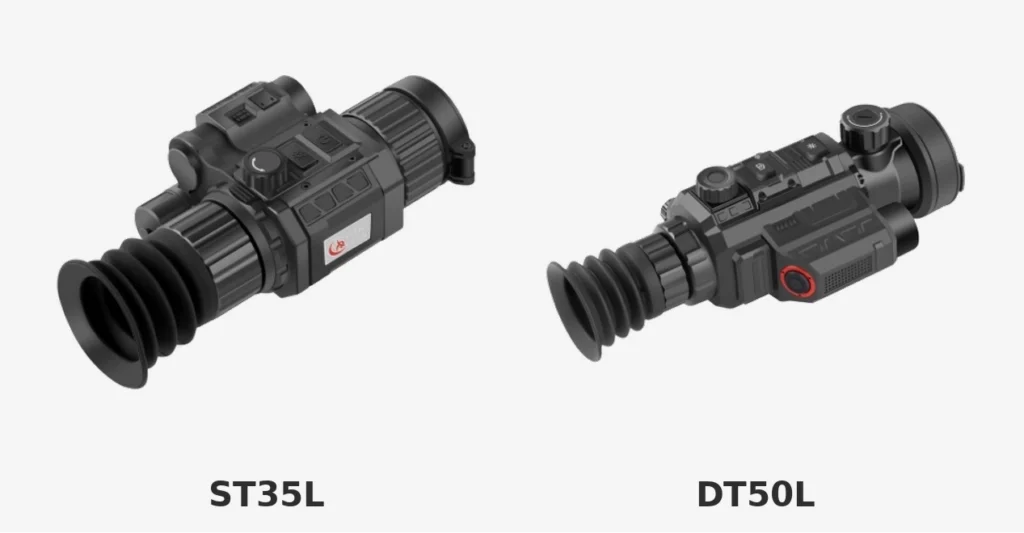
Lens Focal Length Has a Major Effect on Thermal Magnification
Focal length is one of the main optical factors that determines image scale and field of view.
For the same detector format:
- a longer focal length generally produces greater apparent image scale and a narrower field of view;
- a shorter focal length generally produces a wider field of view and less apparent image scale.
This means a 50 mm thermal lens should not automatically be described as “better” than a 35 mm lens.
They solve different viewing problems.
A longer focal length may suit longer-distance observation, while a shorter focal length may provide greater flexibility when scanning closer or mixed terrain.
Detector Resolution Determines How Much Native Detail Is Available
Magnification cannot be evaluated without detector resolution.
A higher-resolution detector contains more native thermal pixels.
That gives the system more spatial information to work with, assuming the lens, focus, processing, and thermal conditions are also suitable.
For example, a higher-resolution detector can retain more useful image information when digital enlargement is applied than a lower-resolution detector under otherwise similar conditions.
However, detector resolution alone does not determine usable range.
Practical performance also depends on:
- focal length;
- target size;
- NETD;
- focus;
- atmosphere;
- thermal contrast;
- image processing;
- display quality.
For a broader explanation, see which thermal imaging scope specifications matter most.
Detection, Recognition, and Identification Need Different Amounts of Detail
One of the biggest mistakes in long-distance thermal observation is treating a published detection figure as if it were an identification figure.
They are not the same.
Detection means noticing that a thermal source is present.
Recognition requires enough information to understand the general type of subject.
Identification requires more detail and context to make a confident determination.
A scope may detect a large heat source at a substantial distance while still providing far less detail than would be required for reliable identification.
Magnification can make the displayed image larger, but it does not remove the difference between these tasks.
For the full explanation, see detection, recognition, and identification in thermal imaging.
More Magnification Does Not Automatically Mean More Useful Range
It is tempting to assume that increasing magnification always extends usable observation distance.
That is not how the complete system works.
If the detector does not contain enough original detail, digital enlargement simply makes limited information larger.
If atmospheric conditions reduce thermal contrast, more magnification cannot restore information that never reached the detector clearly.
If the image is out of focus, zooming it does not solve the focus problem.
Useful long-distance performance therefore depends on the interaction of optics, detector, focus, environment, and processing.
NETD Becomes Important When Thermal Contrast Is Limited
Long-distance observation can become more difficult when the subject and background are close in temperature.
NETD describes thermal sensitivity under defined test conditions.
A lower NETD can help the imaging system distinguish smaller temperature differences under those conditions.
This can be useful in:
- humid environments;
- thermal crossover periods;
- scenes where vegetation and animals are close in temperature;
- other low-contrast conditions.
However, lower NETD does not mean that magnification suddenly creates more spatial resolution.
Thermal sensitivity and spatial detail describe different aspects of the system.
For the technical explanation, see NETD in thermal imaging.
Pixel Pitch Affects the Detector and Lens Relationship
Pixel pitch describes the spacing between detector pixels.
Common modern thermal systems use detector pitches such as 12 μm or 17 μm.
A smaller pixel pitch can support a different relationship between detector size, lens focal length, image scale, and field of view.
It should not be interpreted as a simple statement that smaller pixels always produce a better image.
The complete system still includes:
- detector resolution;
- lens design;
- NETD;
- focus;
- processing;
- display.
For the deeper explanation, see why 12 μm pixel pitch is used in modern thermal optics.
Focus Quality Matters More as Distance Increases
A high-resolution detector and long focal length cannot deliver their full potential if the thermal image is poorly focused.
At longer distances, small focus errors can become more noticeable because the subject occupies fewer useful pixels.
A practical long-distance thermal scope should therefore provide a focus control that is:
- precise;
- repeatable;
- easy to reach;
- usable after installation.
Users should judge focus performance at realistic observation distances rather than only at short indoor distances.
Weather Can Limit Long-Distance Thermal Observation
Thermal imaging does not depend on visible light, but infrared energy still travels through the atmosphere.
High humidity, dense fog, heavy precipitation, and other atmospheric conditions can reduce infrared transmission or lower usable contrast.
This effect becomes particularly important at longer distances because the signal travels through more atmosphere.
As a result, the same thermal scope can appear to perform differently on different nights.
More magnification cannot completely compensate for poor atmospheric transmission.
For the detailed explanation, see thermal performance in extreme weather.
Refresh Rate Affects Motion, Not Long-Range Detail
Refresh rate determines how frequently the thermal display updates.
A higher refresh rate can make moving subjects appear smoother and can improve comfort while panning.
It does not create additional detector resolution or increase optical image scale.
For longer-distance observation, refresh rate should therefore be considered alongside—not instead of—detector resolution, focal length, focus, and field of view.
How Much Thermal Scope Magnification Do You Actually Need?
There is no universal magnification number that works for every situation.
A better approach is to start with the observation environment.
Mixed Terrain
In mixed terrain, a wider starting field of view can be valuable.
A moderate base magnification may make it easier to scan areas where distance changes frequently.
Priorities often include:
- wider field of view;
- comfortable scanning;
- manageable size and weight;
- sufficient image detail;
- flexible digital zoom.
Open Terrain and Longer Distances
Open terrain may justify more starting image scale.
A longer focal length and higher base magnification can help place more detector area on a distant subject.
The trade-off is reduced surrounding field of view.
Important factors include:
- detector resolution;
- focal length;
- focus;
- NETD;
- atmospheric conditions;
- image scale;
- field of view.
Moving Subjects
When subjects move quickly, excessive base magnification can make them more difficult to locate and keep inside the field of view.
A wider starting view may be more practical even when some digital enlargement is used later.
The correct balance depends on whether the priority is scanning, tracking, or examining distant detail.
Use This Comparison Instead of Chasing Maximum Zoom
| Requirement | More Useful Priority | What to Compare |
|---|---|---|
| Scan mixed terrain | Wider starting view | Field of view and base magnification |
| Observe smaller distant subjects | Greater image scale | Focal length and detector resolution |
| Preserve detail under digital zoom | More native information | Detector resolution |
| Low thermal contrast | Thermal sensitivity | NETD, optics and processing |
| Moving subjects | Easier tracking | Field of view and refresh rate |
| Poor weather | Better usable contrast | NETD, optics, atmosphere |
| Longer sessions | Practical operation | Weight, battery and controls |
This type of comparison is more useful than simply choosing the product with the largest stated zoom multiplier.
An Integrated LRF Can Help at Longer Distances
Distance estimation can become difficult through a thermal display because familiar visible-light references may be limited.
An integrated laser rangefinder can provide direct distance information.
That can be useful when observing subjects at longer distances.
Practical rangefinding still depends on:
- target size;
- reflectivity;
- atmosphere;
- weather;
- angle;
- device specification.
An LRF helps reduce distance uncertainty, but it should not be described as eliminating every ranging limitation.
For a detailed comparison, see LRF and non-LRF thermal scopes.
Size and Weight Still Matter in a Long-Range Configuration
Longer lenses, larger housings, integrated LRF modules, batteries, and additional electronics can all increase the size and weight of a thermal scope.
A heavier configuration may be acceptable when stability and longer-distance observation are the priorities.
A lighter configuration may be preferable when the equipment is carried for extended periods.
The correct comparison should include the complete installed system:
- thermal scope;
- mount;
- battery;
- accessories;
- external power if used.
For a wider compatibility discussion, see how to match a thermal scope with your rifle.
How to Compare Current Yubeen Thermal Scope Configurations
When comparing current Yubeen thermal scopes for longer-distance observation, do not start by asking which model has the largest zoom number.
Use this sequence:
- define the typical observation distance;
- define how much field of view is needed;
- compare detector resolution;
- compare lens focal length;
- compare base magnification;
- compare NETD;
- check focus performance;
- consider atmospheric conditions;
- decide whether an integrated LRF is required;
- compare dimensions and installed weight;
- compare battery configuration and runtime;
- confirm current durability and support information.
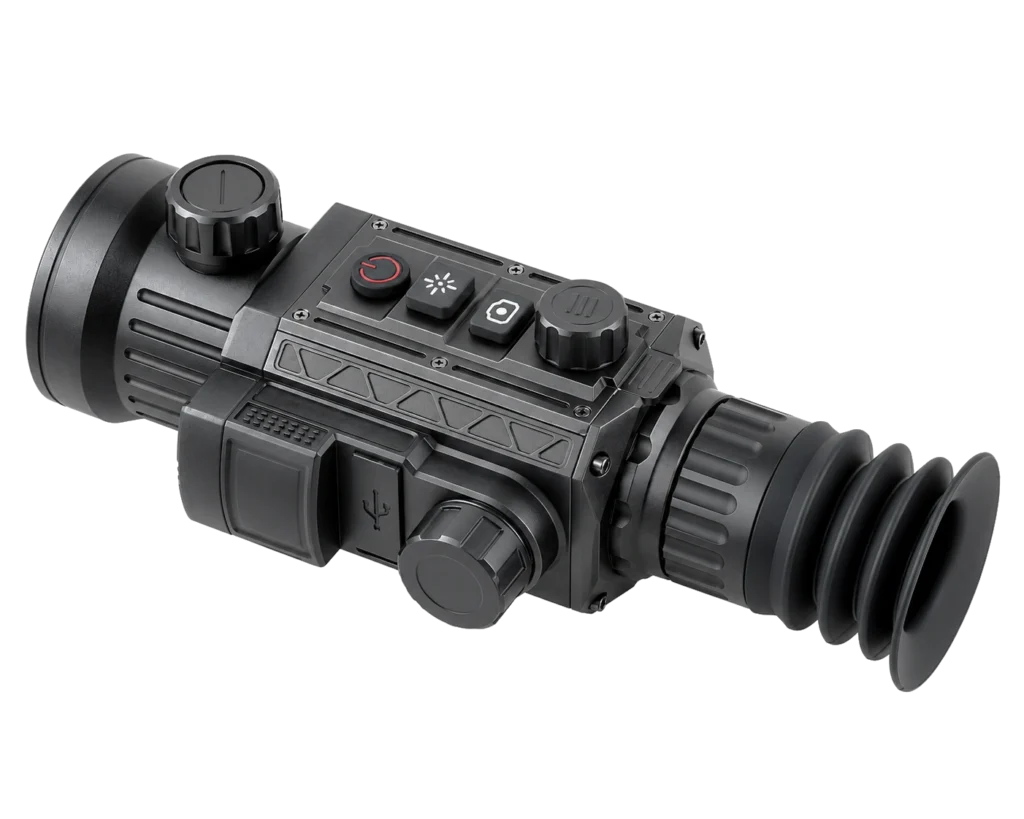
The correct configuration is the one that provides enough native image information and useful image scale without narrowing the field of view more than the application allows.
Final Thoughts
Thermal scope magnification should never be judged by the maximum zoom number alone.
Base magnification determines the starting image scale. Field of view determines how much surrounding environment remains visible. Focal length affects both. Detector resolution determines how much native thermal information is available. Digital zoom enlarges that existing information.
For longer-distance observation, the most useful configuration balances these factors rather than maximizing only one.
A thermal scope with moderate magnification, appropriate focal length, strong native detector resolution, reliable focus, and a suitable field of view can be more practical than a system that advertises a larger maximum zoom but provides less useful information.
FAQ
Is higher thermal scope magnification always better for long-range observation?
No.
Higher magnification can make a distant subject appear larger, but it generally reduces field of view and may make scanning more difficult.
Useful long-distance performance also depends on detector resolution, focal length, focus, NETD, atmosphere, and thermal contrast.
Does digital zoom increase thermal image resolution?
No.
Digital zoom enlarges thermal information already captured by the detector.
It can make the displayed subject larger but does not create additional native detector pixels.
Is a 50 mm thermal lens always better than a 35 mm lens?
No.
For the same detector format, a longer focal length generally provides greater image scale and a narrower field of view.
A shorter focal length generally provides a wider view.
The better choice depends on distance, terrain, target size, and scanning requirements.
Does higher detector resolution allow more useful digital zoom?
Generally, a higher-resolution detector provides more native image information to work with, which can help preserve useful detail during digital enlargement.
However, optics, focus, NETD, processing, and environmental conditions still influence the final image.
Is detection range the same as identification range?
No.
Detection only indicates that a thermal source can be noticed.
Identification requires substantially more shape and contextual information.
A scope may detect a subject at a much greater distance than it can identify it confidently.
What matters most for longer-distance thermal observation?
The most important factors are the combination of detector resolution, lens focal length, field of view, base magnification, focus, NETD, target size, thermal contrast, atmosphere, and practical handling.
No single specification defines useful long-range performance.