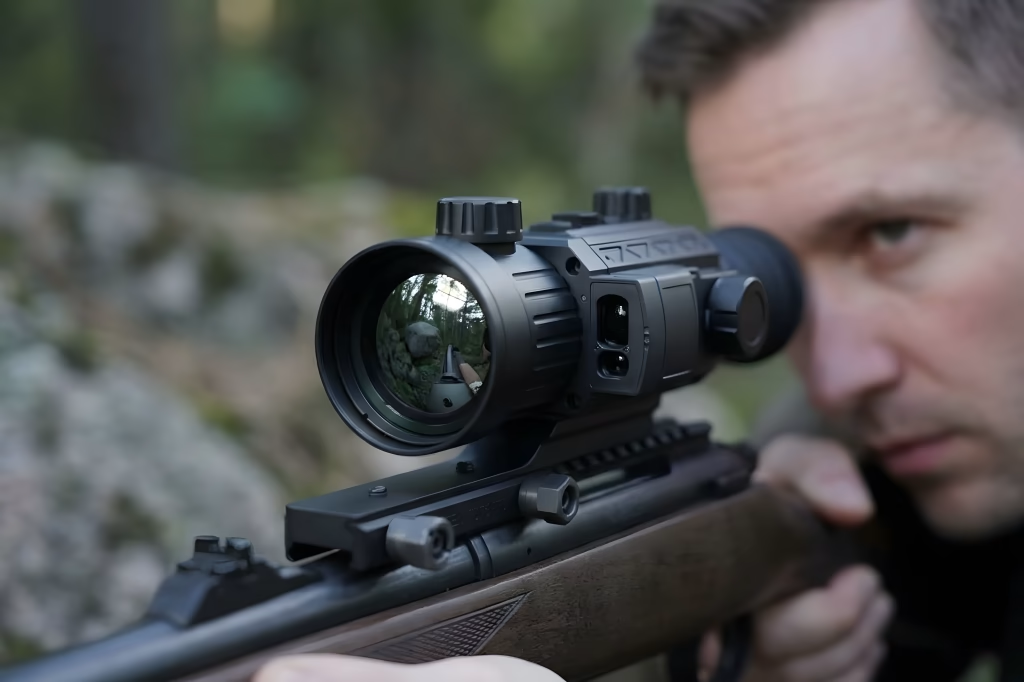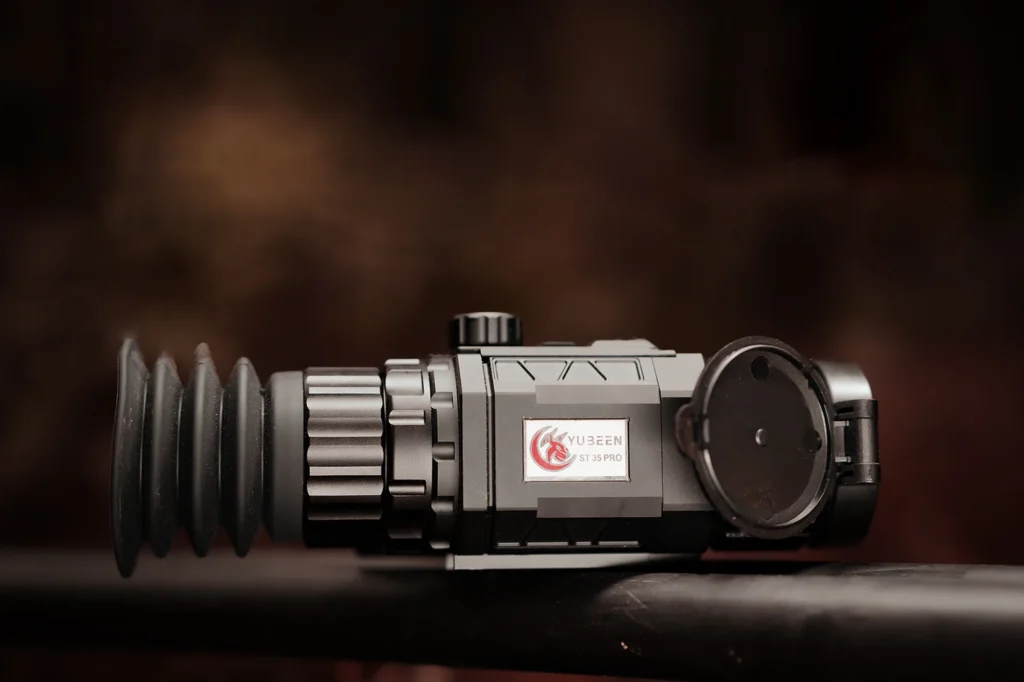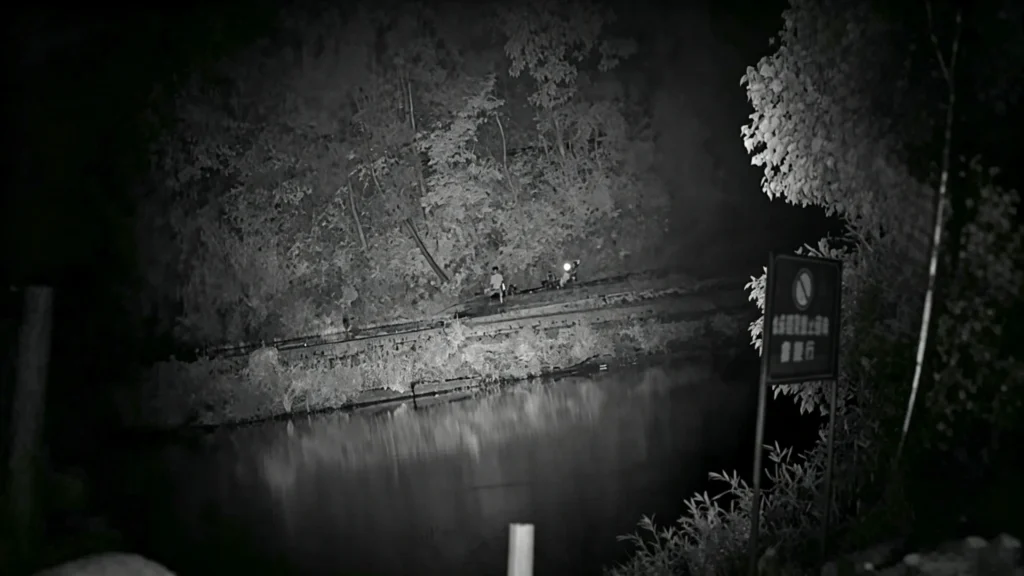
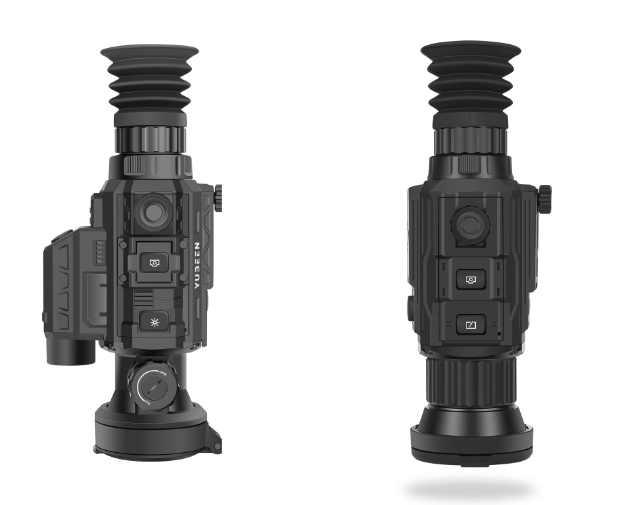
LRF stands for Laser Rangefinder. An LRF thermal scope combines thermal imaging with built-in laser distance measurement, displaying the measured range within the viewing interface. A non-LRF thermal scope does not have this integrated function, so distance must be estimated or measured with a separate device when needed. The better choice depends on how often distance measurements are required, the viewing conditions, and the user’s equipment setup.
The most important point is that an LRF does not improve detector resolution, NETD, lens quality, or thermal image detail. It adds another source of information: measured distance. That information can be valuable, but only when direct ranging is useful enough to justify the additional hardware, controls, power consumption, size, and cost.
What Is an LRF Thermal Scope?
An LRF thermal scope integrates a laser rangefinder into the thermal device.
The rangefinder emits a laser pulse toward a subject and measures the returned signal to estimate distance.
The result can then be displayed inside the thermal interface, depending on the product design.
This reduces the need to move between the thermal device and a separate handheld rangefinder.
The LRF Measures Distance, Not Thermal Detail
A laser rangefinder and a thermal detector perform different jobs.
The thermal detector creates the thermal image.
The LRF measures distance.
Adding an LRF therefore does not automatically make the thermal image:
- sharper;
- higher resolution;
- more thermally sensitive;
- clearer in poor weather;
- capable of identifying a subject at a greater distance.
Those characteristics depend on the imaging system.
An Integrated LRF Changes the Workflow
Without an integrated LRF, the user may estimate distance from experience, use known landmarks, or use a separate ranging device.
With an integrated LRF, distance information can be obtained directly through the same device.
The main benefit is therefore workflow integration, not improved thermal imaging.
What Is a Non-LRF Thermal Scope?
A non-LRF thermal scope does not contain an integrated laser rangefinder.
It can still use the same types of detector resolution, NETD, lens focal length, refresh rate, display, recording, and image-processing technologies found in LRF-equipped products.
The absence of an integrated LRF does not mean the thermal imaging system is technically inferior.
It simply means ranging is handled separately—or is not required for the intended use.
This can result in a simpler configuration with fewer components and controls.
The Core Difference Is Ranging Workflow
The most useful comparison between LRF and non-LRF thermal scopes is not:
“Which one has better image quality?”
Instead, ask:
“Do I need direct distance information integrated into the thermal device?”
If the answer is yes, an LRF configuration may simplify the workflow.
If distance is already known, measured separately, or not important to the task, a non-LRF configuration may remain completely appropriate.
When Is an Integrated LRF Most Useful?
An integrated LRF becomes more valuable when distance is difficult to estimate visually or when observation occurs across changing distances.
Open Terrain and Longer Observation Distances
At longer distances, visual depth cues can become difficult to interpret through a thermal display.
An LRF can provide a direct distance measurement rather than forcing the user to estimate based only on apparent subject size.
This can be particularly useful across:
- open fields;
- agricultural land;
- large clearings;
- mixed terrain with few familiar reference points.
However, direct ranging should not be confused with identification.
Knowing that a subject is 300 meters away does not mean the thermal image provides enough information to determine exactly what the subject is.
For that distinction, see detection, recognition, and identification in thermal imaging.
Changing Distances
An integrated LRF can also be useful when observation distances change frequently.
Instead of estimating each new distance or switching to another device, the user can obtain a measurement while remaining in the thermal interface.
This can make the workflow more consistent.
The value depends on how often accurate distance information is actually needed.
Nighttime Distance Estimation Can Be Difficult
At night, familiar visible-light references may be limited.
Thermal images also emphasize temperature differences rather than the same visual texture and depth cues seen through conventional optics.
This can make subjective distance estimation less reliable.
An LRF provides an independent distance measurement rather than requiring the user to infer distance from the thermal image.
When Can a Non-LRF Thermal Scope Be the Better Fit?
Integrated ranging is useful, but it is not mandatory for every user.
Known or Predictable Distances
If observation normally occurs in a location where distances are already known, direct ranging may add limited value.
Examples can include fixed observation areas or familiar terrain where relevant reference distances have already been established.
In these situations, the imaging system may be the higher priority.
A Separate Rangefinder Is Already Part of the Workflow
Some users already carry a separate rangefinder or another device that provides distance information.
In that case, duplicating the function inside the thermal scope may not be necessary.
The decision depends on whether one-device integration is worth the additional size, weight, controls, and power requirements.
Simpler and Lighter Configurations May Be Preferable
An integrated LRF requires additional hardware.
Depending on the design, this can affect:
- dimensions;
- weight;
- housing complexity;
- button layout;
- battery demand;
- cost.
A non-LRF configuration may therefore appeal to users who prioritize simplicity or lower installed weight.
LRF Performance Depends on the Target and Environment
A maximum ranging specification should not be interpreted as a guaranteed distance under every condition.
Laser ranging performance can vary with the characteristics of the target and environment.
Target Reflectivity Matters
Different surfaces return laser energy differently.
A large, highly reflective surface may be easier to range than a small or low-reflectivity subject at the same distance.
This means a published maximum range cannot describe every real target equally.
Target Size and Angle Matter
A larger target can provide a stronger ranging opportunity than a very small one.
Angle can also affect the amount of laser energy returned toward the device.
The practical ranging distance therefore depends partly on what is being measured.
Weather and Atmosphere Matter
Fog, rain, humidity, airborne particles, and other atmospheric conditions can affect laser transmission and return.
The same conditions can also influence the thermal image itself, although the LRF and thermal detector operate through different physical processes.
An LRF-equipped thermal scope should not be described as immune to poor weather.
For thermal-image performance specifically, see thermal performance in extreme weather.
Maximum LRF Range Is Not the Same as Consistent Practical Range
A specification such as “up to X meters” usually describes performance under particular test conditions.
That does not mean every target can be ranged at that distance.
When comparing LRF systems, ask:
- What kind of target was used?
- Under what environmental conditions?
- Was the surface highly reflective?
- How large was the target?
- Is the published figure a maximum or a typical operating figure?
- What level of repeatability can be expected?
This produces a more useful comparison than simply choosing the largest number.
LRF Does Not Improve Thermal Image Quality
This distinction is important enough to treat separately.
The quality of the thermal image depends primarily on the imaging chain:
- detector resolution;
- pixel pitch;
- NETD;
- lens focal length;
- aperture;
- focus;
- processing;
- refresh rate;
- display.
The LRF adds distance information to that system.
A non-LRF thermal scope with a stronger imaging configuration can therefore provide a better thermal image than an LRF-equipped model with weaker imaging specifications.
Likewise, an LRF-equipped scope can combine strong imaging performance with integrated ranging.
The features need to be compared independently.
For a complete thermal-specification overview, see which thermal imaging scope specifications matter most.
Magnification and LRF Solve Different Problems
Magnification changes how large the thermal image appears.
An LRF measures distance.
Higher magnification does not tell the user the actual distance, and knowing the distance does not add more native image detail.
For longer-distance observation, both may be useful, but they should remain separate parts of the evaluation.
A balanced system should consider:
- detector resolution;
- focal length;
- base magnification;
- field of view;
- focus;
- direct ranging requirements.
For the magnification side of the comparison, see our thermal scope magnification guide.
LRF and Ballistic Functions Are Not the Same Feature
Some thermal products may combine an integrated LRF with ballistic-related software.
These are still separate functions.
The LRF supplies a distance measurement.
Ballistic-related software may use distance together with other configured information to calculate or present additional data.
A product should therefore not be described as providing a complete ballistic solution simply because it contains an LRF.
For any model with ballistic-related functions, confirm:
- what inputs are required;
- whether the LRF data is transferred automatically;
- which profiles can be stored;
- what calculation is performed;
- how the result is displayed;
- which firmware or software version supports the function.
Until these details are confirmed for a specific model, generic articles should avoid promising automatic correction or guaranteed accuracy.
Size and Weight Are Part of the LRF Trade-Off
An integrated LRF normally adds hardware to the thermal system.
The effect varies by design.
When comparing LRF and non-LRF configurations, check the complete installed system rather than only the thermal unit itself.
Consider:
- thermal device weight;
- mount weight;
- dimensions;
- balance;
- battery position;
- control accessibility;
- other accessories.
A small difference on the specification sheet can become more noticeable after the complete system is installed.
For a broader platform check, see how to match a thermal scope with your rifle.
Power Consumption and Battery Management Matter
The LRF is another electronic function that uses power.
How much it affects practical runtime depends on the product design and how frequently the ranging function is used.
Published battery-runtime figures should therefore be interpreted according to their test conditions.
Real runtime can also change with:
- ambient temperature;
- display brightness;
- recording;
- Wi-Fi;
- image processing;
- LRF use;
- battery age;
- external accessories.
When comparing two products, check the complete power system rather than assuming that one runtime figure applies under every configuration.
Controls and Interface Matter More on Feature-Rich Devices
Adding integrated ranging increases the number of functions the device must manage.
A good interface should make ranging easy to access without making normal thermal controls difficult to use.
Important factors include:
- dedicated or shared LRF button;
- button spacing;
- menu structure;
- distance display position;
- units;
- focus accessibility;
- glove usability;
- accidental activation risk.
A feature can be technically capable and still be inconvenient if the interface is poorly organized.
Compare LRF and Non-LRF Configurations Side by Side
| Factor | LRF Thermal Scope | Non-LRF Thermal Scope |
|---|---|---|
| Thermal image | Depends on detector, lens and processing | Depends on detector, lens and processing |
| Direct distance measurement | Integrated | Not integrated |
| Separate rangefinder needed | Usually not for basic ranging | Required if direct ranging is needed |
| Size | May be larger depending on design | Can be simpler/compact |
| Weight | May be higher | Can be lower |
| Power demand | LRF adds another powered function | No integrated ranging load |
| Controls | Additional ranging controls | Simpler interface |
| Cost | Often higher | Can be lower |
| Best fit | Users who value integrated distance measurement | Users who do not need integrated ranging |
The table shows the architectural difference, not a quality ranking.
How to Decide Which Configuration Fits Your Needs
Use the following sequence.
Choose LRF When Direct Distance Information Is a Regular Requirement
An LRF configuration is more compelling when:
- observation distances change frequently;
- direct ranging is used regularly;
- nighttime distance estimation is difficult;
- one-device integration is valuable;
- a separate rangefinder would disrupt the workflow.
Choose Non-LRF When Imaging Is the Priority and Ranging Is Secondary
A non-LRF configuration can make sense when:
- distances are known or predictable;
- direct ranging is rarely needed;
- a separate rangefinder is already available;
- lower complexity is preferred;
- size or weight is a higher priority.
Neither choice is automatically more professional or more capable.
The correct choice depends on which functions are actually required.
How to Evaluate YUBEEN Thermal Imaging Scope Specifications
When evaluating YUBEEN thermal imaging scopes, compare the published specifications of each model, including its integrated ranging capability, thermal imaging performance, optics, and overall system design.
Similar-looking devices may differ in their technical specifications, so each model should be assessed individually.
Use this sequence:
- confirm whether the exact model includes an LRF;
- compare detector resolution;
- compare pixel pitch and NETD;
- compare focal length and field of view;
- compare base magnification;
- check focus;
- verify the published LRF specification where applicable;
- compare dimensions and weight;
- compare power configuration and runtime;
- check recording and connectivity;
- confirm any ballistic-related functions separately;
- confirm the current firmware, warranty, and support terms.
The product with the integrated LRF is not automatically the better choice. It is the better choice only when ranging provides enough practical value to justify the additional hardware and system complexity.
Explore the YUBEEN thermal imaging range for model-specific specifications. The upcoming YUBEEN GX55L provides an example of a thermal imaging scope with an integrated laser rangefinder.
A Buyer Checklist for LRF Thermal Scopes
If you are specifically considering an LRF-equipped thermal scope, verify:
| Factor | What to Confirm |
|---|---|
| Thermal detector | Resolution and pixel pitch |
| NETD | Stated sensitivity and conditions |
| Lens | Focal length and aperture |
| FOV | Starting scene coverage |
| Base magnification | Starting image scale |
| LRF presence | Confirm exact model |
| LRF specification | Published range and conditions |
| Ranging display | Where and how distance appears |
| Controls | How ranging is activated |
| Units | Meter/yard availability where applicable |
| Ballistic integration | Separate function; verify exact implementation |
| Weight | Complete device and mount |
| Battery | Type and realistic runtime |
| Environmental rating | Current IP and operating specifications |
| Software | Current firmware/app functions |
| Warranty | Current terms for product and market |
This checklist prevents one headline LRF number from dominating the entire buying decision.
Final Thoughts
The real difference between LRF and non-LRF thermal scopes is straightforward.
An LRF-equipped device integrates direct distance measurement into the thermal workflow.
A non-LRF device leaves ranging separate.
That feature can be highly useful, but it does not improve detector resolution, NETD, lens quality, focus, or thermal image detail by itself.
Choose an LRF configuration when direct distance information is used often enough to justify the additional hardware, weight, power, controls, and cost.
Choose a non-LRF configuration when the thermal image itself is the priority and ranging is known, unnecessary, or already handled elsewhere.
FAQ
Is an LRF thermal scope always better than a non-LRF model?
No.
An integrated LRF adds direct distance measurement, but thermal image quality still depends on the detector, lens, NETD, focus, processing, and display.
A non-LRF model can be the better fit when integrated ranging is not needed.
Does an LRF improve thermal detection range?
No.
The LRF measures distance. It does not increase detector resolution, thermal sensitivity, lens focal length, or native thermal detail.
Thermal detection performance and laser-ranging performance are separate specifications.
Does the maximum LRF range work on every target?
No.
Practical ranging depends on target size, reflectivity, angle, weather, atmospheric conditions, and the exact rangefinder design.
A maximum published distance should not be interpreted as guaranteed performance on every subject.
Is an LRF useful at night?
It can be.
Distance can be harder to estimate when normal visible-light references are limited, so direct range measurement may provide useful information.
Whether this justifies an integrated LRF depends on the user’s typical distances and workflow.
Does an LRF automatically provide ballistic correction?
No.
Laser ranging provides distance information.
Ballistic-related functions are separate software features that may use range together with other configured inputs.
Their availability and implementation must be confirmed for the exact model.
Should I choose an LRF scope for longer-distance observation?
Not solely because the observation distance is longer.
First compare detector resolution, focal length, field of view, focus, NETD, and image quality.
Then decide whether direct distance measurement provides enough additional value to justify an LRF-equipped configuration.