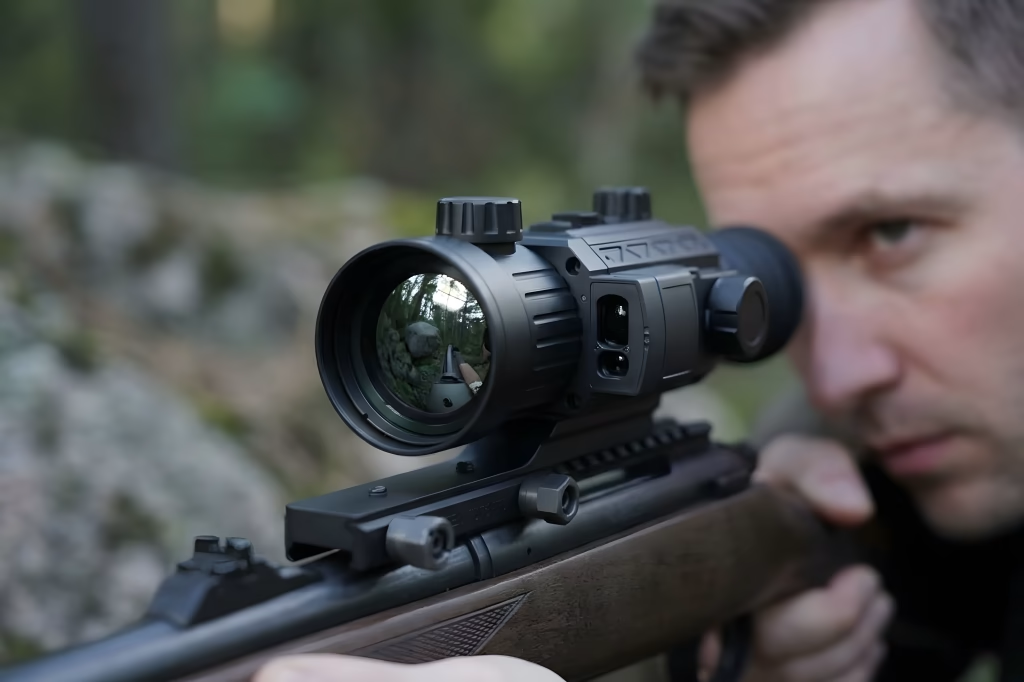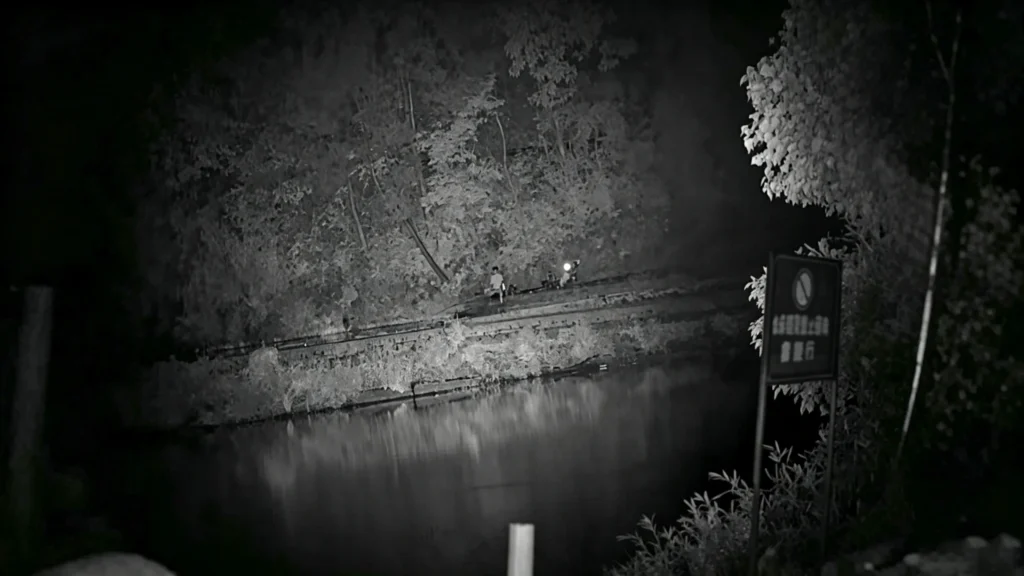
Using a thermal scope during the day is possible because thermal imaging forms an image from infrared radiation rather than visible light. However, daylight changes the thermal scene. A thermal scope does not fully replace a conventional optical scope, as the two systems provide different kinds of information.
Sunlight changes the temperatures of the ground, vegetation, buildings, rocks, metal, and other surfaces. These changes can increase or reduce the thermal contrast between a target and its background. Reflections, weather, humidity, and atmospheric conditions can also affect how the scene appears.
Daytime thermal imaging is therefore not simply “nighttime performance with the sun turned on.”
The better question is therefore not only:
“Can a thermal imaging scope work during the day?”
but:
“How does the daytime thermal environment change what the detector sees?”
If you are new to thermal imaging itself, start with our guide to thermal imaging for beginners.
Thermal Imaging Does Not Need Visible Light
Visible-light cameras form images from light reflected by the scene.
Traditional low-light and image-intensification systems also depend, directly or indirectly, on available light.
Thermal imaging uses a different signal.
Objects emit infrared radiation according to their temperature and surface properties. A thermal detector receives differences in that infrared energy and converts them into electrical signals that can be processed into an image.
This is why a thermal imager can operate:
- in daylight;
- at dusk;
- at night;
- in complete darkness.
Visible illumination is not the primary requirement for image formation. FLIR describes thermal imaging as capable of producing images in both darkness and bright daylight because the detector responds to infrared radiation rather than relying on visible scene illumination.
For a deeper explanation of the detector itself, see our guide to thermal imaging FPA and microbolometers.
Daylight Changes the Thermal Scene
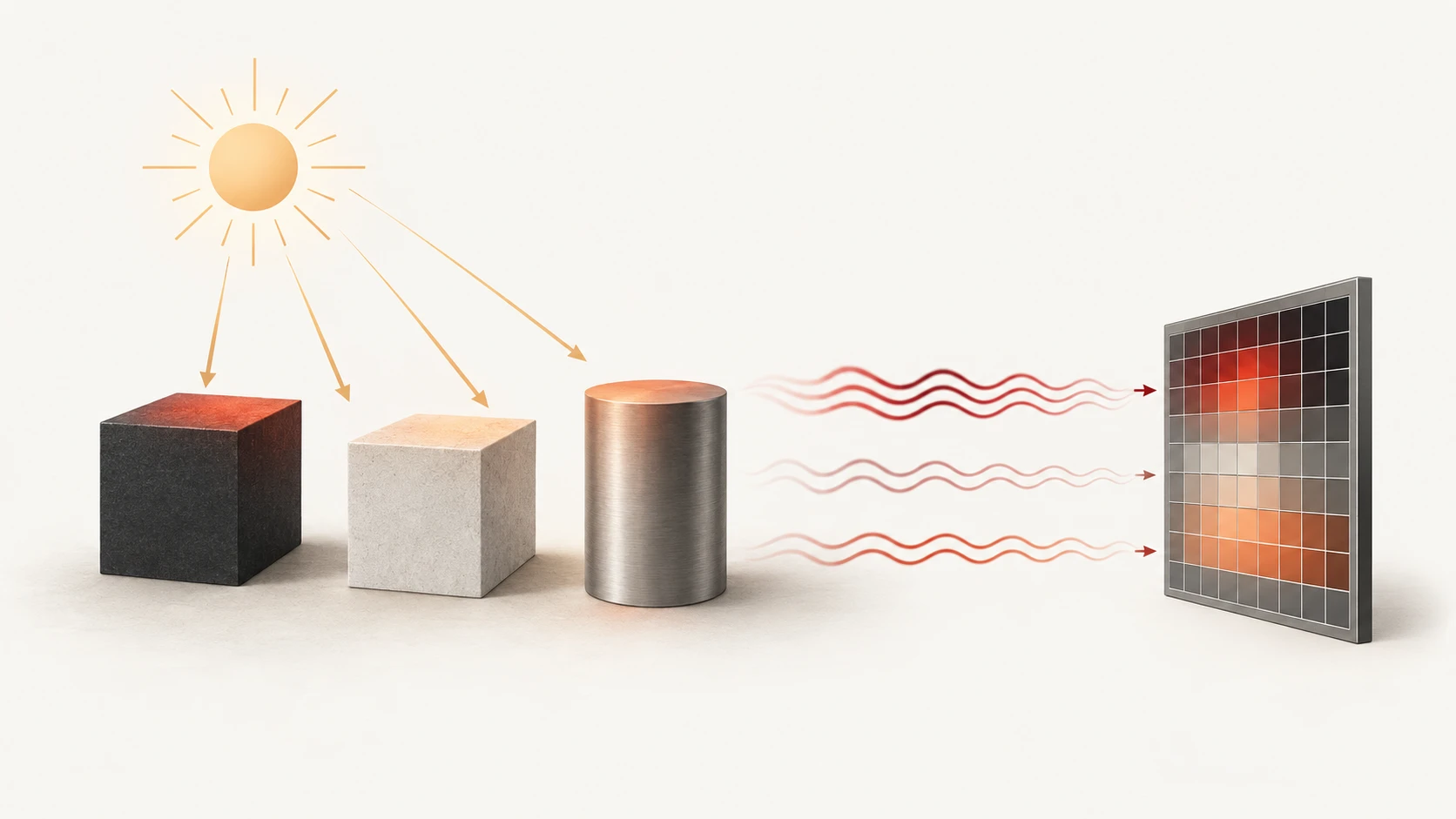
Although visible sunlight is not required by the detector, sunlight changes the temperatures of the surfaces being observed.
During the day, solar energy can heat:
- exposed soil;
- rocks;
- walls and roofs;
- vehicles and machinery;
- vegetation;
- metal surfaces;
- other outdoor materials.
Different materials heat and cool at different rates.
As a result, a scene viewed shortly after sunrise can have a very different thermal pattern from the same scene in mid-afternoon.
This is the main reason daytime thermal imaging should not be described as identical to nighttime thermal imaging.
The detector may operate in both cases.
The scene has changed.
Solar Loading Can Increase or Reduce Thermal Contrast
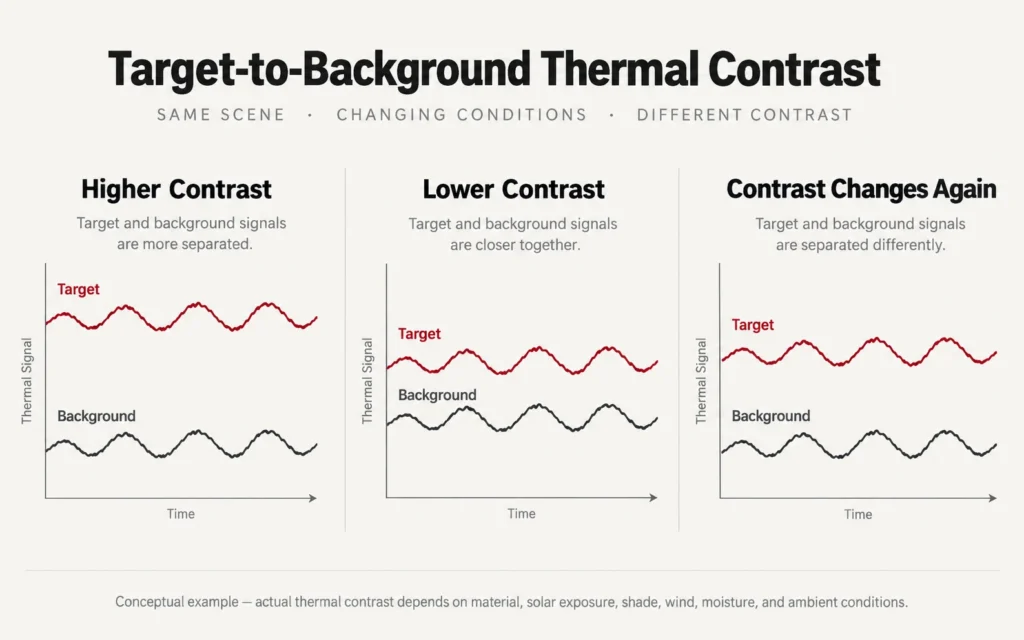
Thermal contrast is the difference between the infrared signal from a target and the surrounding background.
Strong thermal contrast makes an object easier to distinguish.
Weak thermal contrast makes the target blend into the scene.
Sunlight can produce either result.
For example, solar heating may make one surface much warmer than its surroundings, increasing apparent contrast.
But prolonged heating can also bring several materials toward similar apparent temperatures, reducing contrast between them.
FLIR’s infrared-imaging guidance notes that outdoor solar loading can heat the lens, camera, and observed surfaces, changing the radiation received by the detector compared with controlled conditions.
This means:
brighter daylight does not automatically mean better or worse thermal imagery.
What matters is how the thermal scene changes.
Thermal Crossover Can Make a Scene Harder to Interpret
The term thermal crossover is often used informally for periods when a target and its background approach similar apparent temperatures.
This can occur during environmental transitions.
For example, one material may heat faster after sunrise, while another retains heat longer after sunset.
At some point their thermal signals may become relatively similar.
When that happens, visible thermal contrast can decrease even though the detector is functioning normally.
The exact timing depends on:
- material;
- surface condition;
- solar exposure;
- shade;
- wind;
- ambient temperature;
- moisture;
- target activity.
There is no universal “worst time of day.”
Thermal crossover depends on the actual scene.
A Hot Afternoon Does Not Automatically Make Thermal Imaging Useless
High ambient temperature does not switch off a thermal detector.
However, hot conditions can reduce target-to-background contrast when many surfaces become warm.
Consider a warm target against cool ground.
The temperature separation may be strong.
Now imagine the ground, rocks, and vegetation heating through the afternoon.
As the background becomes warmer, the apparent difference can decrease.
A sensitive detector may still preserve small differences, but the available thermal contrast has changed.
This is where NETD becomes relevant.
For more on sensitivity in low-contrast scenes, see NETD in thermal imaging.
NETD Can Help When Daytime Contrast Is Weak
NETD describes thermal sensitivity relative to system noise under stated measurement conditions.
A lower NETD generally means smaller thermal differences can be distinguished relative to noise when comparison conditions are equivalent.
That can be useful during low-contrast daytime conditions.
But NETD does not create a temperature difference that does not exist.
It also does not replace:
- detector resolution;
- optics;
- focus;
- field of view;
- atmospheric transmission;
- image processing.
A low NETD value therefore should not be interpreted as a guarantee that every hot-afternoon scene will remain highly detailed.
Detector Resolution Still Controls Spatial Sampling
Daylight does not change the native number of detector pixels.
A 384 × 288 detector remains 384 × 288.
A 640 × 512 detector remains 640 × 512.
Higher native detector resolution can provide more spatial samples when optics and field of view are comparable.
But resolution cannot compensate completely for weak thermal contrast.
A high-resolution detector still needs usable infrared information from the scene.
This is why resolution and NETD solve different problems:
- resolution → spatial information;
- NETD → thermal sensitivity relative to noise.
Reflective Surfaces Can Be Misleading
Not every surface seen by a thermal detector behaves like an ideal emitter.
A useful concept here is emissivity.
High-emissivity surfaces emit infrared radiation efficiently.
Low-emissivity surfaces—especially polished metals—can reflect a substantial amount of infrared radiation from their surroundings.
FLIR notes that highly polished metals may behave almost like infrared mirrors, so the thermal camera can see reflected radiation from surrounding objects rather than a simple representation of the surface’s own temperature.
This becomes particularly relevant outdoors, where sunlight and other warm objects can influence the apparent thermal pattern.
Therefore, a bright or dark area on a shiny surface should not automatically be interpreted as the actual temperature of that surface.
For a non-radiometric thermal scope, the practical lesson is simpler:
reflective surfaces can create thermal appearances that require careful interpretation.
Visible Color Does Not Tell You Thermal Emissivity
A surface that looks dark in visible light is not necessarily a strong infrared emitter.
Likewise, a shiny visible surface may behave very differently in the LWIR band.
Thermal appearance depends on:
- material;
- surface finish;
- emissivity;
- reflection;
- viewing angle;
- surrounding infrared sources.
That is why daytime thermal interpretation requires more than assuming:
hotter-looking = physically hotter.
This is especially important around polished metal, glass, water, and other reflective or partially reflective surfaces.
Direct Sun Exposure Is a Separate Question
Using a thermal imaging device during daylight is not the same as intentionally pointing it directly at the sun.
Direct solar exposure creates a much more concentrated input than viewing a normal sunlit landscape.
Different detector and optical systems may respond differently.
For example, Teledyne FLIR states that it does not recommend intentionally viewing the sun with Boson, Tau2, or Quark2 cameras. For those specific cores, FLIR reports that solar viewing may produce temporary image artifacts and require recovery or flat-field correction.
That information should not be generalized into a claim about every thermal product.
The appropriate rule is:
follow the direct-sun guidance for the exact device.
Unless the manufacturer explicitly states otherwise, avoid prolonged intentional viewing of the sun. For a broader discussion of solar exposure and other equipment risks, see our guide to what can damage a thermal scope.
Daylight and Direct Sun Should Not Be Confused
These two statements can both be true:
A thermal imaging scope can normally be used during daylight.
and:
Intentionally pointing the system directly at the sun may be discouraged.
There is no contradiction.
Normal outdoor daylight means observing ordinary scenes illuminated and heated by the sun.
Direct solar viewing means placing the solar disk itself within the optical field.
Those are very different exposure conditions.
Weather Still Matters During the Day
Daylight does not eliminate atmospheric effects.
Humidity, fog, rain, snow, and atmospheric path length can still reduce the infrared information reaching the detector.
In addition, weather changes surface temperatures and therefore target-to-background contrast.
For example:
- rain can cool surfaces;
- wet materials can change thermal behavior;
- cloud cover can reduce solar heating;
- wind can change surface temperature;
- humidity can affect long-path transmission.
For the complete environmental discussion, see how weather affects thermal imaging.
Shadows Can Be Thermally Visible
A visible-light shadow is created when direct illumination is blocked.
Thermal scenes can show a related but different effect.
A surface exposed to sunlight may heat more than an adjacent shaded surface.
That temperature difference can remain visible thermally even after the visible lighting pattern changes.
As a result, a thermal image may reveal:
- warm sun-exposed surfaces;
- cooler shaded regions;
- retained heat after the light source changes.
These are real thermal patterns, but they can complicate interpretation if they are mistaken for target-specific heat signatures.
Daytime Image Quality Can Change Over Minutes or Hours
A thermal scene is dynamic.
Sunlight intensity changes.
Clouds move.
Surfaces heat.
Shade moves.
Wind changes convective cooling.
Moisture evaporates.
Because these processes happen at different rates, the thermal image of the same location can change significantly during the day.
This means a product comparison made at 8:00 AM should not automatically be treated as equivalent to one made at 3:00 PM.
When comparing thermal devices, use similar environmental and viewing conditions whenever possible.
Automatic Gain Control Changes the Presentation
Thermal devices commonly use image-processing functions that adjust the displayed contrast according to the current scene.
Automatic gain control can redistribute display levels so useful differences remain visible.
This can make the image appear dramatically different as the scene changes.
That does not mean the detector’s physical resolution or NETD has changed.
It means the available detector data are being presented differently.
Likewise, palette selection can influence how easily a user notices certain differences without changing the underlying thermal measurements.
NUC / FFC Is Not a Day-or-Night Mode
Many uncooled thermal systems perform non-uniformity correction, often called NUC or FFC.
This helps compensate for differences between detector elements and changes in detector behavior.
It is not a switch between daytime and nighttime operation.
Changing environmental temperature or device temperature can increase the need for calibration behavior in some systems, but the exact process is product-specific.
FLIR describes NUC as a correction for detector non-uniformity rather than an illumination mode.
Use the exact manufacturer’s procedure for the device.
Digital Zoom Does Not Become More Powerful in Daylight
Digital zoom enlarges thermal information already captured by the detector.
It does not add native detector pixels.
Daylight does not change this rule.
A strong daytime thermal contrast may make an enlarged target easier to interpret.
Weak contrast may make enlargement less useful.
But maximum digital-zoom specification should not be confused with native spatial detail.
For the relationship between detector data and computational enhancement, see our guide to AI processing in thermal scopes.
Daytime DRI Still Depends on the Complete System
Detection, recognition, and identification are different information tasks.
Daytime thermal contrast can change the distance at which each task remains practical.
A warm target against a thermally similar background may become harder to distinguish even in perfect visible daylight.
Conversely, strong target-to-background contrast can make detection easier.
Practical DRI still depends on:
- target size;
- detector resolution;
- pixel pitch;
- focal length;
- FOV;
- thermal contrast;
- atmosphere;
- NETD;
- processing.
For the full discussion, see thermal detection, recognition, and identification.
Can a Thermal Imaging Scope Replace a Regular Optical Scope in Daylight?
Not completely. A thermal imaging scope and a conventional optical scope provide different kinds of information. Thermal imaging emphasizes differences in emitted infrared energy, which can make heat signatures easier to detect against some backgrounds. A conventional optical scope uses visible light and can provide color, texture, surface detail, and other visual information that thermal imaging does not reproduce.
For daytime use, thermal imaging is therefore better treated as complementary rather than as a universal replacement for conventional optics. Thermal can be useful for detection and scanning, while visual identification may still benefit from an optical scope or binoculars when conditions allow. The practical choice depends on target size, thermal contrast, distance, field of view, detector detail, optics, and how much visual confirmation is required.
What Specifications Matter for Daytime Thermal Use?
The same core specifications still matter during the day:
| Factor | Why it matters |
|---|---|
| Detector resolution | Native spatial sampling |
| NETD | Sensitivity to small thermal differences |
| Pixel pitch | Detector geometry and IFOV with the lens |
| Focal length / FOV | Scene coverage and angular sampling |
| Lens quality | Infrared transmission and focus |
| Image processing | Presentation of available thermal data |
| Display | User viewing and interface presentation |
| Operating temperature | Supported environmental range for the exact product |
| Battery system | Practical operating time |
| Environmental protection | Product-specific exposure limits |
Daytime operation does not create a separate set of thermal physics.
It changes the scene in which the system operates.
A Real Product Still Needs Exact Daytime Specifications
A current thermal product can be used here as a real brand example without claiming that one model represents all daylight conditions.
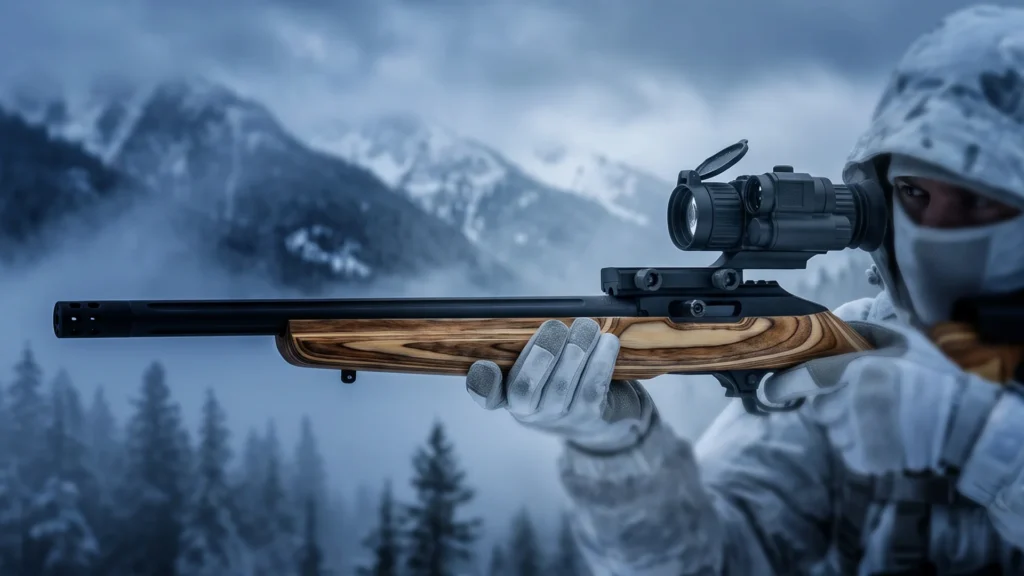
For the exact product, verify:
- native detector specification;
- NETD;
- optics;
- FOV;
- operating-temperature range;
- direct-sun guidance;
- environmental protection;
- battery/runtime conditions;
- calibration procedure.
Do not infer these specifications from another product in the same family.
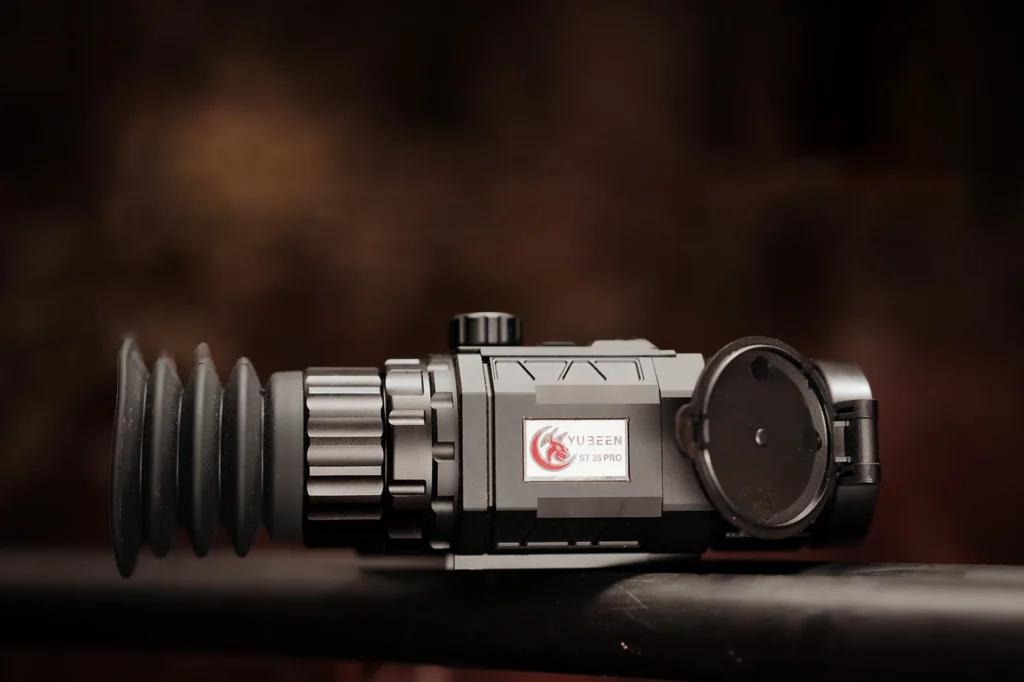
A real product image should connect the technical article to the Yubeen range—not serve as proof of an unsupported “all-day” performance claim.
How to Evaluate a Thermal Scope During Daylight
A practical evaluation can be done in this order:
- Choose a realistic scene.
Include both warm and cool materials rather than one artificially high-contrast target. - Observe at more than one time of day.
Morning and afternoon thermal patterns can differ significantly. - Check target-to-background contrast.
Determine whether objects remain distinguishable as the background warms. - Look at reflective surfaces carefully.
Do not assume every apparent thermal pattern represents surface temperature. - Compare the same FOV.
Different fields of view can make one system appear more detailed than another. - Use comparable focus.
Poor focus can overwhelm differences between detectors. - Check image processing separately.
Strong sharpening or gain adjustment can change appearance without changing native detector capability. - Avoid intentional direct solar viewing unless explicitly permitted.
- Check current operating-temperature limits for the exact device.
- Compare products under similar environmental conditions.
Uncontrolled screenshots taken at different times are weak evidence.
What Daylight Thermal Imaging Can—and Cannot—Tell You
Thermal imaging can:
- operate without visible illumination;
- remain usable in bright daylight;
- reveal differences in infrared radiation that visible imagery may not show;
- reveal thermal effects from sunlight, shade, and surface heating;
- support observation across both day and night conditions.
Thermal imaging cannot:
- guarantee the same contrast at every time of day;
- make all surfaces easy to interpret;
- eliminate reflection from low-emissivity surfaces;
- turn digital zoom into additional detector resolution;
- guarantee identical DRI range in daytime and nighttime;
- justify prolonged direct solar viewing without product-specific guidance.
The key point is simple:
daylight does not prevent thermal imaging, but it changes the thermal environment being imaged.
FAQ
Can a Thermal Imaging Scope Work in Bright Daylight?
Yes. Thermal imaging does not depend on visible-light illumination, so normal daylight does not prevent image formation. However, solar heating can change target-to-background thermal contrast and therefore change the appearance of the scene.
Is Daytime Thermal Imaging as Good as Nighttime Thermal Imaging?
Not necessarily better or worse. Performance depends on the thermal contrast of the actual scene. Some targets may stand out more strongly at night, while other daytime conditions can produce useful contrast.
Can Direct Sunlight Damage a Thermal Imaging Scope?
The answer is product-specific. Normal daylight use and intentionally pointing the optic directly at the sun are different conditions. Some thermal-core manufacturers explicitly discourage intentional solar viewing, so follow the guidance for the exact product.
Why Does Thermal Contrast Sometimes Get Worse on Hot Afternoons?
Solar heating can bring the temperatures of different surfaces closer together. When target and background signals become similar, thermal contrast decreases even though the detector continues operating normally.
Why Can Shiny Metal Look Strange in a Thermal Image?
Low-emissivity surfaces such as polished metal can reflect infrared radiation from their surroundings. The displayed pattern may therefore include reflected thermal energy rather than representing only the surface’s own temperature.
Does Daylight Improve Thermal Detection Range?
Not automatically. Daytime solar heating can increase or decrease target contrast. Practical range still depends on detector resolution, optics, NETD, field of view, target size, atmosphere, and processing.