Choosing a thermal imaging scope is not about finding the largest number on a specification sheet. Detector resolution, NETD, pixel pitch, lens design, field of view, magnification and refresh rate describe different parts of the imaging system, while battery life, size, weight and controls determine how practical that system is to use.
The specifications also interact. A longer focal length can provide a narrower field of view for distant observation, but it reduces the amount of surrounding scene visible at once. A higher detector resolution provides more native spatial samples, but it does not automatically mean better thermal sensitivity. A low NETD value can help preserve subtle temperature differences, but it does not tell you how many pixels are available across a distant target.
The right approach is therefore to begin with the intended use and then identify which specifications support it.
If you are new to the technology itself, our thermal imaging for beginners guide explains how a thermal detector forms an image before you begin comparing individual specifications.
Start With the Use Case, Not the Specification Sheet
Before comparing products, define the conditions in which the device will actually be used.
Ask:
- How far away are the subjects you normally need to observe?
- How large are those subjects?
- Do you need a wide scene for scanning, or a narrower view for more distant observation?
- Will the device or subject move frequently?
- How long does the device need to operate before charging or replacing batteries?
- How important are overall weight and size?
- Do you need integrated ranging, recording or other workflow functions?
- What environmental conditions are realistic for your use?
These questions help determine which specifications deserve the most weight.
A specification can be objectively impressive and still be poorly matched to a particular application.
Detector resolution describes the number of sensing elements in the thermal focal plane array.
Common formats may be expressed as values such as:
- 256 × 192
- 384 × 288
- 640 × 512
These numbers represent native thermal detector samples, not display pixels.
A 384 × 288 detector contains:
110,592 native detector elements
A 640 × 512 detector contains:
327,680 native detector elements
Under comparable optical conditions, having more detector elements can place more native samples across objects in the scene. This can help preserve shape, boundaries and smaller spatial details.
Higher detector resolution can therefore be especially useful when the subject occupies only a small portion of the total image.
However, resolution is not a complete measure of image quality. Optical quality, field of view, thermal sensitivity, focus, processing and atmospheric conditions all affect the final result. Teledyne FLIR likewise notes that detector resolution is only one part of thermal-system performance; sensitivity, optics, calibration and processing also matter.
Do Not Confuse Detector Resolution With Display Resolution
A high-resolution OLED or LCD does not increase the number of thermal measurements collected by the detector.
For example, if a thermal detector produces 384 × 288 native samples and the resulting image is shown on a higher-resolution display, the display can present the interface and processed image more smoothly, but the detector remains 384 × 288.
Similarly:
Detector resolution = thermal measurement grid
while:
Display resolution = presentation grid
Both matter to the user experience, but they are not interchangeable.
For a deeper explanation of the detector itself, see our guide to thermal imaging FPA, microbolometers, resolution and refresh rate.
NETD: Thermal Sensitivity Is Different From Resolution
NETD stands for Noise Equivalent Temperature Difference and is normally expressed in millikelvin, or mK.
In simplified terms, it describes how small a temperature difference a thermal imaging system can distinguish relative to its noise under specified test conditions.
A lower NETD value generally represents greater thermal sensitivity under comparable conditions. FLIR describes lower NETD as the ability to distinguish smaller thermal differences.
But several cautions are important.
First, NETD is not resolution.
A 640 × 512 detector does not automatically have lower NETD than a 384 × 288 detector.
Second, NETD values should be compared with their test conditions. Lens f-number can affect system sensitivity, which is why thermal-system NETD values are often specified or normalized with a stated f-number.
Third, lower NETD does not override every other characteristic of the system. Focus, lens transmission, processing and the thermal contrast of the actual scene still affect what the user sees.
For buying decisions, treat detector resolution and NETD as two separate questions:
- How much spatial information is sampled?
- How effectively can the system distinguish small thermal differences?
Pixel Pitch: Useful, but Never Read It Alone
Pixel pitch describes the physical spacing between neighboring detector elements.
Values such as 12μm and 17μm are therefore geometrical specifications. They are not detector resolutions and they are not NETD values.
Smaller pixel pitch can permit finer angular sampling with a given focal length and can support more compact detector and optical-system designs. But the final result depends on detector architecture, resolution, lens design and signal processing.
This means:
- 12μm does not automatically mean higher resolution;
- 12μm does not automatically mean lower NETD;
- 12μm does not automatically mean longer detection range.
Pixel pitch becomes more meaningful when read together with lens focal length, detector resolution and field of view.
For the complete explanation, see 12μm pixel pitch in thermal imaging.
Lens Focal Length and Field of View Must Be Compared Together
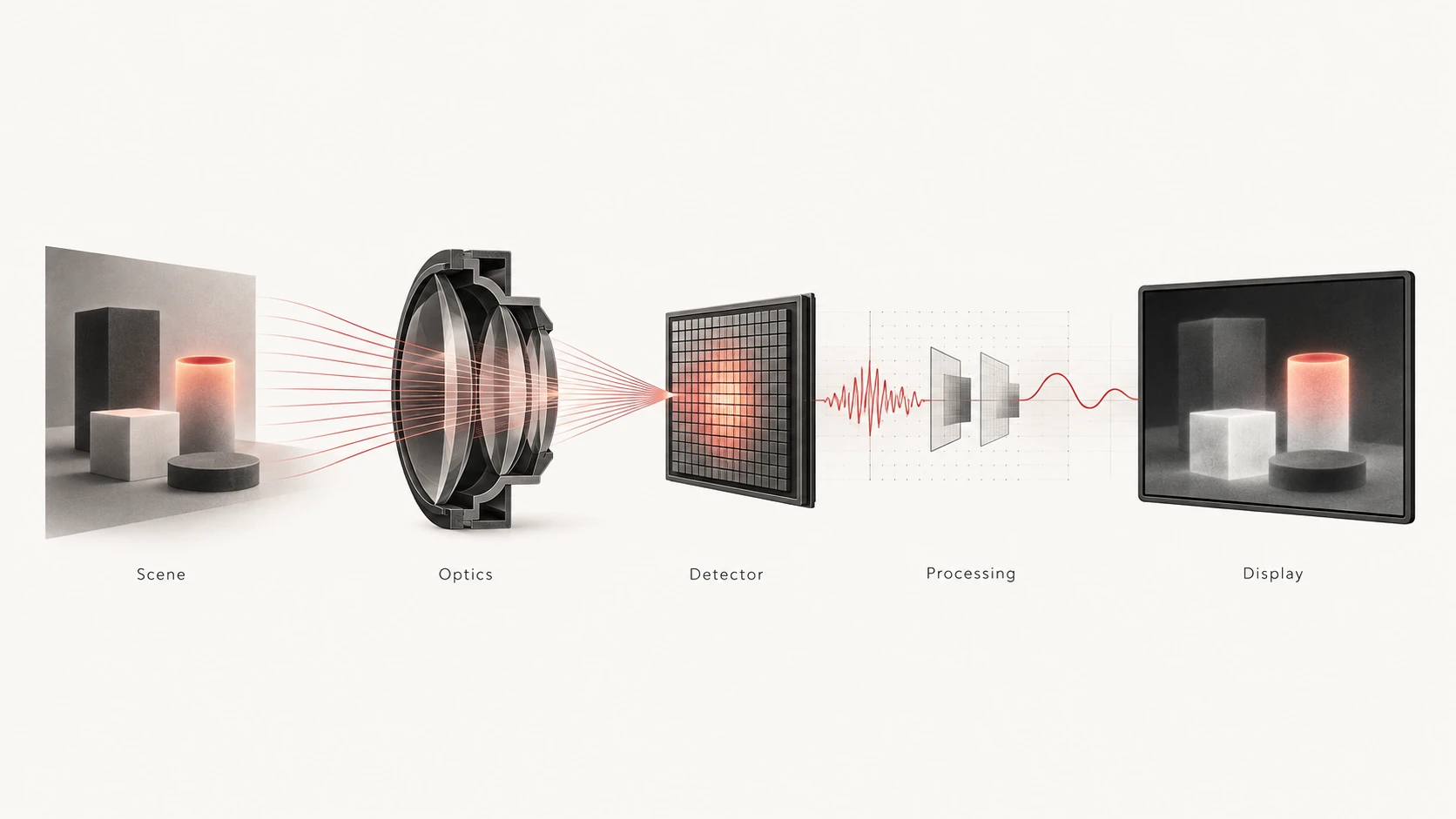
The lens determines how infrared energy from the scene is projected onto the detector.
One of the most important results is field of view, or FOV.
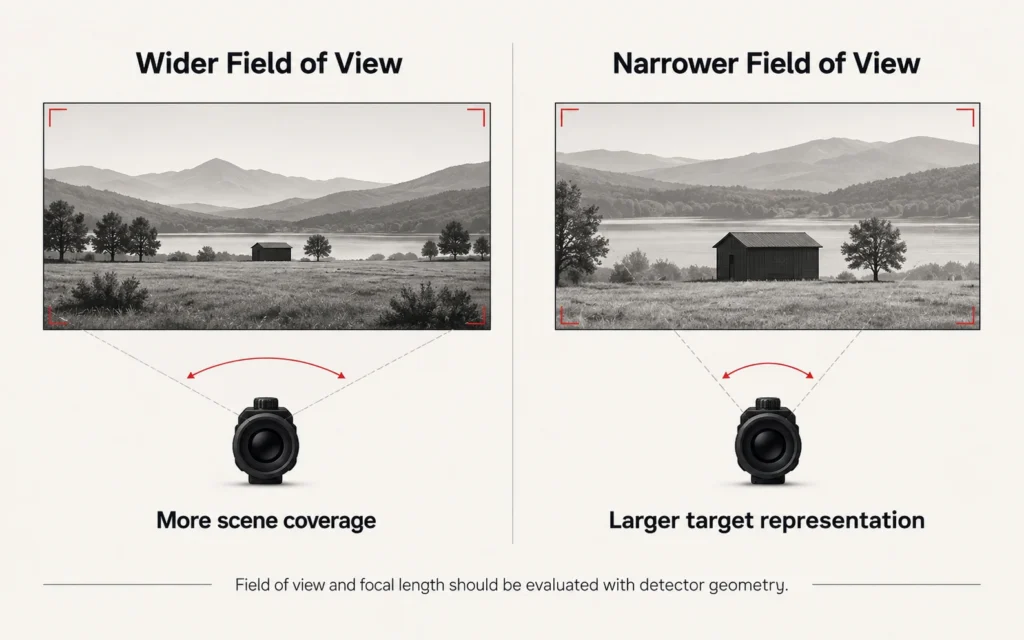
A wider field of view shows more of the scene at once. This can make scanning and locating subjects easier.
A narrower field of view covers less of the scene, so a distant object occupies a larger part of the image.
In general, with the same detector, shorter focal lengths produce a wider field of view while longer focal lengths produce a narrower field of view. FLIR’s thermal-optics guidance describes focal length, FOV and IFOV as directly connected design variables.
Neither is universally better.
A Wider Field of View Is Useful When:
- the expected working distance is shorter;
- subjects may appear anywhere across a broad area;
- fast scanning matters;
- situational awareness matters more than making a distant target occupy more of the frame.
A Narrower Field of View Is Useful When:
- expected observation distances are longer;
- a smaller section of the scene needs closer inspection;
- putting more available detector samples across a distant object is important.
Real thermal systems demonstrate this trade-off: changing focal length can produce very different scene coverage even when the underlying detector remains the same.
Base Magnification Is Only Part of the Viewing Geometry
Thermal scope magnification should not be considered separately from detector size, pixel pitch, focal length and field of view.
A higher base magnification makes objects appear larger from the starting view, but normally provides less surrounding scene.
A lower base magnification generally provides a wider initial view, which may make scanning easier.
The correct choice depends on normal observation distance and how quickly the user needs to move between scanning and closer inspection.
For a detailed treatment of this trade-off, see our guide to thermal scope magnification.
Digital Zoom Does Not Increase Native Detector Resolution
Digital zoom enlarges the image data already produced by the detector.
It does not add physical detector elements.
As digital zoom increases, each native detector sample is displayed over more screen area. Image-processing techniques such as interpolation or super-resolution can improve presentation, but the physical detector information does not increase.
This is why native detector resolution, base magnification and field of view should be evaluated before treating the maximum digital-zoom number as a major purchasing advantage.
IFOV Helps Connect the Detector to the Lens
Instantaneous Field of View, or IFOV, describes the angular portion of the scene represented by an individual detector pixel.
In simplified geometry:
IFOV ≈ pixel pitch ÷ focal length
This makes IFOV useful because it connects two specifications that are often advertised independently.
A smaller IFOV means an individual detector element covers a smaller angle of the scene.
As distance increases, however, that angular area corresponds to an increasingly large physical area on the target plane.
This is one reason target size, distance, detector geometry and focal length must all be considered together rather than using one specification to predict performance.
Refresh Rate: How Often Is a New Thermal Frame Produced?
Frame rate or image frequency describes how often the system produces new thermal frames.
For example:
- 30 Hz ≈ one new frame every 33.3 ms
- 50 Hz ≈ one new frame every 20 ms
- 60 Hz ≈ one new frame every 16.7 ms
Higher frame rates provide more temporal samples of moving scenes.
This can make panning and moving subjects appear more continuous.
But refresh rate does not increase detector resolution.
A 384 × 288 detector running at 60 Hz remains a 384 × 288 detector. Likewise, a 640 × 512 detector at a lower frame rate still contains more native spatial samples.
This distinction is covered in more detail in our article on thermal imaging FPA and refresh rate.
For selection purposes, ask how much motion is actually involved in your use. Higher frame rate can matter significantly in dynamic scenes, but it should not automatically outweigh resolution, field of view or sensitivity in applications where motion is limited.
Detection, Recognition and Identification Are Not the Same Distance
A long detection-range number is easy to notice on a specification sheet, but it is often one of the most misunderstood specifications.
Detection means noticing that a relevant object or thermal signature is present.
Recognition requires enough information to classify what kind of object is present.
Identification requires still more information to distinguish the object at the level required for the specific task.
These distances are not interchangeable.
DRI performance depends on the number of resolved samples across the subject, but also on subject dimensions, thermal contrast, atmosphere, optics, detector sensitivity, processing, display conditions and the criteria used for the test or model. Teledyne FLIR specifically cautions that DRI estimates should be treated as planning approximations rather than universal fixed thresholds.
Therefore, when a thermal scope lists a detection distance, check:
- what target was used;
- what target dimensions were assumed;
- whether the number is calculated or field-tested;
- what atmospheric assumptions were used;
- whether the figure refers to detection, recognition or identification.
Never treat a detection-range figure as a guaranteed identification distance.
The dedicated DRI article on the Yubeen site is still undergoing its second technical audit, so this page should not link to it until that review is complete.
For a deeper explanation of range modeling and target detail, see our guide to thermal detection, recognition, and identification.
Weather and Thermal Contrast Can Change Practical Performance
Thermal imaging does not require visible illumination, but that does not mean atmospheric conditions are irrelevant.
The detector must still receive infrared radiation from the scene.
Humidity, rain, fog and atmospheric path length can reduce the infrared signal reaching the sensor, while low target-to-background temperature contrast can make objects harder to distinguish.
Physical obstructions such as dense vegetation also remain physical obstructions.
Weather and Atmospheric Conditions Still Matter
Thermal imaging does not depend on visible light, but the atmosphere between the scope and the subject still affects how much thermal infrared information reaches the detector.
Fog, rain, humidity, atmospheric path length and target-to-background thermal contrast can all affect practical image quality and useful range.
Therefore avoid interpreting claims such as:
- “sees through fog,”
- “sees through vegetation,”
- or “works the same in every weather condition”
literally.
Thermal imaging can remain useful in many difficult visibility conditions, but practical image quality and range depend on the scene and atmosphere.
Focus and Calibration Affect More Than the Headline Specifications
Even a high-resolution thermal detector can produce a poor image if the optical system is not properly focused.
Focus affects how effectively the lens projects spatial detail onto the detector.
Calibration and non-uniformity correction also matter because microbolometer arrays contain individual detector elements whose outputs must be corrected to produce a uniform image.
The most useful product comparison is therefore not simply:
higher resolution = better
but:
detector + optics + calibration + processing + display + field conditions.
That is also the central idea behind our guide to what defines a high-end thermal scope.
LRF and Other Integrated Features Should Be Evaluated Separately
An integrated laser rangefinder can reduce the need to use a separate ranging device and can make distance information available directly within the viewing workflow.
That can be valuable.
But LRF capability does not improve native detector resolution, NETD or optical quality.
When evaluating a rangefinder-equipped thermal scope, check the current product specification for:
- stated ranging capability;
- display workflow;
- measurement units;
- how the range value is presented;
- whether additional functions depend on the range reading.
Do not assume that the presence of an LRF automatically means a product has ballistic calculation, automatic compensation or any particular software feature.
Those functions must be confirmed independently for the exact model.
Secondary Features Should Be Evaluated Separately
Features such as integrated ranging, recording, wireless connectivity, ballistic functions and AI-assisted enhancement can improve workflow and usability.
However, they should not be confused with the thermal imaging core itself. Detector resolution, NETD, optics, field of view, focus and image processing still determine the underlying imaging performance.
Battery Runtime, Power Architecture and Field Use
Battery specifications deserve more attention than they often receive.
A thermal scope operates an infrared detector, processing electronics and a display, and may also power recording, wireless connectivity, an LRF or other functions.
Published runtime should therefore be read together with its test conditions.
Real operating time can vary with:
- ambient temperature;
- display brightness;
- wireless functions;
- recording;
- rangefinder use;
- processing mode;
- battery age and condition.
When comparing products, also check whether the battery is:
- integrated;
- replaceable;
- proprietary;
- or based on a commonly available cell format.
For long periods away from charging, the battery system can matter as much as the maximum laboratory runtime figure.
Size and Weight Matter After the First Few Minutes
Dimensions and weight are easy to overlook when comparing detector specifications.
They become much more noticeable after extended carrying, repeated mounting or long observation sessions.
A heavier or larger thermal scope may be justified if the additional size supports the optical system, battery arrangement or features you actually need.
But extra specifications have little value if they create a device that is poorly matched to your intended setup.
Compare:
- device weight;
- whether the published weight includes batteries;
- overall dimensions;
- mounting arrangement;
- battery weight;
- and the total configuration rather than the main unit alone.
Durability Ratings Need Their Test Conditions
Environmental and mechanical ratings can matter for field equipment, but avoid vague labels such as “military-grade” unless a clearly identified test standard supports the statement.
For the exact product, confirm:
- IP rating;
- specified water and dust protection;
- shock or recoil rating where applicable;
- operating-temperature range;
- storage-temperature range where published.
Do not assume these values are identical across an entire product family.
And do not treat durability ratings as image-quality specifications.
For practical ownership issues such as mounting, battery management and handling, see our guide to thermal scope reliability.
Which Specifications Should You Compare First?
A useful way to organize the decision is:
| Question | Specification to check | What it primarily tells you |
|---|---|---|
| How much native spatial detail is available? | Detector resolution | Number of thermal detector samples |
| How well can small thermal differences be separated? | NETD | Thermal sensitivity under stated conditions |
| How much of the scene is visible? | Field of view | Scene coverage |
| How is angular sampling determined? | Pixel pitch + focal length / IFOV | Detector-to-lens geometry |
| How large does the scene appear initially? | Base magnification | Starting viewing scale |
| How smoothly are moving scenes updated? | Sensor frame rate | Temporal sampling |
| How far might a target be detected? | DRI data + test assumptions | Task-dependent range estimate |
| Is distance measurement integrated? | LRF specification | Ranging workflow |
| How long can the system operate? | Runtime + battery architecture | Power practicality |
| How manageable is the complete setup? | Dimensions + weight | Portability and handling |
| What environmental exposure is supported? | IP / shock / temperature ratings | Product durability |
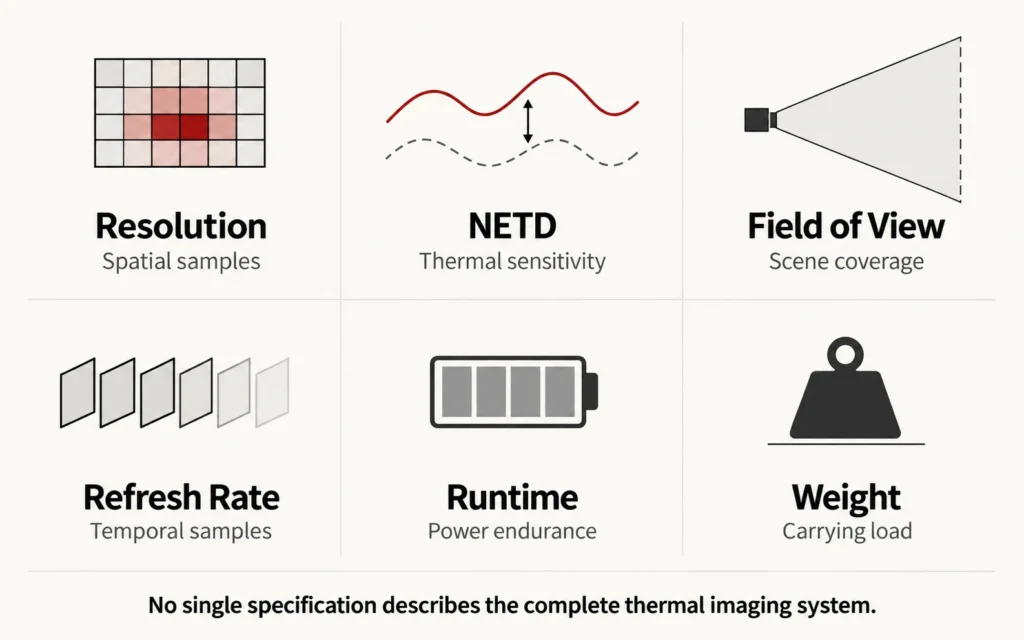
The important point is that no single row replaces the others.
A Practical Order for Comparing Thermal Scopes
When you have several models in front of you, compare them in this order.
- Define normal working distance and subject size.
This determines whether broad scene coverage or finer distant sampling matters more. - Compare native detector resolution.
Ignore display resolution at this stage. - Compare the lens and field of view.
Resolution without viewing geometry is incomplete. - Check pixel pitch and IFOV where available.
Use them to understand angular sampling. - Compare NETD under stated conditions.
Do not assume resolution and sensitivity rise together. - Check base magnification before digital zoom.
Maximum digital zoom should not drive the decision. - Compare sensor frame rate.
Give it more weight when motion is an important part of the use case. - Review DRI figures carefully.
Check target and test assumptions rather than comparing only the largest distance. - Evaluate LRF and workflow functions.
Decide whether they solve a real need rather than adding features you will not use. - Check runtime, batteries, weight and dimensions.
These determine whether the system remains practical over a full period of use. - Confirm environmental ratings.
Use the current specification for the exact model. - Finally compare image processing and secondary features.
These matter, but they should complement—not replace—the underlying detector and optical system.
What Should You Verify Before Buying?
Before making a final decision, confirm that the information you are comparing belongs to the exact current model and configuration.
Check:
- native detector resolution;
- pixel pitch;
- NETD and stated test conditions;
- objective focal length and f-number;
- field of view;
- base magnification;
- sensor frame rate;
- detector versus display resolution;
- DRI target and calculation or test conditions;
- LRF specification if fitted;
- battery configuration and runtime conditions;
- weight and whether batteries are included in that figure;
- dimensions;
- IP rating;
- shock or recoil rating if relevant;
- operating-temperature specification;
- recording, storage and connectivity functions if needed.
Also confirm applicable local regulations for the intended use and market.
If a specification sheet does not make clear whether a number belongs to the detector, display, optics or software output, ask before comparing it with another product.
Choose the System, Not the Biggest Number
A good thermal imaging scope is a balanced system.
Detector resolution supplies spatial samples.
NETD describes thermal sensitivity under specified conditions.
Pixel pitch and focal length influence angular sampling.
Field of view controls scene coverage.
Frame rate controls temporal sampling.
The lens determines how infrared energy reaches the detector.
Processing affects how the detector output is corrected and presented.
And the battery, controls, size and weight determine whether the system works practically in the field.
The best choice is therefore not the scope with the largest number in every column. It is the configuration whose detector, optics, viewing geometry, power system and workflow best match the intended use.
You can compare the current Yubeen thermal imaging range after identifying those priorities, rather than choosing a model from one specification alone.
FAQ
What Is the Most Important Specification When Choosing a Thermal Imaging Scope?
There is no single specification that is most important in every situation. Start with normal observation distance, target size and required field of view, then compare detector resolution, optics, NETD and frame rate in that context.
Is 640 × 512 Always Better Than 384 × 288?
A 640 × 512 detector contains more native detector elements and can provide more spatial samples, but that does not automatically make the complete device better for every application. Field of view, lens design, NETD, magnification, weight and other characteristics still matter.
Is Lower NETD Always Better?
Under comparable measurement conditions, lower NETD generally indicates greater thermal sensitivity. However, NETD does not describe detector resolution, field of view or optical quality, so it should not be used as the only measure of overall image performance.
Should I Choose the Longest Detection Range?
Not automatically. Detection is only one DRI task, and the quoted result depends on target size, optics, atmosphere, sensitivity, processing and the model or test conditions used. A large detection figure is not the same as recognition or identification distance.
Does Higher Digital Zoom Mean a Better Thermal Scope?
No. Digital zoom enlarges existing detector data and does not increase the detector’s native pixel count. Consider native detector resolution, base magnification and field of view before comparing maximum digital zoom.
Do I Need an Integrated LRF?
It depends on whether direct distance measurement improves your workflow. An integrated LRF can be convenient, but it is separate from thermal image quality and does not by itself prove the presence of ballistic or other software functions.