Thermal scope detection range describes only the distance at which a target may become detectable; recognition and identification require progressively more spatial information.
This is why a single statement such as “detection range: 1,800 m” cannot answer the broader question of how far a thermal imaging scope can actually provide useful information.
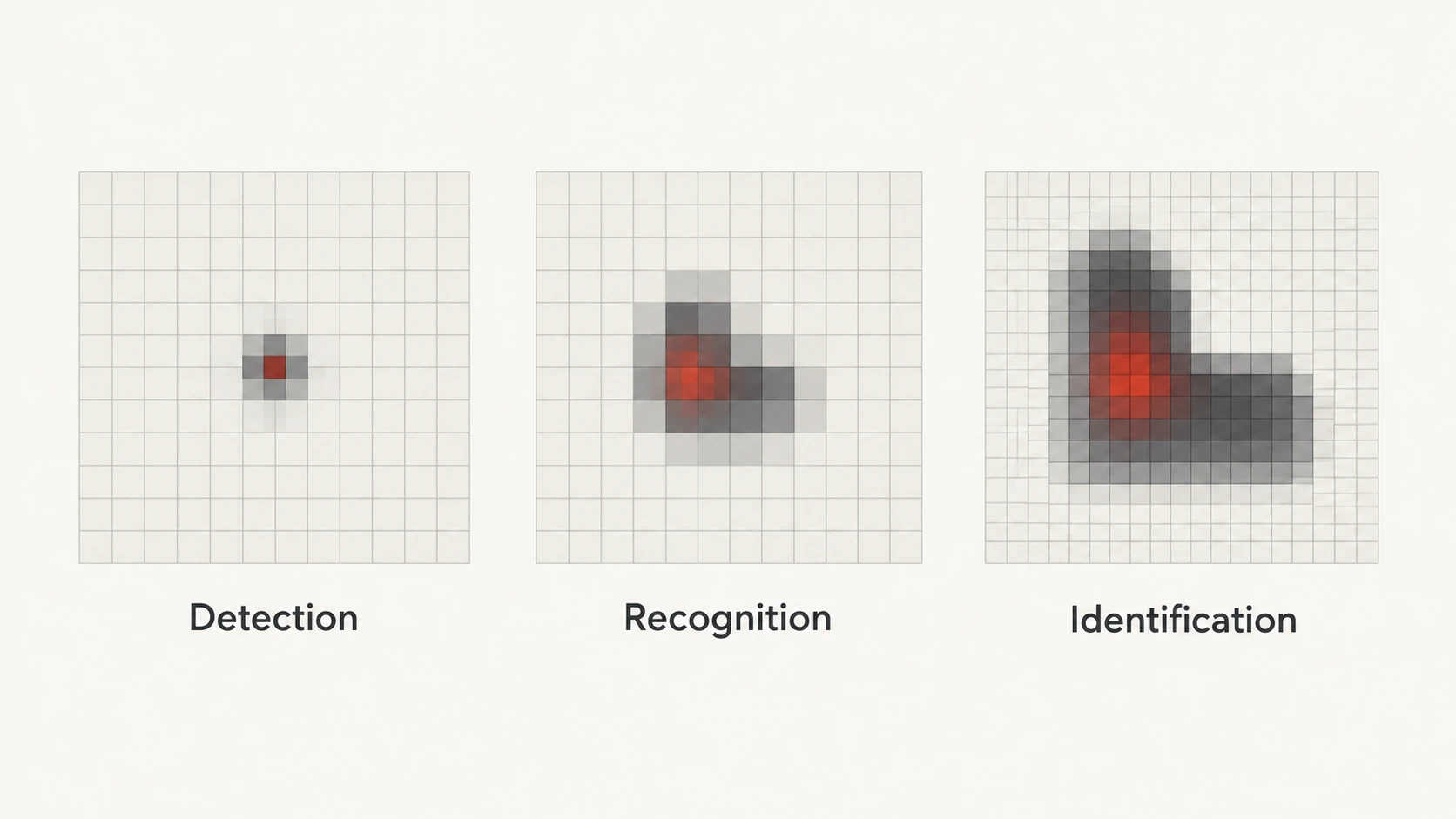
Thermal imaging performance at distance is normally discussed in terms of three different tasks: detection, recognition, and identification, often abbreviated as DRI. Each requires a different amount of useful target information.
The distance at which those tasks can be completed depends not only on the detector, but also on the target, optics, field of view, thermal contrast, atmosphere, image processing, and the criteria used to define success.
If you are comparing complete products rather than DRI alone, start with our guide on how to choose a thermal imaging scope.
What Does “See” Mean in Thermal Imaging?
The word “see” is too broad to describe useful thermal range accurately.
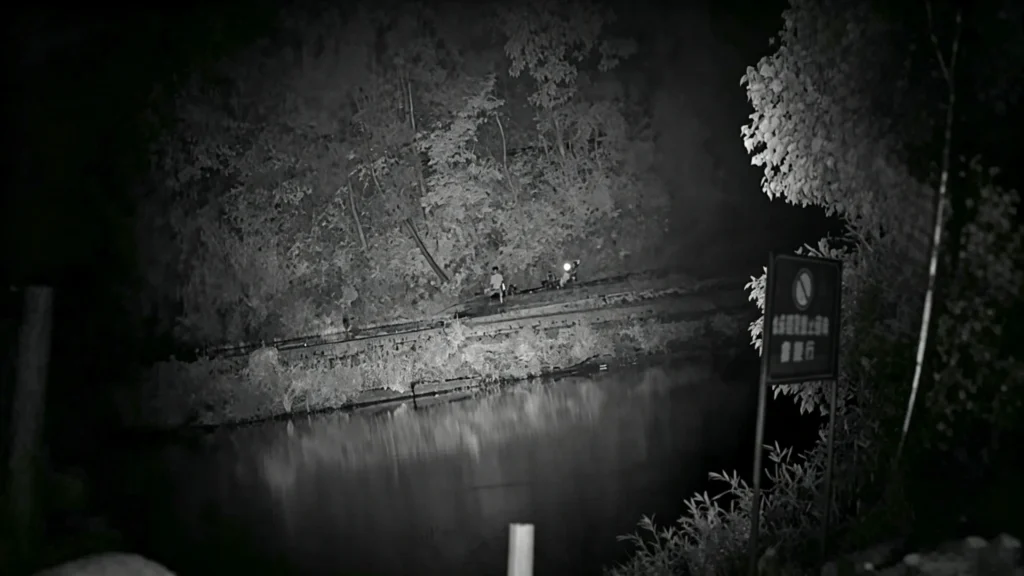
At long distance, a target may occupy only a very small number of detector samples. That may be sufficient to reveal the presence of a thermal anomaly, while providing too little structural information for reliable classification.
As the target occupies more useful image samples, more information about shape and structure becomes available.
This leads to the three DRI tasks.
Detection: Is Something There?
Detection is the least demanding of the three tasks.
The goal is to determine that a relevant object or thermal signature is present in the scene.
At this stage, the image may provide very little information about exactly what the object is.
A detectable thermal signature should therefore not be treated as a recognizable or identifiable target.
Recognition: What General Type of Object Is It?
Recognition requires more useful spatial information.
The observer or algorithm must be able to classify the object into a meaningful category based on characteristics such as overall size, shape, movement, or thermal structure.
For example, recognition might distinguish one broad object class from another without providing enough detail to determine a specific identity.
Identification: Is There Enough Detail for the Required Decision?
Identification is the most demanding DRI task.
The image must contain enough usable information to distinguish the specific object or characteristics required by the application.
What counts as “identified” depends on the task.
Identification is therefore not a universal visual threshold. A requirement to distinguish between two broad categories is different from a requirement to distinguish between visually similar objects.
Modern DRI modeling reflects this by associating different task difficulties with different probabilities of successful discrimination rather than treating identification as one fixed distance.
Detection, Recognition, and Identification Are Different Range Claims
The three terms should never be used interchangeably.
| DRI task | Main question | Amount of useful target information |
|---|---|---|
| Detection | Is a relevant object present? | Lowest |
| Recognition | What general type or class is it? | More |
| Identification | Is there enough detail for the required distinction? | Highest |
A manufacturer may therefore quote a detection distance that is much longer than its recognition or identification distance for the same target and optical configuration.
That is not contradictory.
It simply reflects the increasing amount of information required as the task becomes more demanding.
This is why a headline maximum detection range should not be read as the distance at which the target can be confidently identified.
Why There Is No Universal Thermal Detection Distance
A thermal imaging system does not have one absolute “maximum distance” that applies to every object.
Consider two targets at the same range.
One may be large and thermally distinct from its background. The other may be much smaller or have very little temperature contrast with its surroundings.
The first can occupy more useful detector samples and produce a stronger thermal signal even though both are at exactly the same distance.
Practical DRI range therefore depends on the combination of:
- target size;
- target critical dimension;
- target-to-background thermal contrast;
- atmospheric transmission;
- detector resolution;
- pixel pitch;
- lens focal length;
- field of view;
- optical quality;
- thermal sensitivity;
- focus;
- image processing;
- display conditions;
- observer or algorithm performance.
Teledyne FLIR similarly notes that DRI results vary with environment, camera sensitivity, system setup and operator performance, and are normally associated with a probability of accomplishing the specified task rather than a guaranteed range.
Pixels on Target: The Geometric Basis of DRI
One of the most important concepts behind DRI is pixels on target.
A distant target projects an angular size through the lens onto the detector.
If the target occupies very few detector samples, only limited spatial information is available.
As more detector samples span the target’s relevant dimension, progressively more shape information can potentially be resolved.
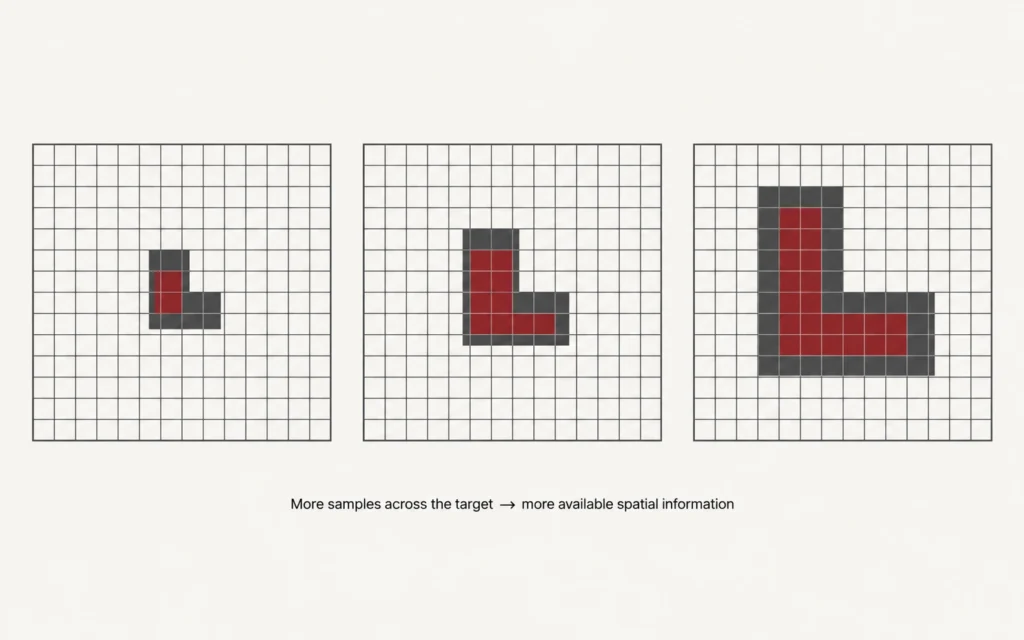
This is why higher detector resolution can improve DRI capability when the optical configuration and other conditions are comparable: more detector samples may be available across the target.
But detector resolution alone is not enough.
A 640 × 512 detector behind a very wide field of view can distribute those pixels over a large scene, while the same detector behind a narrower field of view can place more of those samples across a distant object.
For more detail on how detector arrays create thermal images, see our guide to thermal imaging FPA and detector resolution.
Target Critical Dimension Matters
DRI calculations require a definition of the target dimension that is relevant to the task.
This is often called the critical dimension.
It might represent a target’s width, height, or another characteristic dimension depending on the model and the task being evaluated.
This matters because “a person,” “an animal,” “a vehicle,” or another object class does not have one universal size.
Changing the assumed target dimensions changes the estimated range.
Therefore a DRI figure without a stated target or target dimension is incomplete.
When comparing two products, make sure they are not using different target assumptions to produce apparently comparable range numbers.
IFOV Connects Pixel Pitch, Lens, and Distance
Instantaneous Field of View, or IFOV, describes the angular portion of the scene represented by an individual detector pixel.
In simplified geometry:
IFOV ≈ pixel pitch ÷ focal length
Smaller IFOV means one detector element represents a smaller angular portion of the scene.
The approximate number of detector samples across a target can then be understood from the relationship between:
- target angular size;
- detector IFOV;
- target distance.
In simplified small-angle geometry:
target angular size ≈ target critical dimension ÷ distance
and therefore:
pixels across target ≈ target angular size ÷ IFOV
These relationships explain why pixel pitch, focal length and target size all influence spatial sampling.
They are useful for understanding the geometry, but real DRI models also account for factors such as optics, modulation transfer, noise, atmosphere, processing, and task probability.
For the detailed relationship between pitch, focal length and IFOV, see 12μm pixel pitch in thermal imaging.
Detector Resolution Changes the Number of Available Samples
Higher detector resolution means more detector elements are available across the total image.
For example:
- 384 × 288 = 110,592 detector elements
- 640 × 512 = 327,680 detector elements
If field of view and other system conditions are comparable, the higher-resolution detector can provide more samples across objects in the scene.
This can help preserve structural information as distance increases.
However, that does not mean a 640 × 512 device will always outperform every 384 × 288 device at every range.
Different focal lengths, fields of view, pixel pitches, optical quality, sensitivity and processing can produce very different system-level results.
Detector resolution must therefore be evaluated together with the optical system.
Lens Focal Length and Field of View Change Target Sampling
The lens strongly affects how much of the scene is projected across the detector.
A wider field of view shows more surrounding area.
That can be useful for scanning and situational awareness, but the available detector samples are distributed across a larger angular scene.
A narrower field of view shows less of the surrounding scene and makes a distant target occupy a larger portion of the detector image.
This can improve spatial sampling of a distant object.
The trade-off is that narrower field of view makes broad-area scanning more difficult.
This is why long-range thermal imaging should not be evaluated from focal length alone.
The relevant combination is:
detector resolution + detector dimensions + pixel pitch + focal length + field of view
For a practical explanation of this trade-off, see our guide to thermal scope magnification.
NETD Can Matter When Thermal Contrast Is Low
Spatial sampling is only part of the problem.
The detector also needs sufficient signal relative to noise to preserve useful temperature differences within the scene.
NETD, or Noise Equivalent Temperature Difference, is commonly used to describe thermal sensitivity under specified conditions.
Lower NETD generally indicates that smaller thermal differences can be distinguished when measurement conditions are comparable.
This can matter when the target and background have similar temperatures.
But NETD does not directly specify DRI range.
A device with strong thermal sensitivity can still have insufficient spatial sampling for a demanding identification task, while a high-resolution detector can still struggle when thermal contrast is weak.
Useful range depends on both spatial and thermal information.
Atmospheric Conditions Can Reduce Practical Range
Infrared radiation must travel through the atmosphere before it reaches the detector.
Humidity, fog, rain, snow and atmospheric path length can influence how much useful infrared information reaches the imaging system.
Background clutter and changing environmental temperatures can also reduce target contrast.
FLIR specifically identifies humidity, temperature, solar loading, precipitation, background clutter, camera sensitivity, system setup and operator experience among the variables that can influence practical DRI performance.
This means that a modeled or measured range under favorable conditions should not be treated as a guaranteed result in every environment.
Thermal imaging can remain useful when visible illumination is poor, but it does not “see through” atmosphere or physical obstructions without loss.
Thermal Contrast Changes With the Scene
A target does not generate the same level of thermal contrast against every background.
Its apparent separation can change with:
- ambient temperature;
- solar heating;
- shade;
- surface materials;
- wind;
- precipitation;
- time of day;
- target activity.
A large temperature difference can make detection relatively easy even when little structural detail is available.
A low temperature difference can make the same target harder to distinguish from the background.
This is another reason that DRI cannot be reduced to detector resolution or focal length alone.
Digital Zoom Does Not Increase Native DRI Information
Digital zoom enlarges detector data that has already been captured.
It does not increase the number of physical detector samples across the target.
For example, if a distant object occupies a small number of detector pixels, applying 4× digital zoom enlarges those samples on the display but does not turn them into four times as many native measurements.
FLIR makes the same distinction in thermal imaging: zoom can enlarge displayed pixels without increasing the underlying spatial measurement capability.
Image interpolation or AI-based super-resolution may improve presentation or reconstruction, but those functions should still be separated from native detector sampling.
Base Magnification Does Not Tell the Whole Range Story
Base magnification is useful because it describes the starting viewing scale of the system.
However, two thermal scopes with the same quoted base magnification can still have different:
- detector resolutions;
- pixel pitches;
- fields of view;
- lens designs;
- NETD;
- image processing.
Similarly, a system with higher quoted magnification is not automatically capable of better identification at distance.
Always compare magnification with detector geometry and field of view rather than as an isolated range specification.
Johnson-Style DRI Models Are Estimates, Not Guarantees
Johnson-style criteria and later target-task-performance models are widely used to estimate the probability that an imaging system can support detection, recognition or identification of a defined target.
They are useful engineering tools because they connect target size and task difficulty with the spatial information delivered by the imaging system.
But a modeled DRI result is not a promise that every observer will accomplish the same task at exactly that distance.
Modern modeling can include factors such as:
- target critical dimension;
- target contrast;
- optics;
- sensor modulation transfer;
- signal-to-noise performance;
- atmosphere;
- display;
- observer or algorithm performance;
- task difficulty;
- required probability of success.
For example, FLIR describes DRI predictions using task-performance metrics associated with a specified probability, while emphasizing that operational performance should be validated for the real mission and conditions.
For that reason, this article does not reduce detection, recognition and identification to one universal set of fixed pixel thresholds.
How to Read a Manufacturer’s DRI Specification
Before comparing two quoted range figures, check how each one was produced.
- Identify the task.
Is the number for detection, recognition, or identification? - Identify the target.
What target type and physical dimensions were assumed? - Check the critical dimension.
Which width, height, or feature was used in the calculation? - Check the optics.
Which focal length and field of view apply to the quoted result? - Check the detector configuration.
Resolution and pixel pitch influence spatial sampling. - Check the probability criterion.
Is the number associated with a modeled probability of completing the task? - Check environmental assumptions.
Atmosphere and thermal contrast affect practical range. - Check whether the value is modeled or field-tested.
The two should not automatically be treated as equivalent. - Check processing assumptions.
Determine whether the result includes specific enhancement or processing modes. - Compare like with like.
A detection figure for one target should not be compared directly with an identification figure for another.
If these assumptions are not available, treat the quoted range as a broad reference rather than a universal performance guarantee.
What Matters Most for Long-Range Thermal Observation?
If useful information at distance is the priority, evaluate the complete system.
Start with:
- native detector resolution;
- pixel pitch;
- focal length;
- field of view;
- IFOV where available;
- NETD;
- optical quality;
- focus;
- image-processing behavior.
Then consider the actual target and environment.
A device intended mainly for broad-area scanning may reasonably prioritize field of view.
A device intended for more distant observation may prioritize finer angular sampling.
Neither configuration is universally superior.
For a broader system-level comparison, see what defines a high-end thermal scope.
Detection Range and LRF Range Are Different Specifications
A thermal detection-range figure and a laser rangefinder specification describe two different systems.
Thermal detection refers to the imaging system’s ability to reveal a relevant thermal target.
An LRF measures distance using its own ranging process.
The fact that a thermal image can detect an object does not guarantee that an integrated LRF can obtain a valid range from that same object at the same distance.
Likewise, the presence of an LRF does not improve the native detector resolution or NETD.
If a product includes an LRF, evaluate its current ranging specification separately from its thermal DRI performance.
Do not assume that an LRF also means the device includes ballistic calculation or automatic aiming correction. Those functions must be confirmed independently for the exact product.
A Useful Range Is the Range at Which the Required Task Can Be Completed
The most useful question is not:
“How far can this thermal scope see?”
It is:
“At what distance can this system provide enough information for the task I actually need?”
For simple detection, the required information may be limited.
Recognition requires more.
Identification requires still more.
And every quoted distance depends on the target and the conditions used to define it.
That is why a thermal imaging system should be selected from its detector, optics, sensitivity, field of view and intended application—not from the largest range number in a specification table.
Once those requirements are clear, you can compare the current Yubeen thermal imaging range using the specifications of the exact current models.
FAQ
Is Thermal Detection Range the Same as Identification Range?
No. Detection only requires enough information to determine that a relevant target is present. Identification requires substantially more usable spatial information for the specific distinction being made.
Does a Higher-Resolution Detector Increase DRI Range?
It can improve spatial sampling when optics, field of view and other conditions are comparable, which may improve DRI performance. It does not by itself guarantee a specific range because optics, contrast, atmosphere, sensitivity and processing also matter.
Can Digital Zoom Increase Detection or Identification Range?
Digital zoom enlarges the detector data already captured and does not create additional native detector samples. It may make the displayed image easier to inspect, but maximum digital zoom should not be treated as a direct increase in native DRI capability.
Does Lower NETD Mean a Longer Detection Range?
Not automatically. Lower NETD generally indicates better thermal sensitivity under comparable conditions, which can help when thermal contrast is low. DRI range also depends on spatial sampling, optics, target size, atmosphere and other factors.
Can Thermal Imaging See Through Fog or Vegetation?
Not in the literal sense. Atmospheric moisture and physical obstruction can reduce the infrared information reaching the detector. Thermal imaging may remain useful under some difficult visibility conditions, but performance is not unaffected by fog, rain, humidity or dense vegetation.
Is an LRF Range the Same as Thermal Detection Range?
No. The LRF and thermal imaging system perform different tasks. Their maximum useful ranges should be checked independently for the exact product.