What can thermal imaging see that the human eye cannot? The answer begins with the fact that thermal imaging and human vision detect different parts of the electromagnetic spectrum.
The human eye depends on visible light reaching the retina. When visible illumination becomes very weak, much of the information we normally use to distinguish shape, color, texture, and background disappears.
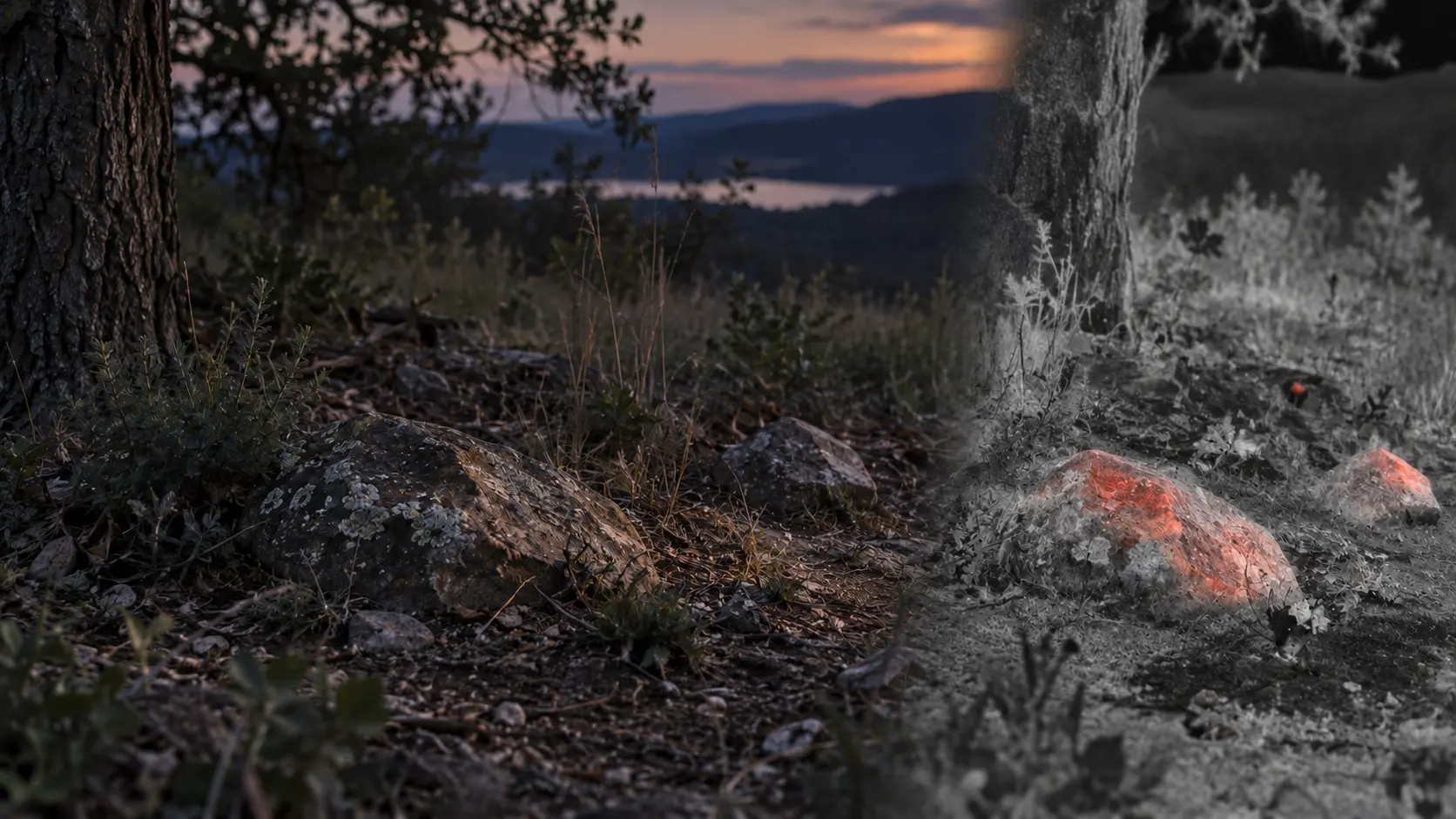
Thermal imaging works from a different part of the electromagnetic spectrum. A thermal detector responds to infrared radiation reaching the sensor and converts differences in that signal into an image that can be displayed to the user.
That allows a thermal imaging scope to reveal thermal contrast that the unaided human eye cannot perceive.
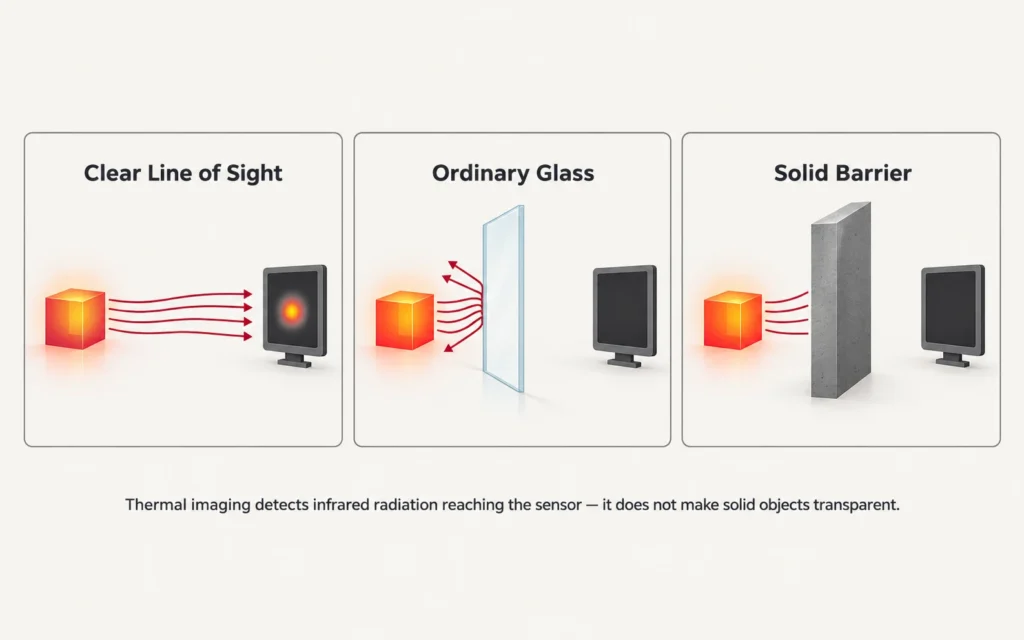
But this capability has clear limits. Thermal imaging is not X-ray vision. It does not automatically see through walls, ordinary glass, dense vegetation, or other solid barriers, and a detectable heat signature is not automatically an identifiable target.
If you are new to the underlying technology, start with our thermal imaging for beginners guide.
Why Thermal Imaging Reveals Information the Human Eye Cannot See
The human eye is optimized for visible light.
A thermal detector is designed to respond to infrared radiation instead.
Objects in ordinary environments emit infrared energy according to their temperature and surface properties. Thermal imaging converts variations in that radiation into a visible representation such as grayscale or a selected color palette.
This means the user is not literally “seeing heat” with the eye.
The imaging system is translating infrared differences into a display that human vision can interpret.
That distinction matters because thermal appearance depends on more than temperature alone.
Surface emissivity, reflections, atmosphere, optics, detector sensitivity, processing, and viewing geometry all influence the resulting image.
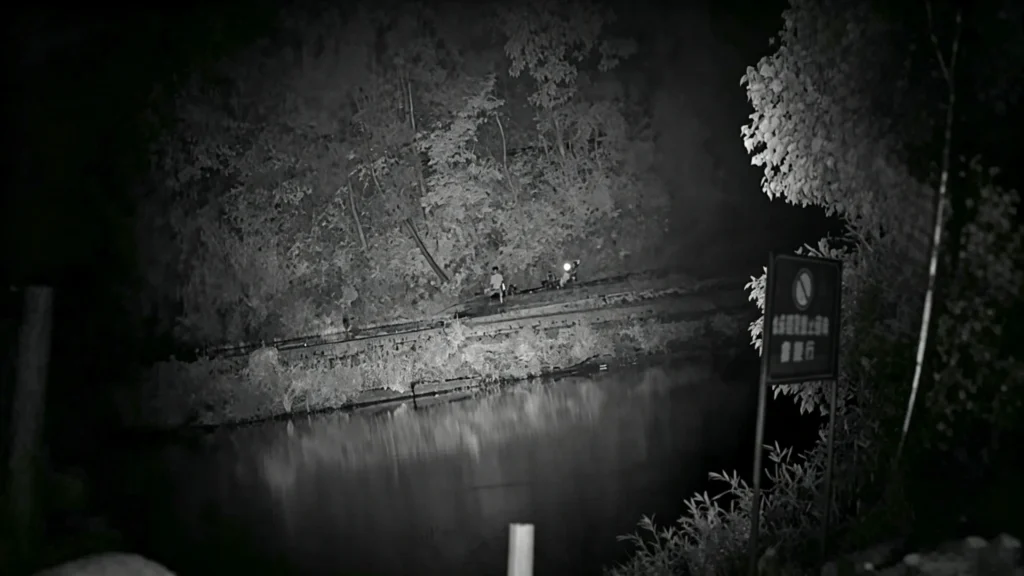
Thermal Imaging Can Work in Complete Darkness
One of the clearest differences between thermal imaging and normal human vision is that thermal imaging does not require visible illumination to form an image.
A scene does not need:
- sunlight;
- moonlight;
- visible artificial lighting;
- a flashlight.
If sufficient infrared contrast reaches the detector, a thermal image can be produced even when the scene appears completely dark to the human eye.
This makes thermal imaging fundamentally different from ordinary visible-light optics and digital night vision systems that depend on reflected light.
Darkness itself, however, does not guarantee a strong thermal image.
If the target and background have similar thermal signals, contrast can still be weak.
Thermal Contrast Can Reveal an Object That Blends Into the Visible Background
An object can be difficult to notice in visible light because its color, texture, or pattern resembles the background.
Thermal imaging does not evaluate that visible camouflage in the same way.
If the object’s infrared signal differs sufficiently from the surrounding scene, the thermal detector may reveal a contrast boundary even when the object is visually difficult to distinguish.
This is why thermal imaging can sometimes make a subject stand out against:
- vegetation;
- soil;
- rocks;
- structures;
- dark backgrounds.
But this does not mean thermal imaging defeats every form of concealment.
If the target is physically blocked by dense vegetation, a wall, tree trunk, rock, or another opaque object, the detector cannot simply recover the hidden image behind it.
Thermal contrast and physical line of sight are different issues.
Thermal Imaging Can Reveal Small Surface-Temperature Differences
Two surfaces can look nearly identical to the human eye while having different infrared characteristics.
Thermal imaging may display those differences as different brightness levels or palette values.
Depending on the scene, this can reveal:
- warmer and cooler surface regions;
- differences caused by sunlight and shade;
- recently heated or cooling surfaces;
- equipment or structures with different thermal states;
- warm subjects against cooler surroundings.
The important word is surface.
Thermal imaging normally receives infrared radiation from the first relevant surface within its line of sight.
It does not automatically reveal the internal structure of an object.
A Thermal Image Is Not a Direct Temperature Map
Brightness or color in a thermal display should not automatically be interpreted as exact temperature.
Surface emissivity and reflected infrared radiation influence thermal appearance.
Highly reflective, low-emissivity surfaces can show infrared energy reflected from their surroundings rather than simply representing their own surface temperature. FLIR specifically notes that polished metals can behave strongly reflectively in thermal imaging.
For a thermal imaging scope, the practical lesson is:
bright does not always mean “hotter,” and dark does not always mean “colder.”
Unless a device is specifically designed and specified for radiometric temperature measurement, do not treat its display as a precision thermometer.
What Detection Actually Means
At long distance, a thermal imager may reveal that a thermal anomaly is present without providing enough information to determine exactly what it is.
That is detection.
The target might appear as only a small thermal signature.
Detection answers:
Is something relevant present?
It does not necessarily answer:
What exactly is it?
This is one of the most important distinctions in thermal observation.
Recognition Requires More Spatial Information
As more usable detector samples span the target, shape and movement can become easier to interpret.
Recognition means enough information is available to classify the object at a broader level.
The exact requirement depends on the task.
A general silhouette, dimensions, movement pattern, and thermal structure may all contribute.
But thermal contrast alone does not guarantee recognition.
Detector resolution, lens focal length, field of view, focus, atmosphere, target size, and distance still matter.
Identification Requires More Information Again
Identification is more demanding than detection or broad recognition.
The thermal image must contain enough reliable information for the distinction required by the task.
That may involve:
- overall body shape;
- characteristic features;
- dimensions;
- movement;
- spatial detail.
The relevant threshold depends on what the user is trying to distinguish.
This is why one headline “detection range” should never be interpreted as an identification range.
For a full explanation, see our guide to thermal detection, recognition, and identification.
Thermal Imaging Cannot See Through Solid Walls
Thermal imaging is frequently misunderstood as a form of see-through imaging.
It is not.
A conventional thermal imager normally receives infrared radiation from the surface facing the detector.
A wall can sometimes display a thermal pattern caused by conditions behind it—for example, heating, insulation differences, moisture, or another source that changes the wall’s surface temperature.
But that is different from seeing the hidden object itself.
FLIR makes the same distinction: thermal cameras do not see through walls; they can sometimes detect surface-temperature patterns influenced by conditions behind them.
Ordinary Glass Is Also a Major Limitation
A visible-light camera can normally look through a clear window.
A long-wave thermal imaging system behaves differently.
Ordinary glass does not act as a transparent thermal window in the way it does for visible light.
Instead, the thermal imager may primarily show:
- the glass surface;
- reflected infrared energy;
- nearby thermal reflections.
This is why thermal observation through a closed vehicle or building window can produce a very different image from visible observation.
FLIR demonstrates this effect by showing that ordinary glass can behave almost like a reflective surface to a thermal camera.
Purpose-designed infrared optical materials are therefore used in thermal imaging systems rather than ordinary window glass.
Dense Vegetation Still Blocks Information
Sparse branches and leaves can sometimes leave gaps through which part of a thermal target remains visible.
That should not be described as “seeing through vegetation.”
The detector is receiving infrared information through the available gaps.
As vegetation becomes denser, progressively more of the target is physically obscured.
A thick tree trunk, dense foliage, earth, rock, or another solid barrier can completely hide the direct thermal signature behind it.
The technically accurate statement is:
thermal contrast can sometimes remain visible through gaps in sparse cover.
Not:
thermal imaging sees through brush or trees.
Fog, Rain, and Humidity Can Reduce What the Detector Receives
The atmosphere is also part of the imaging path.
Humidity, fog, rain, and distance can attenuate the infrared signal traveling from the target toward the detector.
Thermal imaging may outperform visible imaging in some light-fog or poor-visibility conditions, but that does not make atmospheric attenuation disappear.
FLIR notes that fog and rain can reduce thermal imaging range because water droplets scatter and absorb part of the infrared signal, with denser conditions producing greater losses.
For the full environmental explanation, see how weather affects thermal imaging.
Daylight Does Not Prevent Thermal Imaging
Thermal imaging does not require darkness.
The same detector can continue receiving infrared radiation during daylight.
But sunlight changes the thermal scene.
Ground, vegetation, buildings, rocks, and other materials heat at different rates, which can change target-to-background contrast over the course of the day.
Therefore:
thermal imaging can operate during daylight,
but:
thermal contrast does not necessarily remain identical from day to night.
For a detailed explanation, see how thermal imaging works in daylight.
NETD Affects Weak Thermal Contrast
When a target and background have a strong thermal difference, separating them is relatively easy.
When their thermal signals move closer together, system noise becomes more significant.
NETD describes thermal sensitivity relative to that noise under stated test conditions.
Lower NETD can help preserve smaller thermal differences when conditions are comparable.
But NETD does not create spatial detail and does not make physical barriers transparent.
For the complete explanation, see NETD in thermal imaging.
Detector Resolution Determines How Much Spatial Information Is Available
Thermal sensitivity and spatial resolution are different characteristics.
Detector resolution tells you how many native thermal detector samples are available across the scene.
More native detector samples can provide more spatial information under comparable optical conditions.
But additional pixels do not automatically solve:
- weak thermal contrast;
- poor focus;
- atmospheric attenuation;
- physical obstruction;
- unsuitable field of view.
A thermal imaging system therefore should never be judged from resolution alone.
Lens and Field of View Change What the Detector Samples
The thermal lens determines how the scene is projected onto the detector.
A wider field of view covers more surrounding area.
A narrower field of view places more of the available detector sampling across a smaller angular scene.
This changes how much spatial information can be available across a distant target.
The meaningful comparison is therefore not:
detector resolution alone
but:
detector + pixel pitch + lens + field of view + focus + sensitivity + processing.
Digital Zoom Does Not Reveal New Native Detail
Digital zoom enlarges data that the detector has already captured.
It does not create additional physical detector samples.
If a distant target occupies only a small number of native pixels, enlarging those pixels may make the image easier to inspect, but it does not recover information that the detector never recorded.
Processing techniques can improve presentation.
They still need to be separated from native detector resolution.
What Thermal Imaging Reveals Depends on the Complete Scene
The amount of useful information available in a thermal image depends on several factors working together:
| Factor | What it affects |
|---|---|
| Target-to-background contrast | How strongly the target separates thermally |
| Detector resolution | Available native spatial samples |
| NETD | Sensitivity to small thermal differences |
| Lens / FOV | Angular sampling and scene coverage |
| Focus | Spatial detail reaching the detector |
| Distance | Target size within the detector image |
| Atmosphere | Infrared transmission |
| Surface emissivity | How surfaces emit and reflect infrared energy |
| Processing | How detector data are presented |
This is why the question:
“What can thermal imaging see?”
does not have one universal distance or one universal level of detail.
A Real Thermal Product Applies These Principles as a System
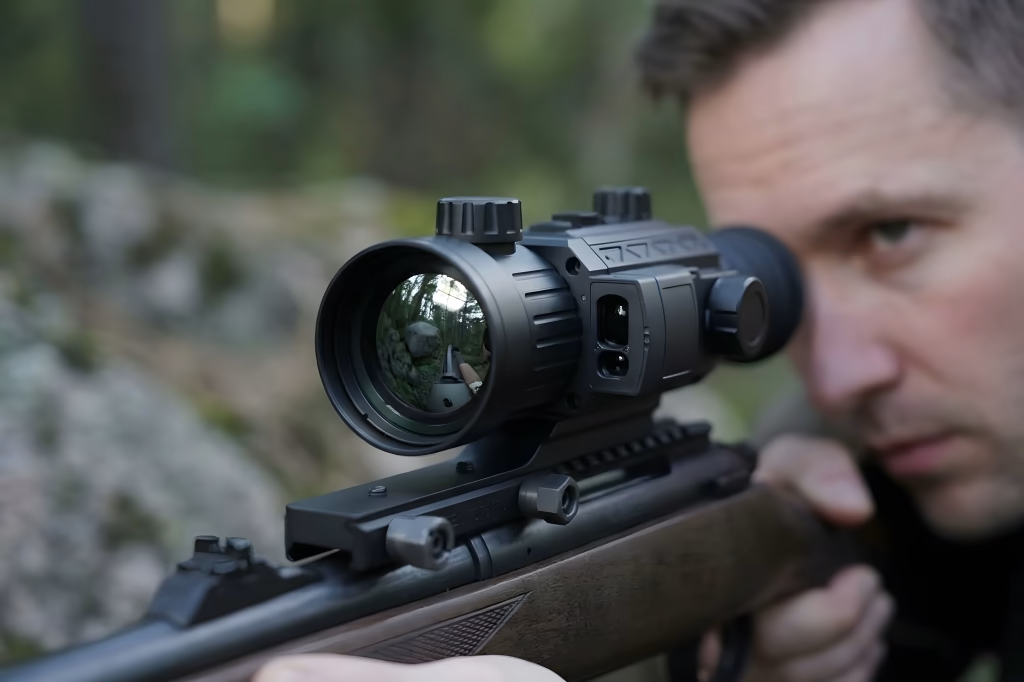
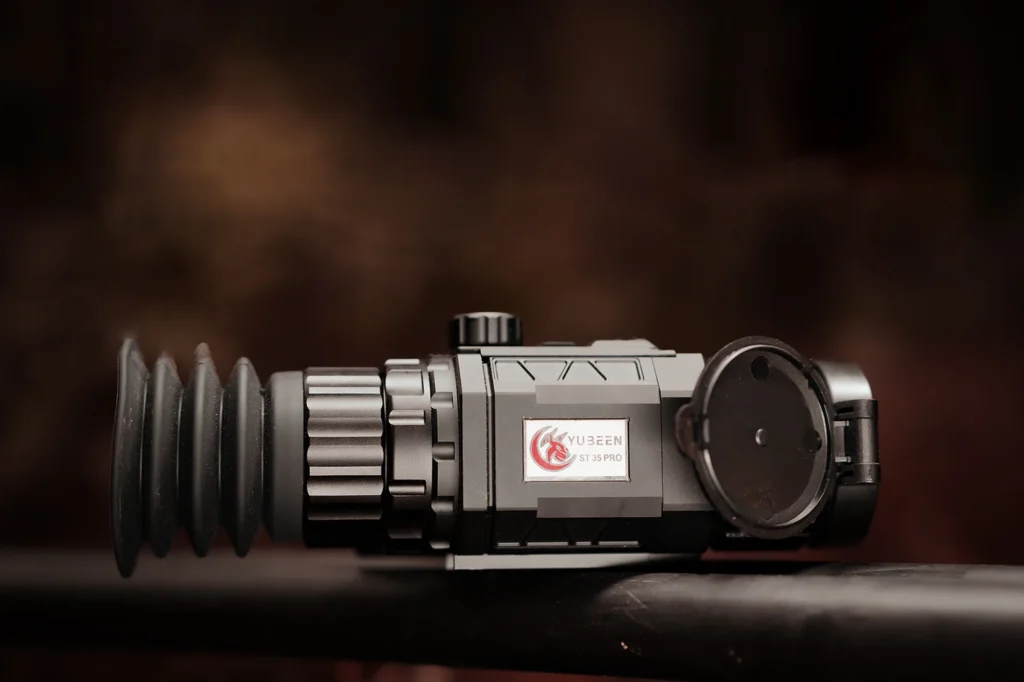
A real thermal imaging scope combines detector, optics, processing, display, controls, power, and mechanical hardware.
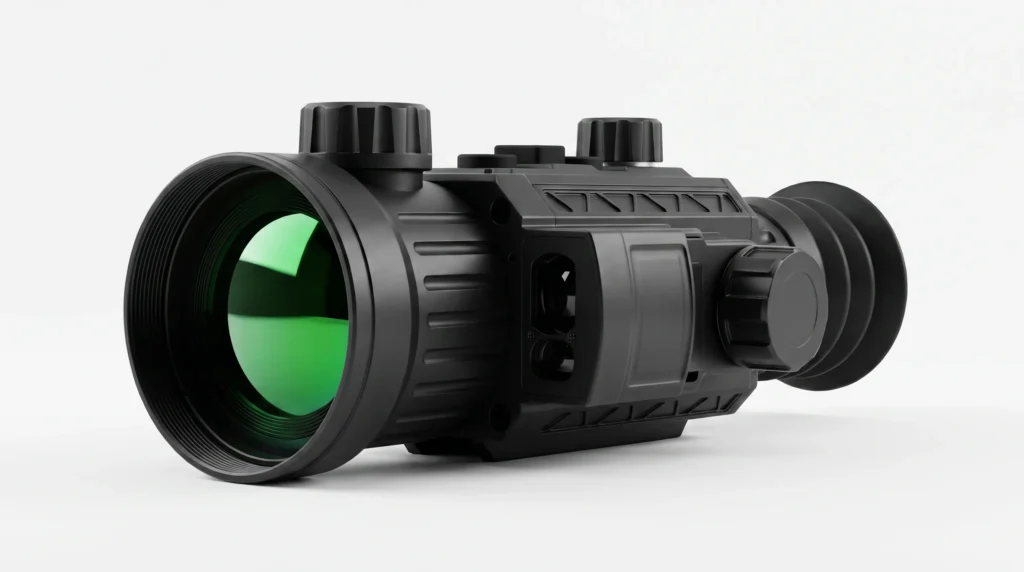
As an example, the upcoming YUBEEN GX55L brings thermal detection, optics, image processing, and display technology together in a complete imaging system.
Its published specifications describe the hardware, but real-world detection, recognition, and identification depend on target size, thermal contrast, distance, focus, and environmental conditions rather than any single specification.
Explore the YUBEEN GX55L thermal imaging riflescope for more information about the model and its technical specifications.
What Thermal Imaging Can—and Cannot—Reveal
A useful summary is:
Thermal imaging can:
- reveal infrared contrast invisible to the human eye;
- operate without visible illumination;
- make thermally distinct objects easier to distinguish from some backgrounds;
- reveal surface-temperature patterns that visible imagery does not show;
- support detection and, when enough information is available, recognition or identification.
Thermal imaging cannot:
- see through solid walls;
- see directly through ordinary glass like a visible camera;
- make dense physical cover transparent;
- guarantee target identity from a weak heat signature;
- create native spatial detail through digital zoom;
- eliminate atmospheric attenuation;
- guarantee the same image quality under every environmental condition.
Understanding both sides of that distinction is more useful than treating thermal imaging as “superhuman vision.”
FAQ
Can Thermal Imaging Work in Complete Darkness?
Yes. Thermal imaging does not require visible illumination. It forms an image from infrared differences reaching the detector.
Can Thermal Imaging See Through Walls?
No. A thermal imager normally detects the surface facing it. It may reveal a surface-temperature pattern influenced by something behind the wall, but it does not directly image the hidden object through the wall.
Can a Thermal Scope See Through Glass?
Ordinary glass is generally not transparent to the long-wave infrared energy used by common thermal imaging systems. The image may instead show the glass surface and thermal reflections.
Can Thermal Imaging See Through Vegetation?
Not literally. A thermal target may remain partially visible through gaps in sparse vegetation, but dense leaves, branches, trunks, and other solid cover can block the direct thermal signal.
Does a Bright Thermal Signature Mean the Object Is Definitely Hotter?
Not necessarily. Thermal appearance also depends on emissivity, reflection, palette settings, gain, and other factors. Reflective surfaces can display infrared energy from their surroundings.
Does Thermal Imaging Always Work Better at Night?
No. Thermal imaging can work during both day and night. Practical image quality depends on target-to-background thermal contrast, atmosphere, detector sensitivity, optics, and other conditions.