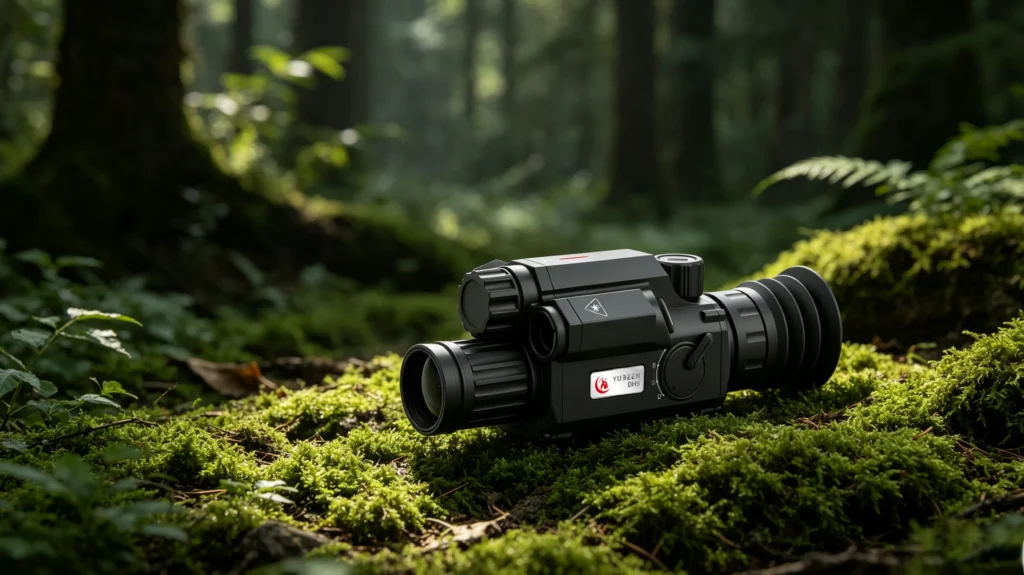
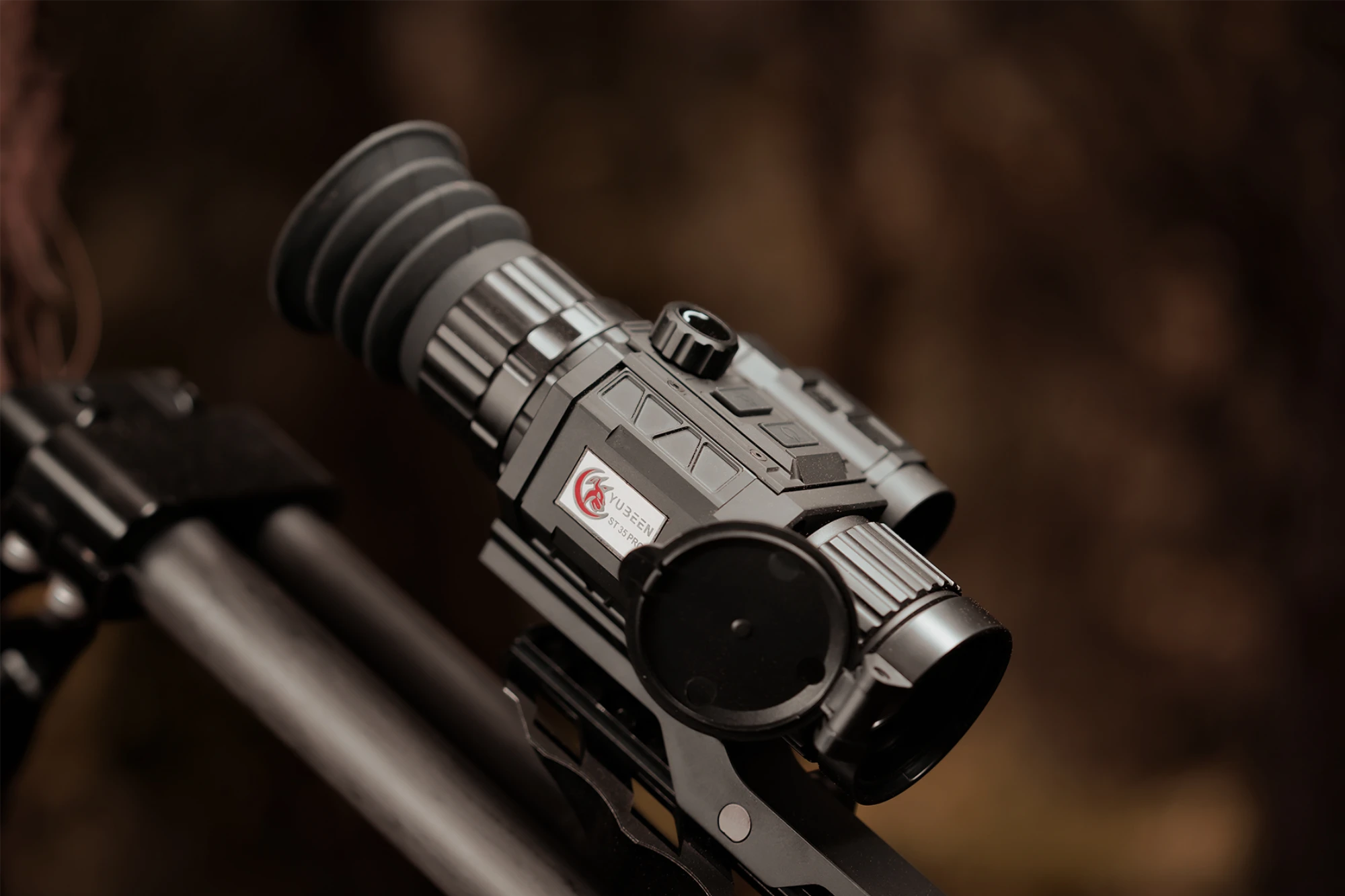
Smart ballistics in thermal optics refers to software-assisted functions that can combine information from the thermal device, a laser rangefinder, internal sensors, and configured system data. Depending on the exact product, the software may present additional information inside the display to support the user’s decision-making.
The important distinction is that ballistic software does not improve thermal detector resolution, NETD, lens quality, or native image detail. It also does not guarantee where a projectile will land. Its value depends on the accuracy of the available data, the supported software functions, the hardware integration, and correct setup of the complete system.
What Does “Smart Ballistics” Actually Mean?
The term can describe several different functions, so it should never be treated as one universal feature.
Depending on the product, ballistic-related software may combine information from:
- an integrated laser rangefinder;
- internal orientation sensors;
- stored equipment profiles;
- configured system data;
- software calculations;
- the thermal display interface.
The result may then be presented as additional information inside the device.
The exact implementation differs between products.
For this reason, buyers should ask what the software actually calculates and displays, rather than relying on the phrase “smart ballistics” alone.
Rangefinding and Ballistic Software Are Different Functions
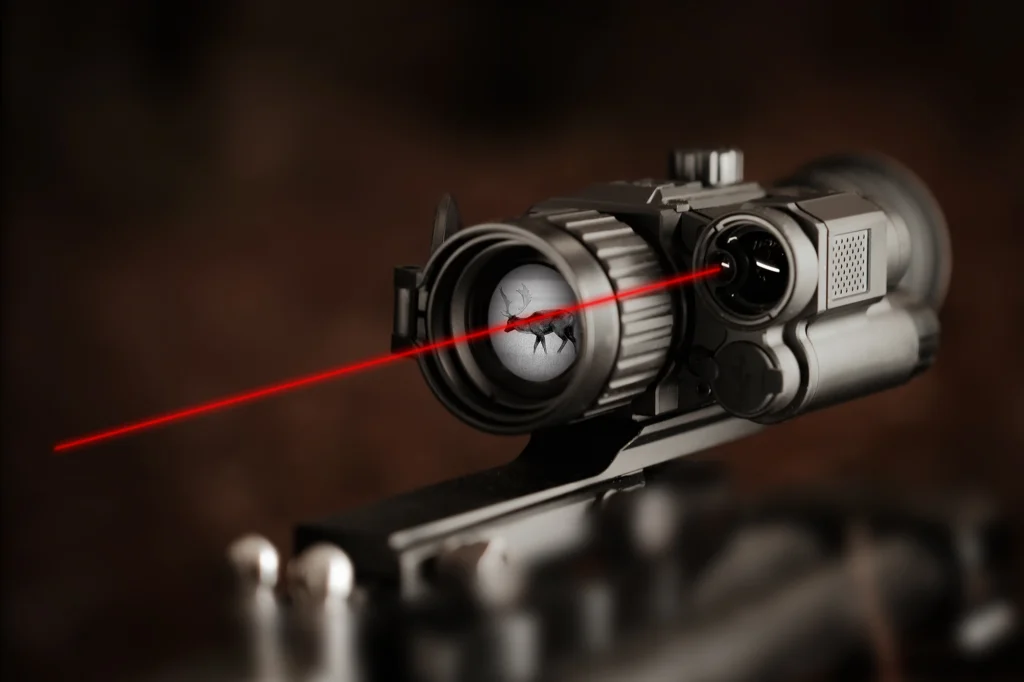
An integrated laser rangefinder measures distance.
Ballistic-related software uses information according to the implementation supported by the device.
They are not the same feature.
A scope can include:
- an LRF without ballistic software;
- ballistic-related software that requires manually supplied distance information;
- or an integrated system where supported functions can use LRF information.
The exact relationship must be confirmed for the individual model and software version.
For a detailed comparison of integrated ranging itself, see LRF and non-LRF thermal scopes.
Distance Information Is Only One Part of the System
Knowing distance can remove one source of uncertainty, but distance alone does not describe the complete external environment or mechanical system.
A ballistic-related feature may depend on several categories of information supported by the device.
If those inputs are incomplete, outdated, incorrect, or unsupported, the calculated output can also be unreliable.
This is why smart ballistic functions should be treated as decision-support software, not as an automatic guarantee of accuracy.
The software cannot independently verify every physical variable affecting the complete system.
Smart Ballistics Does Not Replace Correct Zero Verification
Ballistic-related software works on top of the existing optical and mechanical setup.
If the underlying system is not correctly installed or verified, software cannot repair the physical problem.
The same applies when:
- the optic or mount has shifted;
- the wrong profile is active;
- the product configuration has changed;
- the software version does not match the expected function;
- stored data is no longer applicable.
Software should therefore supplement a correctly configured system rather than replace the normal verification process.
For broader mechanical compatibility, see how to match a thermal scope with your rifle.
Angle and Orientation Sensors Provide Additional Context
Some electronic optics can include orientation sensors capable of detecting information such as device angle or cant.
Where supported, software can use this information as part of its internal calculation or display logic.
The important point is that:
sensing an angle and correctly applying that information are two separate functions.
A buyer should therefore confirm:
- which sensors are present;
- which software functions use them;
- whether their information is displayed directly;
- whether they affect any ballistic-related calculation;
- which software or firmware version enables the function.
Generic marketing language such as “real-time elevation compensation” is not enough to establish what the product actually does.
Ballistic Software Does Not Improve Thermal Image Quality
A ballistic calculator and a thermal imaging system solve different problems.
Thermal image quality depends on factors such as:
- detector resolution;
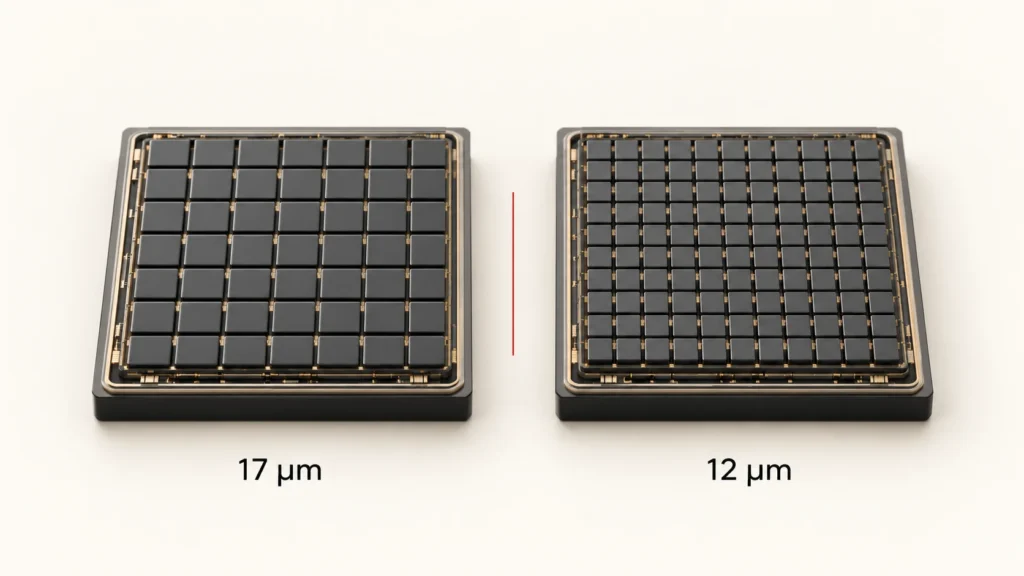
- pixel pitch;
- NETD;
- lens focal length;
- aperture;
- focus;
- image processing;
- refresh rate;
- display quality.
Ballistic-related software does not increase any of these physical imaging specifications.
A device can therefore have sophisticated software but only moderate imaging performance, or strong imaging performance with minimal ballistic functions.
The two areas should be evaluated independently.
For a broader system-level comparison, see what defines a high-end thermal scope.
Magnification Does Not Make Ballistic Information More Accurate
Thermal magnification changes how large the image appears.
It does not make the underlying distance measurement or software calculation inherently more accurate.
Digital zoom also does not create additional native thermal information.
This distinction matters because several functions can appear on the same display while still operating independently:
- thermal imaging;
- magnification;
- rangefinding;
- orientation sensing;
- ballistic-related software.
A sophisticated interface should integrate these functions clearly without encouraging the user to confuse one with another.
For the imaging side of the issue, see our thermal scope magnification guide.
Picture-in-Picture Is a Display Feature, Not a Ballistic Function
Picture-in-picture, or PIP, can show an enlarged section of the thermal image while maintaining a wider scene in the main display.
This can help preserve environmental awareness while inspecting a smaller area in greater apparent detail.
PIP itself does not:
- measure distance;
- calculate a trajectory;
- increase detector resolution;
- verify zero;
- improve NETD.
It is a display function.
If ballistic-related information is shown at the same time as PIP, the two features remain technically separate.
Display Features Should Present Information Clearly
Adding more electronic functions is useful only if the user can understand the interface quickly.
A well-designed system should make it clear which information comes from:
- the thermal detector;
- the LRF;
- the orientation sensors;
- stored settings;
- software calculations.
Important interface considerations include:
- readable text;
- clear units;
- logical menu organization;
- understandable status indicators;
- easy access to frequently used functions;
- minimal obstruction of the thermal image.
A feature-rich system is not automatically a better system if important information is difficult to interpret.
Software Version Matters
Ballistic and other smart functions depend heavily on software.
Two devices with similar hardware can behave differently if their software or firmware versions differ.
Before comparing products or documenting features, confirm:
- the exact model;
- hardware revision where relevant;
- current firmware;
- current app version where applicable;
- supported functions;
- supported profiles;
- whether features differ by market or product version.
This is particularly important for articles, catalogues, and distributor materials.
A function that existed in a demonstration firmware version should not automatically be presented as a current production feature.
AI Image Processing and Smart Ballistics Are Not the Same Thing
The term “AI” can also create confusion.
Image-processing algorithms may be used to improve the visual presentation of thermal data through functions such as:
- noise reduction;
- edge enhancement;
- contrast processing;
- interpolation;
- super-resolution methods.
These functions affect image presentation.
Ballistic-related software processes a different category of information.
Even if both systems use advanced algorithms, they should not be combined into one claim such as:
“AI automatically improves image quality and guarantees ballistic accuracy.”
That would describe two independent systems as if they were one.
The imaging system and ballistic system should be evaluated separately.
What Smart Ballistics Cannot Guarantee
Ballistic-related software should not be described as guaranteeing a result.
It cannot independently guarantee:
- correct mechanical installation;
- correct zero;
- correct stored information;
- stable mounting;
- accurate environmental assumptions;
- consistent equipment behavior;
- reliable range measurement under every condition;
- responsible user judgment.
Software output should therefore be understood as calculated information based on the data and functions available to the system.
That is fundamentally different from a guaranteed physical outcome.
Reliability Matters More as Software Complexity Increases
More integrated functions create more dependencies.
An LRF-equipped device with software integration may depend on:
- detector operation;
- rangefinder operation;
- internal sensors;
- stored configuration;
- battery condition;
- processing hardware;
- firmware;
- display behavior.
This does not mean complex products are inherently unreliable.
It means reliability testing should consider the complete system rather than only one specification.
Power management is also relevant because LRF, recording, wireless connectivity, processing, and display functions all consume energy.
For a broader troubleshooting framework, see thermal scope reliability.
Use a Feature-Verification Checklist Before Comparing Products
For smart ballistic functions, verify the implementation rather than the marketing label.
| Factor | What to Confirm |
|---|---|
| LRF | Is it integrated into the exact model? |
| LRF output | How and where is distance displayed? |
| Ballistic function | Does the exact product actually include it? |
| Data source | What information does the system use? |
| Orientation sensors | Are angle/cant sensors present and supported? |
| Profiles | Can the exact model store profiles? |
| Display | How is calculated information shown? |
| PIP | Is it supported independently of ballistic functions? |
| Software | Which firmware enables the feature? |
| App | Is an external app required? |
| Connectivity | Does the feature depend on Wi-Fi/Bluetooth? |
| Storage | Are settings stored locally? |
| Power | Does the function affect runtime? |
| Documentation | Is the function described in current manuals? |
| Support | Can the manufacturer confirm the exact implementation? |
If these questions cannot be answered, the phrase “smart ballistics” is not specific enough for a reliable product comparison.
How to Evaluate Ballistic-Related Functions on Current Yubeen Products
Do not assume that every Yubeen thermal scope has ballistic-related software.
Feature availability should be confirmed for the exact current product.
Use this sequence:
- identify the exact model and hardware version;
- confirm whether an LRF is integrated;
- confirm whether ballistic-related software is supported;
- confirm whether orientation sensors are used;
- verify what information the system accepts;
- verify what information the system outputs;
- check how the result is displayed;
- verify whether profiles are supported;
- confirm the current firmware version;
- check whether an app or wireless connection is required;
- confirm current documentation;
- confirm current support and warranty terms.
Link Yubeen thermal imaging scopes to the current thermal product category.
Do not publish unverified claims such as:
- “automatic aiming”;
- “guaranteed accuracy”;
- “always correct point of impact”;
- “works at every magnification”;
- “fully compensates for all environmental conditions.”
If a current product genuinely supports a specific ballistic-related function, describe only the verified capability documented for that exact model.
What Professional Buyers Should Ask Before Ordering
For B2B evaluation, confirm the software function before treating it as part of the commercial specification.
Request or verify:
- current product specification;
- current user manual;
- current firmware version;
- supported functions;
- LRF implementation;
- software or app requirements;
- supported display functions;
- current sample behavior;
- relevant certifications;
- warranty terms;
- after-sales support.
A sample evaluation is particularly valuable for software-dependent functions because a static specification sheet cannot fully demonstrate menu behavior or integration.
Final Thoughts
Smart ballistic functions can make electronic optics more informative by bringing ranging, sensor information, software calculations, and display functions into one interface.
Their value comes from integration—not from replacing the underlying imaging system or removing every source of uncertainty.
A laser rangefinder measures distance. A thermal detector creates the image. Orientation sensors provide additional context. Software processes supported information. The display presents the result.
Those components should be evaluated individually and then as a complete system.
The best smart feature is not the one with the strongest marketing claim. It is the one whose inputs, calculations, display behavior, software version, limitations, and product support are clearly documented.
FAQ
Does smart ballistic software automatically guarantee accuracy?
No.
Ballistic-related software provides calculated information based on the data and functions available to the system. It cannot independently guarantee mechanical setup, zero, range measurement, environmental assumptions, or physical outcome.
Does an integrated LRF automatically mean the scope has ballistic calculation?
No.
An LRF provides distance information. Ballistic-related functions are separate software capabilities and must be confirmed for the exact model.
Does smart ballistics improve thermal image quality?
No.
Thermal image quality depends on the detector, optics, NETD, focus, processing, refresh rate, and display. Ballistic software processes different information.
Is picture-in-picture part of the ballistic system?
Not necessarily.
PIP is primarily a display function. A product may allow PIP and ballistic-related information to be used at the same time, but they remain separate functions.
Can AI image processing and ballistic software be the same feature?
No.
AI or advanced image processing typically affects image presentation. Ballistic-related software processes range, sensor, and configured system information. They may coexist in one device but perform different tasks.
What should buyers verify before comparing smart ballistic thermal scopes?
Confirm the exact model, integrated LRF, supported ballistic functions, required data sources, orientation sensors, display behavior, software version, profile support, app requirements, documentation, warranty, and technical support.