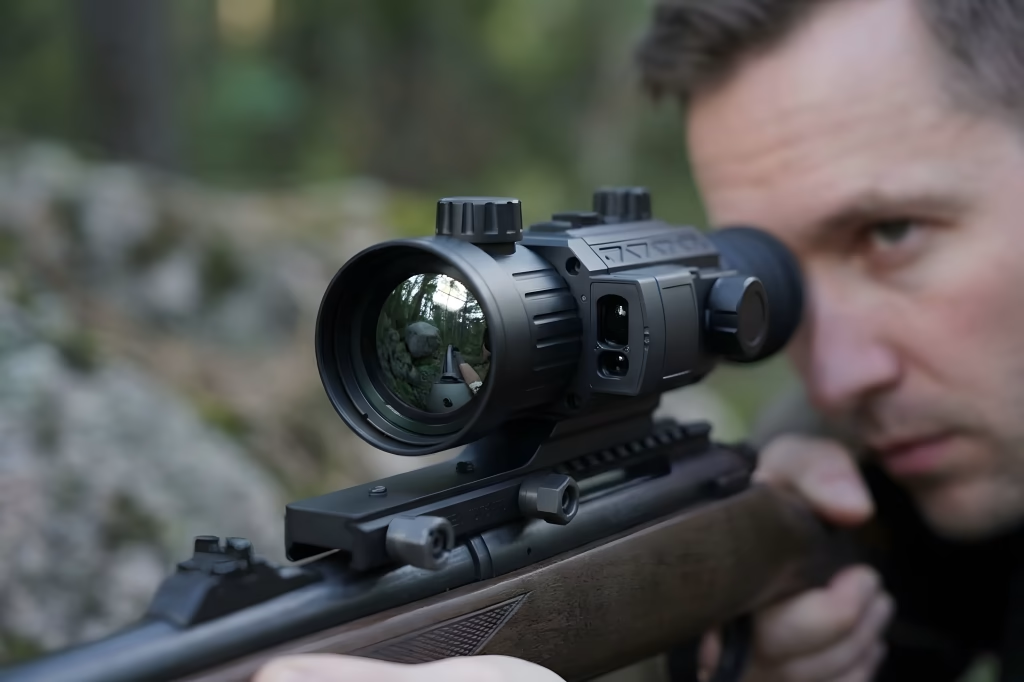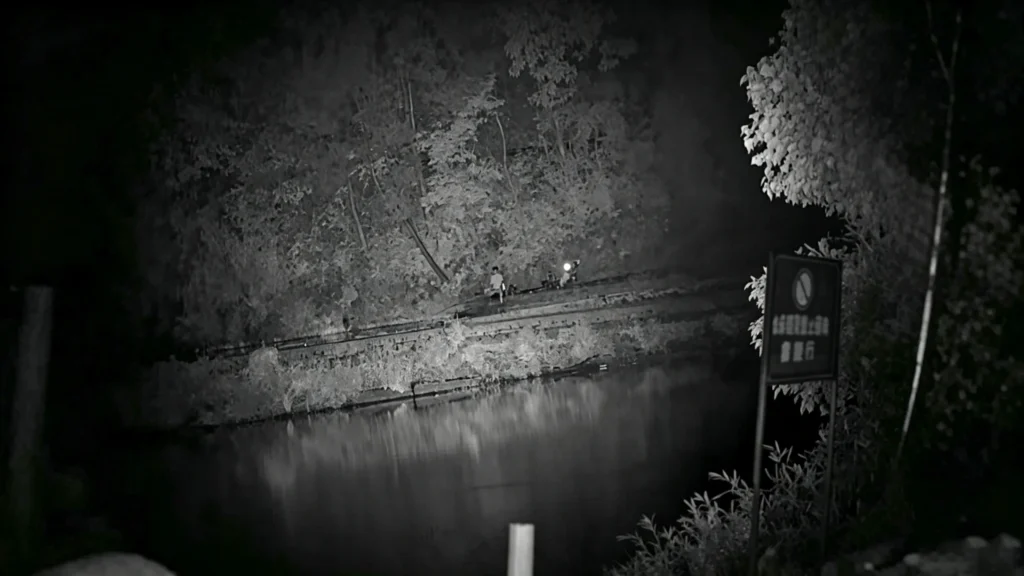
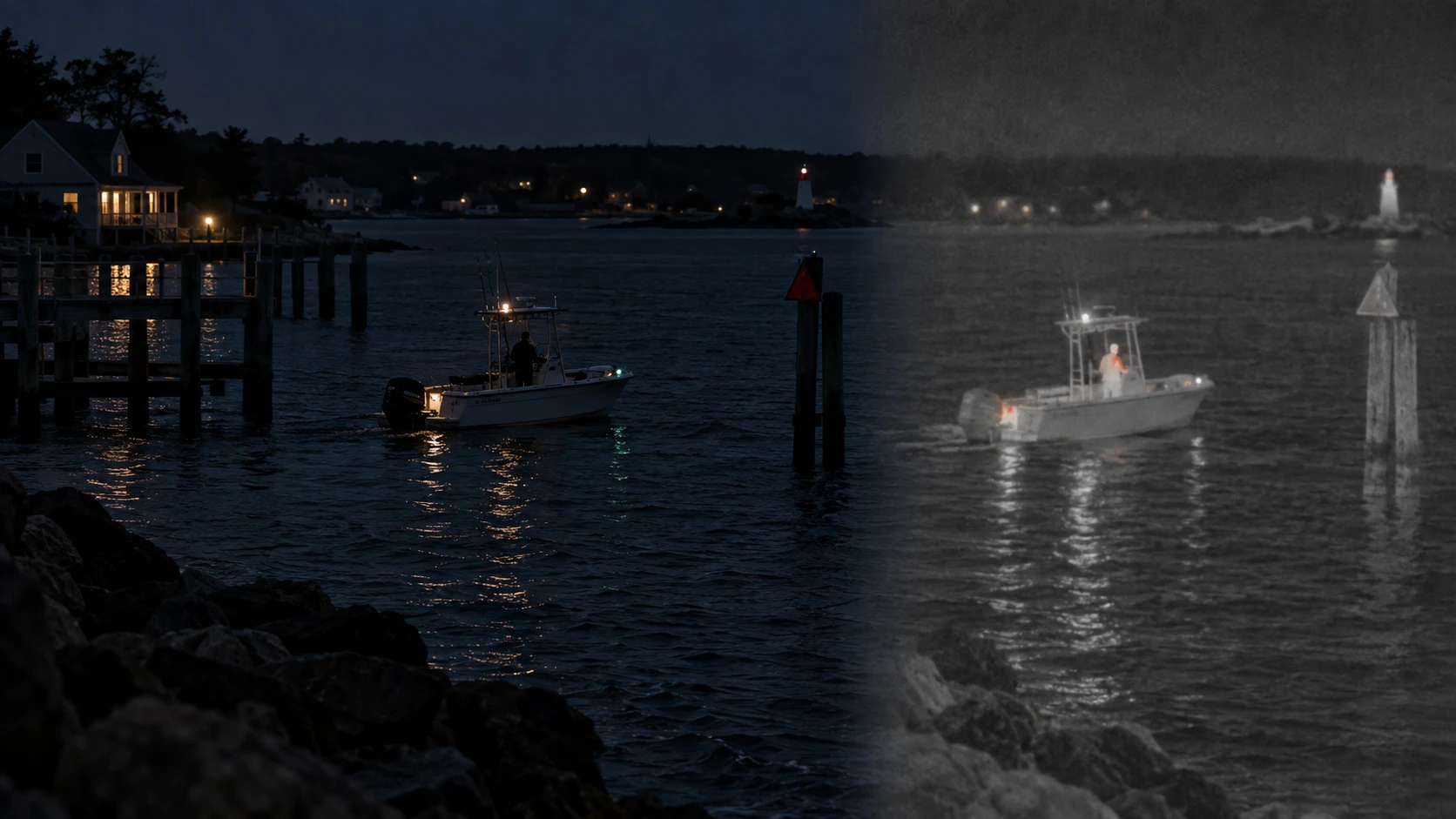
Marine thermal imaging can add useful visual information in darkness and low light, but its performance still depends on weather, range, thermal contrast, and the marine environment.
At night, a thermal imager can reveal temperature differences between vessels, people, shoreline structures, navigation aids, debris, and surrounding water even when the same scene is difficult to interpret with unaided vision.
But marine use also introduces some of the most demanding conditions for thermal imaging.
High humidity, fog, rain, sea spray, long atmospheric paths, moving water, small distant targets, and salt contamination can all reduce practical performance.
Thermal imaging should therefore be treated as an additional source of situational information, not as a replacement for proper lookout, radar, AIS, navigation lights, charts, or other appropriate navigation systems.
International collision regulations require vessels to maintain a proper lookout and use all available means appropriate to the prevailing conditions.
The value of thermal imaging is that it can add another visual layer when conventional visible-light observation is limited.
For the underlying imaging principle, see what thermal imaging can reveal beyond the human eye.
Why Thermal Imaging Can Be Useful at Sea
Visible-light observation depends on reflected illumination.
At night, the sea surface, shoreline, floating objects and distant vessels may have very little visible contrast.
Thermal imaging operates differently.
It responds to differences in infrared radiation reaching the detector.
If an object produces enough thermal contrast relative to the surrounding scene, it may become easier to locate even when visible illumination is extremely low.
Possible marine uses include:
- nighttime situational awareness;
- observing nearby shoreline structures;
- locating vessels or exposed people;
- identifying warm machinery or engine areas;
- checking harbor surroundings;
- wildlife observation at or above the water surface;
- supporting search operations.
The key condition remains:
useful thermal contrast must reach the detector.
Darkness alone does not guarantee a useful image.
Thermal Imaging Is an Aid to Navigation, Not a Navigation Replacement
A thermal image can help an operator see objects that may be difficult to distinguish visually at night.
Depending on range and conditions, that can include:
- pilings;
- docks;
- anchored vessels;
- buoys;
- floating debris;
- shoreline features.
Marine thermal camera manufacturers use thermal imaging for exactly this kind of nighttime awareness.
But a thermal camera does not provide every type of navigation information.
It does not replace:
- radar;
- AIS;
- charts;
- depth information;
- navigation lights;
- sound signals;
- visual and auditory lookout.
A thermal image is one additional observation channel.
It should therefore support—not replace—the broader navigation picture.
Why Darkness Is Not the Only Challenge at Sea
Marine visibility problems are not limited to a lack of light.
The atmosphere above water can contain:
- high humidity;
- fog;
- mist;
- rain;
- spray;
- aerosols.
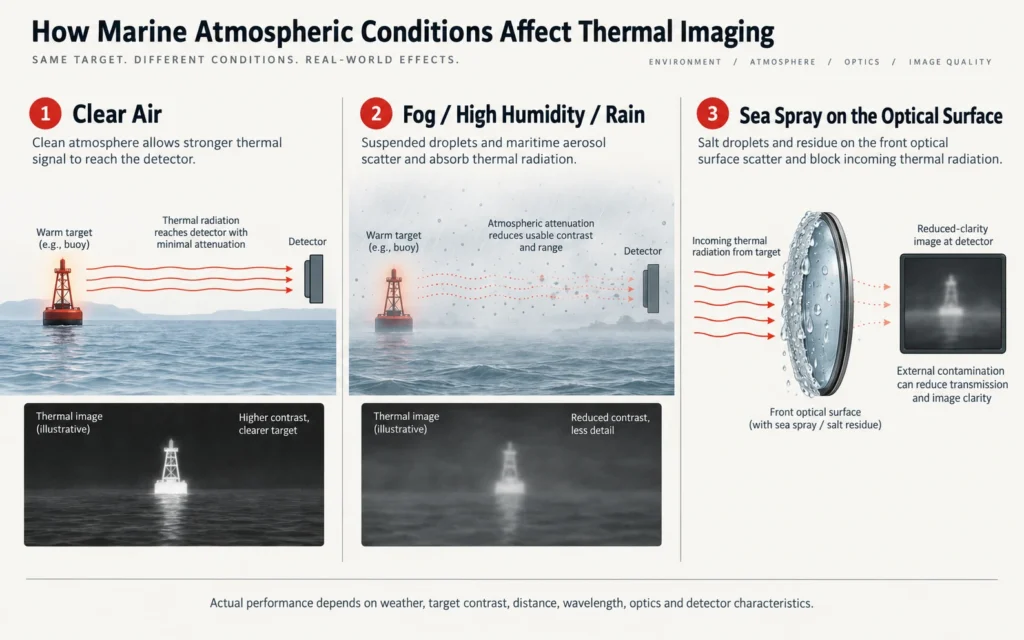
These conditions affect infrared propagation.
Even in clear air, some thermal signal is lost along the atmospheric path.
When humidity, fog or rain increase, usable contrast and range can decrease further.
Marine aerosols can be particularly demanding for long-distance thermal observation.
This means:
thermal imaging may outperform visible observation in some low-light or light-fog conditions,
but:
it should not be described as seeing through all fog, rain or sea mist.
For a deeper explanation, see how weather affects thermal imaging.
Fog Can Reduce Thermal Range Significantly
Fog consists of suspended water droplets.
Those droplets can scatter and absorb part of the infrared signal traveling between the scene and the detector.
In relatively light fog, thermal contrast may remain useful even when visible contrast is poor.
As fog becomes denser, the advantage can decrease substantially.
Under very poor visibility, thermal range can become severely limited.
The practical result depends on:
- fog density;
- wavelength;
- distance;
- target size;
- target-to-background contrast;
- detector sensitivity;
- optics.
There is no single “thermal range in fog” that applies to every system.
Rain and Sea Spray Create Different Problems
Rain affects the thermal path through the atmosphere.
Sea spray can create another problem closer to the device.
Water droplets or salt residue on the front optical surface can reduce:
- contrast;
- sharpness;
- transmission.
A thermal camera with good environmental sealing can still suffer image degradation if the external lens surface becomes coated with water or salt.
That is an optical contamination problem, not necessarily a detector failure.
The correct maintenance procedure depends on the exact device and coating.
Thermal Imaging Does Not See Through Water
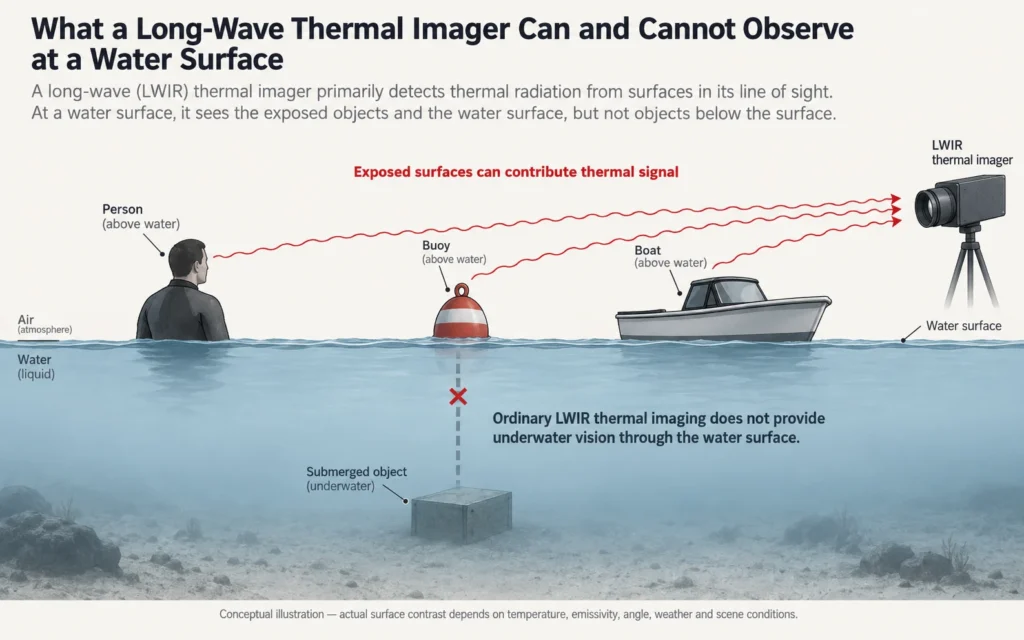
One of the most important marine limitations is simple:
ordinary thermal imaging does not provide underwater vision through the sea surface.
A thermal detector normally receives infrared radiation from the water surface or from objects exposed above it.
An object fully submerged below the surface is not imaged as though the water were transparent.
Thermal imaging can show:
- a person’s head or body above water;
- part of an animal exposed at the surface;
- a floating object;
- surface-temperature patterns.
It cannot be relied upon to see:
- submerged debris;
- underwater hull structure;
- a fully submerged person;
- underwater animals.
This distinction should remain clear in any marine thermal-imaging claim.
Search and Rescue Can Benefit From Thermal Contrast
Search-and-rescue is one of the strongest marine use cases for thermal imaging.
A person in the water may be difficult to locate visually at night.
If part of the body remains exposed above the surface and produces sufficient thermal contrast, a thermal imager may make that exposed area easier to detect.
Marine thermal systems are widely used to support man-overboard and search operations.
However, the thermal imager still has limits.
Detection depends on:
- how much of the person is visible above water;
- distance;
- waves;
- spray;
- target contrast;
- detector resolution;
- focal length;
- focus;
- weather.
Thermal imaging should therefore be considered a search aid—not a guarantee of detection.
A Person in the Water Can Be a Very Small Thermal Target
At longer distance, only a small portion of a person may remain above the waterline.
That exposed area may occupy only a few detector pixels.
This creates a familiar thermal-imaging problem:
detection may occur before recognition or confident identification is possible.
Higher detector resolution can help preserve more spatial information when other factors are comparable.
But resolution alone does not eliminate:
- atmospheric attenuation;
- wave obstruction;
- weak contrast;
- poor focus.
For the complete framework, see thermal detection, recognition and identification.
Waves Can Repeatedly Hide a Target
A marine target is often not continuously visible.
A person, buoy or small object can disappear behind wave crests and then reappear.
This means detection can be intermittent even if thermal contrast itself is strong.
Observation strategy therefore matters.
A single frame with no visible target does not prove that nothing is present.
Repeated scanning and multiple information sources remain important.
Floating Debris Is Not Always Thermally Obvious
A common assumption is that thermal imaging will make every floating object stand out.
That is not necessarily true.
Objects such as:
- timber;
- plastic;
- ropes;
- buoys;
- floating debris
can approach the apparent temperature of the surrounding water.
When target-to-background thermal contrast is low, the object may become difficult to distinguish.
Visible-light cameras, radar, spotlighting, or direct visual observation may provide information that thermal imaging does not.
This is another reason marine thermal should be treated as a complementary sensor.
Warm Machinery Can Be Easier to Detect
Vessels and working equipment may contain thermally distinct components such as:
- engines;
- exhaust systems;
- machinery spaces;
- heated structures.
These areas may remain visible thermally even when the overall vessel silhouette is difficult to see in darkness.
But a strong machinery signature does not automatically reveal:
- vessel identity;
- vessel heading;
- operator intent.
A visible thermal source is only one part of the situational picture.
Harbor and Coastal Observation
Thermal imaging can also support general harbor or shoreline observation.
Depending on conditions, an operator may be able to distinguish:
- people on docks;
- vessels moving near shore;
- warm equipment;
- shoreline structures;
- activity around harbor infrastructure.
The technology can reduce dependence on visible illumination for observation.
But this article does not treat thermal imaging as an autonomous surveillance or identification system.
Any identification or operational conclusion requires sufficient information from the complete scene.
Marine Wildlife Observation
Thermal imaging can be useful for observing animals that expose part of their body above the surface.
Examples can include:
- marine mammals surfacing;
- birds on the water;
- shoreline wildlife;
- animals moving along coastal margins.
The major limitation remains the same:
the detector only receives useful thermal radiation from surfaces within its line of sight.
A fully submerged animal is not visible through the water simply because it is warmer than the surrounding sea.
Detection Is Not Species Identification
A thermal signature at the water surface may reveal:
- movement;
- approximate size;
- a warm exposed region.
That may not be enough to identify the species.
Distance, viewing angle, partial submersion and wave action can remove important shape information.
Thermal wildlife observation should therefore separate:
- detection;
- recognition;
- identification.
The same DRI logic used on land also applies at sea.
Water Surface Temperature Can Change the Background
The sea is not a thermally uniform background.
Surface temperature can vary with:
- sunlight;
- currents;
- wind;
- freshwater inflow;
- depth mixing;
- weather;
- time of day.
The apparent thermal contrast between a target and the water can therefore change over time.
A target that stands out clearly in one set of conditions may become less distinct later.
This makes the marine environment another example of why thermal performance depends on the scene, not just the device.
Reflections and Low-Emissivity Surfaces Can Complicate Interpretation
Not every bright or dark region in a thermal image represents a simple temperature difference.
Low-emissivity materials can reflect infrared radiation from their surroundings.
Marine environments contain reflective surfaces such as:
- polished metal;
- wet surfaces;
- certain coated structures.
This can complicate interpretation.
Thermal images should therefore be read as infrared radiance patterns rather than simple direct temperature maps.
Detector Resolution Matters for Small Marine Targets
A distant buoy, person or small vessel may occupy only a small part of the detector.
More detector samples across the target can provide more spatial information.
But detector resolution must be evaluated together with:
- focal length;
- field of view;
- pixel pitch;
- focus;
- target size;
- atmospheric path.
A higher-resolution detector does not automatically produce a useful long-range image in heavy maritime fog.
Field of View Determines Search Efficiency
A wider field of view can make it easier to scan:
- harbor entrances;
- nearby water;
- shoreline;
- search areas.
A narrower field of view can make a distant target occupy more of the image.
This creates the usual trade-off:
wider FOV → more area visible at one time
versus:
narrower FOV → greater target sampling at distance.
Marine thermal equipment should therefore be selected by realistic observation range and search requirements rather than the largest focal-length number.
NETD Can Matter in Low-Contrast Marine Scenes
NETD describes thermal sensitivity under specified test conditions.
When a target is much warmer or colder than the background, the contrast may already be strong.
When target and background signals become closer, system noise becomes more important.
A lower NETD can help preserve smaller thermal differences when other variables are comparable.
But NETD does not determine:
- detector resolution;
- underwater visibility;
- search area;
- weather penetration;
- identification distance.
It remains one part of the complete system.
Digital Zoom Does Not Add Native Marine Detail
Digital zoom enlarges detector information already captured.
It can help the operator inspect a small region of the display.
It does not create new thermal samples.
If a distant target occupies only a few detector pixels, large digital zoom cannot reconstruct detail that was never captured.
This is particularly important when evaluating small targets on open water.
Laser Rangefinding Can Be Useful but Is Product-Specific
Marine environments often provide fewer familiar visual distance cues than land.
Where a thermal device includes a compatible laser rangefinder, measured distance can add useful information.
However, LRF performance depends on:
- target reflectivity;
- target size;
- beam placement;
- geometry;
- range;
- atmospheric conditions;
- exact hardware.
Open water itself may not provide the same stable ranging surface as a solid target.
Therefore:
LRF capability should be checked from the exact product documentation.
It should not be described as producing guaranteed exact distance to every object on the water.
Recording Can Support Documentation
Some thermal imagers provide still-image or video recording.
Where available, recording can support:
- incident review;
- wildlife observation;
- training;
- equipment evaluation;
- documentation of conditions.
Recording is not universal.
Storage capacity, frame rate and recording functions remain product-specific.
Water Resistance and Marine Durability Are Not the Same Thing
This distinction is critical.
An IP rating describes specific enclosure tests for ingress protection.
It does not automatically establish:
- long-term salt-spray resistance;
- corrosion resistance;
- marine certification;
- suitability for permanent vessel installation.
Salt water is particularly aggressive toward materials and electrical interfaces.
A product intended for routine marine use needs its exact environmental specification evaluated—not just the presence of a waterproof rating.
Salt Spray Can Affect the Optical Surface
Even when water does not enter the device, salt residue can remain on the external lens.
That residue can reduce image quality.
After marine exposure, cleaning should follow the procedure specified for the exact product.
Do not assume:
- every thermal device can be rinsed under a tap;
- every coating tolerates every cleaner;
- waterproof rating equals unlimited cleaning freedom.
The external lens and housing still require appropriate care.
Marine Thermal Imaging Should Complement Radar, AIS, and Lookout
Thermal imaging provides visual information.
Radar provides different information.
AIS provides vessel-transmitted identity and navigation data where available.
Charts, depth instruments, navigation lights, visual observation and sound provide other information again.
No single system should be treated as sufficient for every situation.
A thermal image can help show:
- what an object looks like thermally;
- where a thermally distinct feature appears;
- how activity changes visually.
It does not replace the navigation picture created from all available information.
Practical Marine Thermal Imaging Comparison
| Marine Task | What Thermal Imaging Can Add | Important Limitation |
|---|---|---|
| Night observation | Thermal contrast without visible illumination | Contrast still depends on scene |
| Navigation awareness | Visualize some obstacles and structures | Not a replacement for radar/AIS/lookout |
| Person-overboard search | May reveal exposed body heat | Waves, range and weather can hide target |
| Small-target detection | Can reveal thermal anomalies | Few detector pixels at distance |
| Fog / mist | May outperform visible imaging in some conditions | Range still degrades |
| Rain | Can remain usable in light conditions | Heavy rain reduces contrast/range |
| Floating debris | Can reveal some objects | Low-contrast debris may remain difficult |
| Wildlife observation | Can show exposed animals | Cannot see through water |
| Machinery observation | Can reveal warm components | Does not identify vessel or intent |
| LRF | Can add range where supported | Target/geometry dependent |
| Recording | Can document observations | Product-specific |
| Saltwater use | Possible with appropriate equipment | IP rating alone ≠ marine durability |
The point is not that thermal imaging is weak.
It is that its value depends on how it is integrated with other information.
When Marine Thermal Imaging Is Especially Useful
Thermal imaging can be particularly useful when:
- visible illumination is very low;
- nearby structures lack clear visual contrast;
- the goal is to locate warm exposed targets;
- a shoreline needs observation without additional visible light;
- search operations continue after dark;
- an additional visual sensor can complement radar or other systems.
The exact performance still depends on the thermal system and environment.
When Thermal Imaging Becomes More Difficult at Sea
Performance can become more challenging when:
- fog is dense;
- rain is heavy;
- humidity is high;
- sea spray contaminates the lens;
- atmospheric distance is long;
- targets are small;
- waves repeatedly obscure the target;
- target and water temperatures become similar.
These conditions do not necessarily make the thermal imager useless.
They reduce the amount and reliability of information available.
Current Yubeen Thermal Products Should Not Be Presented as Marine-Certified Systems Without Evidence
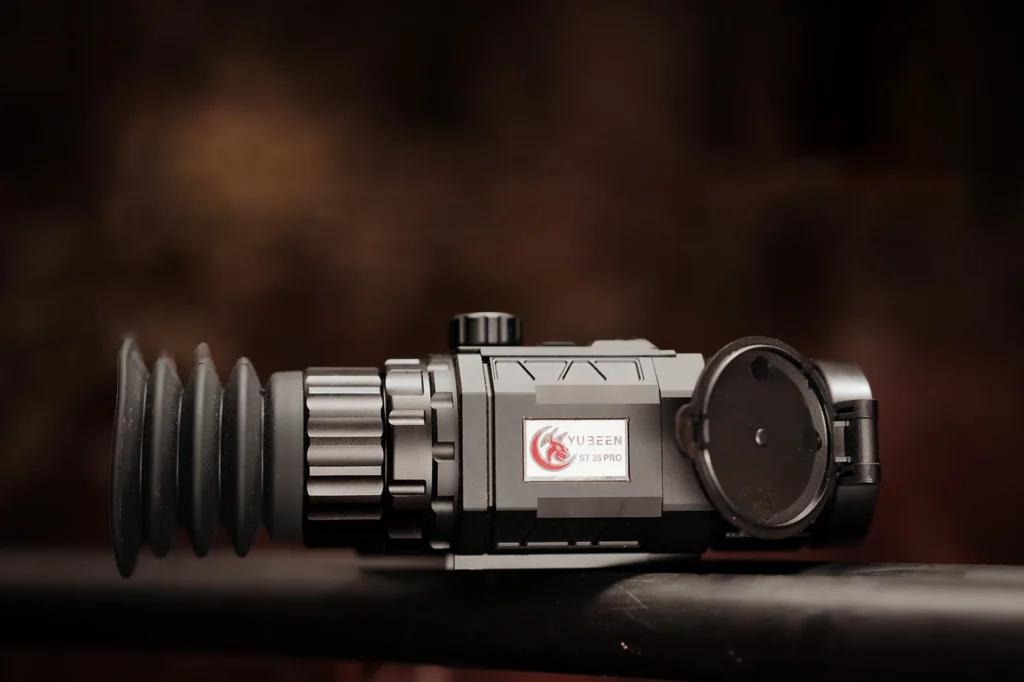
Yubeen’s current thermal range includes dedicated thermal imaging products.
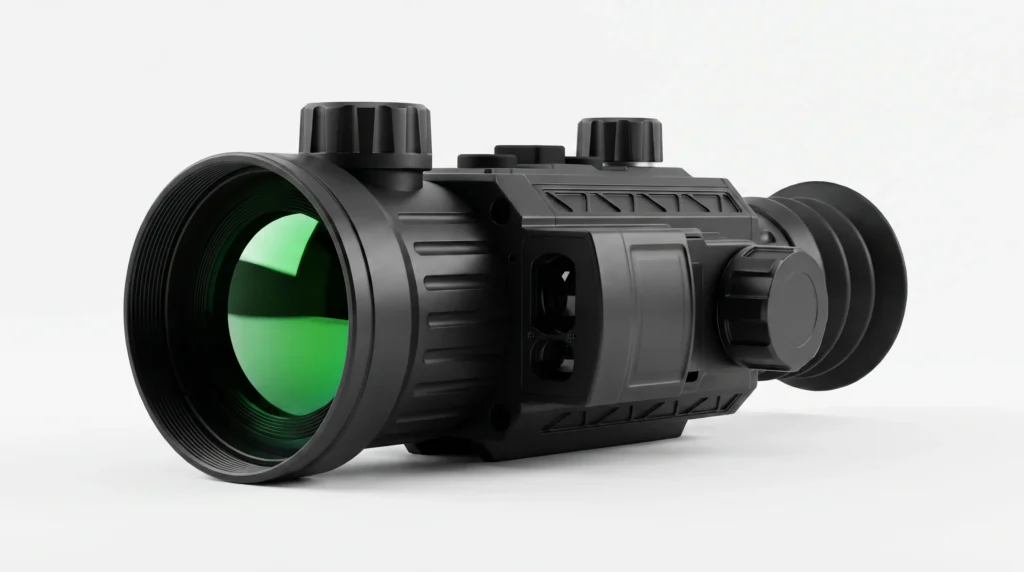
The product shown here should be treated as an example of Yubeen’s current thermal-imaging technology.
This article does not classify it as:
- a marine navigation system;
- a certified SAR device;
- a permanent vessel-mounted marine camera;
- a salt-spray-qualified marine instrument
unless the exact product documentation establishes those points.
Model-specific specifications such as:
- detector resolution;
- NETD;
- lens;
- LRF;
- recording;
- runtime;
- IP rating;
- operating temperature
must be checked from the current documentation for that exact model.
For a broader thermal-selection framework, see how to choose a thermal imaging scope.
You can also review the current Yubeen thermal imaging range for current product information.
How to Evaluate Thermal Imaging for Marine Use
Use this checklist:
- What marine task is the system expected to support?
- Is it observation, navigation awareness, wildlife viewing, or search?
- What target size matters?
- At what realistic distance?
- What field of view is needed?
- What detector resolution and NETD are available?
- How often will fog, rain or high humidity be present?
- Will salt spray reach the optical surface?
- What environmental sealing does the exact model provide?
- Is salt-corrosion testing available?
- Is the device handheld, fixed-mounted, or another architecture?
- Is ranging required?
- Is recording required?
- What other navigation or observation systems will be used alongside it?
That evaluation is much more useful than asking whether thermal imaging simply “works at sea.”
Marine Thermal Imaging Is Valuable Because It Adds Information
Thermal imaging can add a powerful visual channel to marine observation.
It can reveal thermal contrast in complete darkness.
It can help locate exposed people, vessels, shoreline structures and warm equipment.
It can support search, observation and nighttime situational awareness.
But it remains subject to:
- atmospheric attenuation;
- fog;
- rain;
- humidity;
- spray;
- range;
- detector sampling;
- line of sight;
- water-surface limitations.
The correct conclusion is therefore not:
thermal imaging replaces conventional marine navigation tools.
It is:
thermal imaging can add information that visible-light observation may not provide, especially when used alongside other appropriate marine systems.
FAQ
Can Thermal Imaging See Through Water?
No. Ordinary thermal imaging does not provide underwater vision through the water surface. It can show the surface itself and objects exposed above it, but a fully submerged object is generally not visible through the water.
Can Thermal Imaging Find a Person in the Water at Night?
It can help when part of the person remains exposed above the surface and produces sufficient thermal contrast. Distance, waves, weather, detector resolution and target exposure still matter.
Can Thermal Cameras See Through Fog at Sea?
Not completely. Thermal imaging may retain better contrast than visible imaging in some fog conditions, but fog, humidity and maritime aerosols reduce infrared transmission and useful range.
Can Thermal Imaging Replace Marine Radar?
No. Thermal imaging and radar provide different information. Thermal should be treated as an additional visual sensor rather than a replacement for radar, AIS, navigation lights, charts or proper lookout.
Does an IP67 Rating Mean a Thermal Device Is Marine-Grade?
No. IP67 describes specific ingress-protection conditions. It does not automatically certify long-term salt-spray or corrosion resistance.
Can Thermal Imaging Detect Floating Debris?
Sometimes. Detection depends on object size, distance, temperature contrast, waves, weather and detector/optical performance. Debris close to the water temperature can be difficult to detect thermally.
Does Thermal Imaging Work During the Day at Sea?
Yes. Thermal imaging does not require darkness, but solar heating and changing water/structure temperatures can alter target-to-background contrast.
Does More Detector Resolution Help Marine Search?
More native detector samples can provide more spatial information when other conditions are comparable, which can help with small distant targets. Atmospheric conditions, lens choice and target contrast still matter.