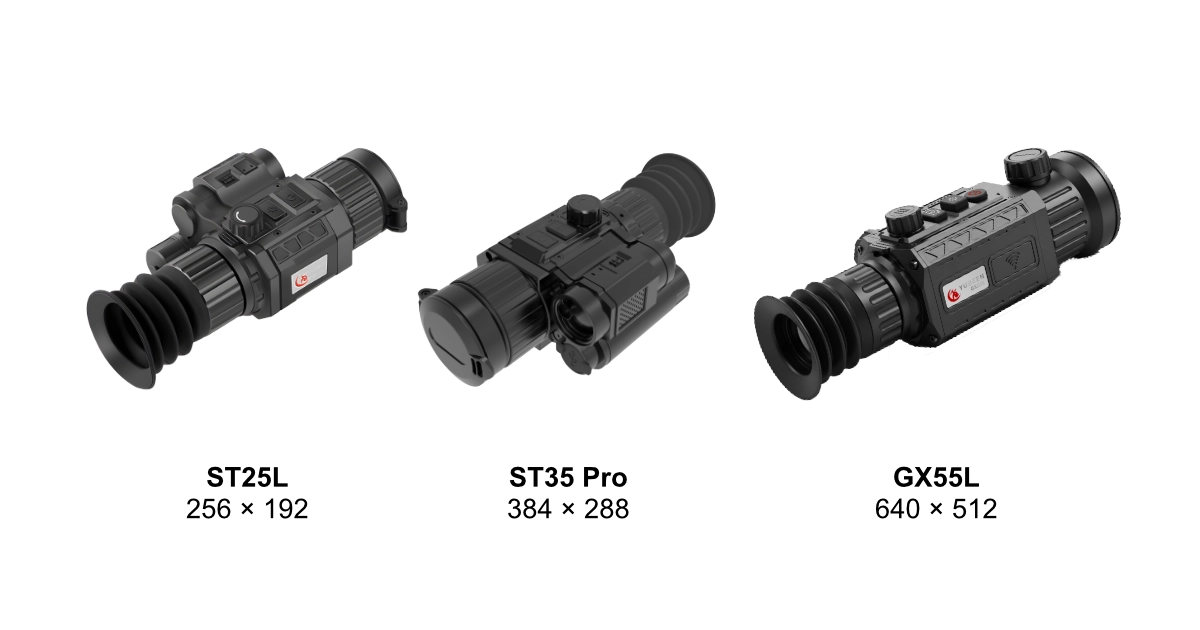
Comparing 256 vs 384 vs 640 thermal scopes means looking beyond pixel counts. YUBEEN ST25L, ST35Pro and GX55L use 256 × 192, 384 × 288 and 640 × 512 detectors, respectively, but their lenses, viewing characteristics, rangefinder specifications and power systems also differ. This guide compares published specifications to help you choose a configuration for your needs without assuming the highest resolution is always the best fit.
Quick answer: which model fits your priorities?
| Model | Good reason to consider it | Important trade-off |
| ST25L · 256 × 192 | Compact 25 mm configuration; 3.2× base magnification; integrated 5–625 m laser ranging. | Smallest native detector grid of the three. |
| ST35Pro · 384 × 288 | More native pixels than ST25L, a slightly wider published field of view, and 5–1,000 m ranging. | Less native pixel capacity than GX55L. |
| GX55L · 640 × 512 | Highest native resolution here, 50 mm objective, high-resolution AMOLED and 3–1,000 m ranging. | Larger 50 mm platform; device cannot recharge its 18650 battery internally. |
ST25L vs ST35Pro vs GX55L: specification comparison
| Specification | ST25L | ST35Pro | GX55L |
| Thermal detector | 256 × 192 | 384 × 288 | 640 × 512 |
| Native detector pixels | 49,152 | 110,592 | 327,680 |
| Pixel pitch / frame rate | 12 μm / 50 Hz | 12 μm / 50 Hz | 12 μm / 50 Hz |
| Objective lens | 25 mm F1.0 | 35 mm F1.0 | 50 mm F1.0 |
| Base magnification | 3.2× | 3× | 2.7× |
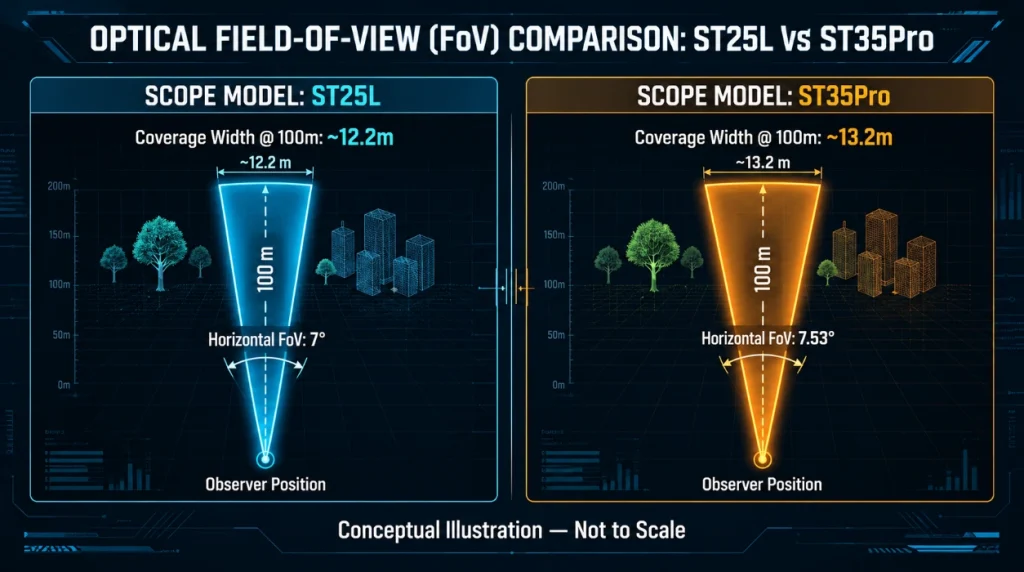
| Published field of view | 7° × 5.3° | 7.53° × 5.65° | Not listed |
| Display (technology and resolution) | 0.32 in; 800 × 600 OLED | 0.49 in; 1344 × 1008 OLED | 0.49 in; 1920 × 1080 AMOLED |
| Published NETD | <25 mK¹ | ≤20 mK¹ | <20 mK¹ |
| Integrated LRF measuring range | 5–625 m | 5–1,000 m | 3–1,000 m |
| Replaceable battery | 18500 Li-ion | 18500 Li-ion | 18650 Li-ion |
| Published battery runtime | ≥4.5 h² | ≥5 h² | ≥4 h² |
| Ingress protection | IP66 | IP66 | IP67 |
¹ NETD reporting conditions are not fully identical across the published product pages; these figures are not a controlled head-to-head test. ² Runtime is specified under stated conditions (25°C, wireless hotspot disabled) and varies in actual use.
Official specifications: ST25L | ST35Pro | GX55L
256 vs 384 vs 640 Thermal Scopes: What Actually Changes?
The total detector-pixel count rises from 49,152 (256 × 192) to 110,592 (384 × 288), then to 327,680 (640 × 512). That is 2.25 times as many native samples from ST25L to ST35Pro and about 2.96 times as many from ST35Pro to GX55L. More native samples give the imaging system more spatial information to work with; they do not translate directly into the same multiplier for recognition or identification distance.
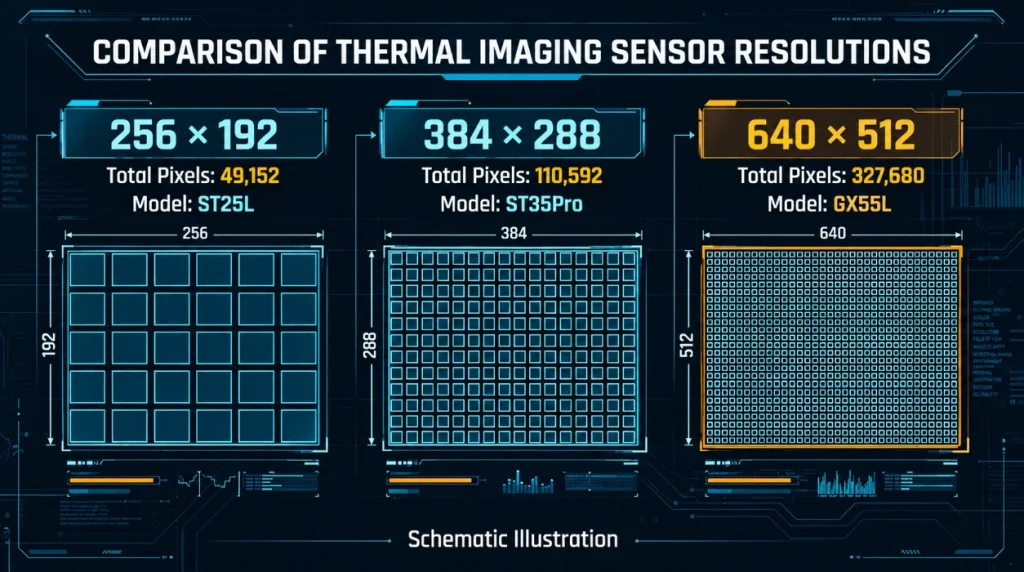
There is a more useful distinction within this particular three-model comparison: all three sensors have 12 μm pixel pitch, but they use 25, 35 and 50 mm lenses. Dividing pixel pitch by focal length gives a simplified nominal angular sampling value of approximately 0.48 milliradians per detector pixel for ST25L, 0.34 for ST35Pro and 0.24 for GX55L. A smaller value means finer theoretical sampling of an object at the same angular size.
Those calculated values describe geometry, not measured image quality. Lens performance, focus, processing, temperature contrast and atmospheric conditions still influence what the viewer can actually distinguish. Likewise, a higher-resolution display or extra digital zoom cannot add physical detector pixels.
256 vs 384: why ST35Pro is more than a pixel-count upgrade
Moving from ST25L to ST35Pro changes the detector from 256 × 192 to 384 × 288 and the objective from 25 mm to 35 mm. ST35Pro also has a slightly wider published field of view: 7.53° × 5.65°, versus 7° × 5.3° for ST25L. In other words, this specific 384 configuration offers a denser sensor grid without sacrificing the published viewing width of the 256 model.
For a simple illustration, those horizontal field-of-view angles correspond to approximately 13.2 m of scene at 100 m for ST35Pro and 12.2 m for ST25L. These are calculations from the listed viewing angles, not field measurements or target-identification claims.
ST25L still offers a compact 25 mm platform and a 3.2× starting view, compared with ST35Pro’s 3×. Both include laser ranging, but the listed maximum increases from 625 m on ST25L to 1,000 m on ST35Pro. If you are considering the two models, compare actual scene coverage, the amount of native image information and the measuring range you need—not just the nominal detector tier.
384 vs 640: what GX55L adds beyond a larger detector
GX55L pairs a 640 × 512 thermal detector with a 50 mm F1.0 objective. Compared with ST35Pro’s 384 × 288 detector and 35 mm lens, it offers finer nominal angular sampling and substantially more native detector elements. It also has a 1920 × 1080 AMOLED, compared with ST35Pro’s 1344 × 1008 display.
Its starting magnification is 2.7×, slightly lower than ST35Pro’s 3×. That does not establish a wider overall field of view: the current GX55L specification page does not publish an official FOV figure. Until that value is confirmed, direct GX55L-to-ST35Pro field-of-view claims would be premature.
Both models list a 1,000 m maximum laser measuring range. GX55L specifies a 3 m minimum and ±1 m measurement accuracy; ST35Pro lists a 5 m minimum. GX55L also publishes AI image enhancement and IP67 ingress protection. These are useful distinctions, but none should be mistaken for proof of a fixed improvement in thermal identification range.
Practical differences: battery, weather protection and measurement
All three models include an integrated laser rangefinder, so “has an LRF” is not a meaningful point of separation. Compare each unit’s specified measuring range instead. The LRF number tells you about distance measurement, not how far the thermal image can reliably identify an animal or object.
The power systems are also different. ST25L and ST35Pro use replaceable 18500 cells; GX55L uses a replaceable 18650 cell. GX55L can be powered through USB-C, but its battery must be charged outside the device. The current published ingress ratings are IP66 for both ST models and IP67 for GX55L. Check the exact model requirements rather than assuming all three share the same charging or water-resistance specification.
ST25L, ST35Pro and GX55L each list a 50 Hz thermal-detector frame rate. This common figure is useful when assessing the three models, but it should not be presented as the display refresh rate.
How to decide between the three YUBEEN models
Start by identifying what you need to see and how much of the surrounding scene must remain in view. If a compact 25 mm configuration and the ST25L’s ranging limit meet your requirements, you may not need the higher detector tiers. If you want more native samples while retaining a slightly wider published view than ST25L, ST35Pro deserves closer consideration. If finer theoretical angular sampling, a 640 × 512 detector and the GX55L feature set matter most, compare GX55L’s complete power, viewing and handling requirements against those priorities.
For any choice, treat detection, recognition and identification as separate tasks. Weather, vegetation, target size, thermal contrast and optics affect performance, and no resolution figure by itself establishes a reliable identification distance. For a general explanation of these specifications, see our thermal scope specification guide.
Compare the current YUBEEN thermal range
Review the full published specifications for ST25L, ST35Pro and GX55L. To explore other configurations or discuss product selection and distribution requirements, visit the YUBEEN thermal imaging range. For product information or distribution enquiries, contact our team.