Thermal detector specifications can look deceptively simple. Resolution, NETD, refresh rate and pixel pitch are often listed side by side, which makes it easy to assume that a smaller number automatically means a better thermal image.
Pixel pitch does not work that way.
A 12μm pixel pitch is widely used in modern thermal detector designs, and it can provide important advantages in spatial sampling, detector size and optical-system design. But it does not, by itself, determine image quality, thermal sensitivity or detection range.
To understand what 12μm actually changes, it helps to separate the detector geometry from the rest of the thermal imaging system.
For a broader introduction to detector resolution, thermal sensitivity and image formation, start with our thermal imaging for beginners guide.
What Does Pixel Pitch Mean in a Thermal Detector?
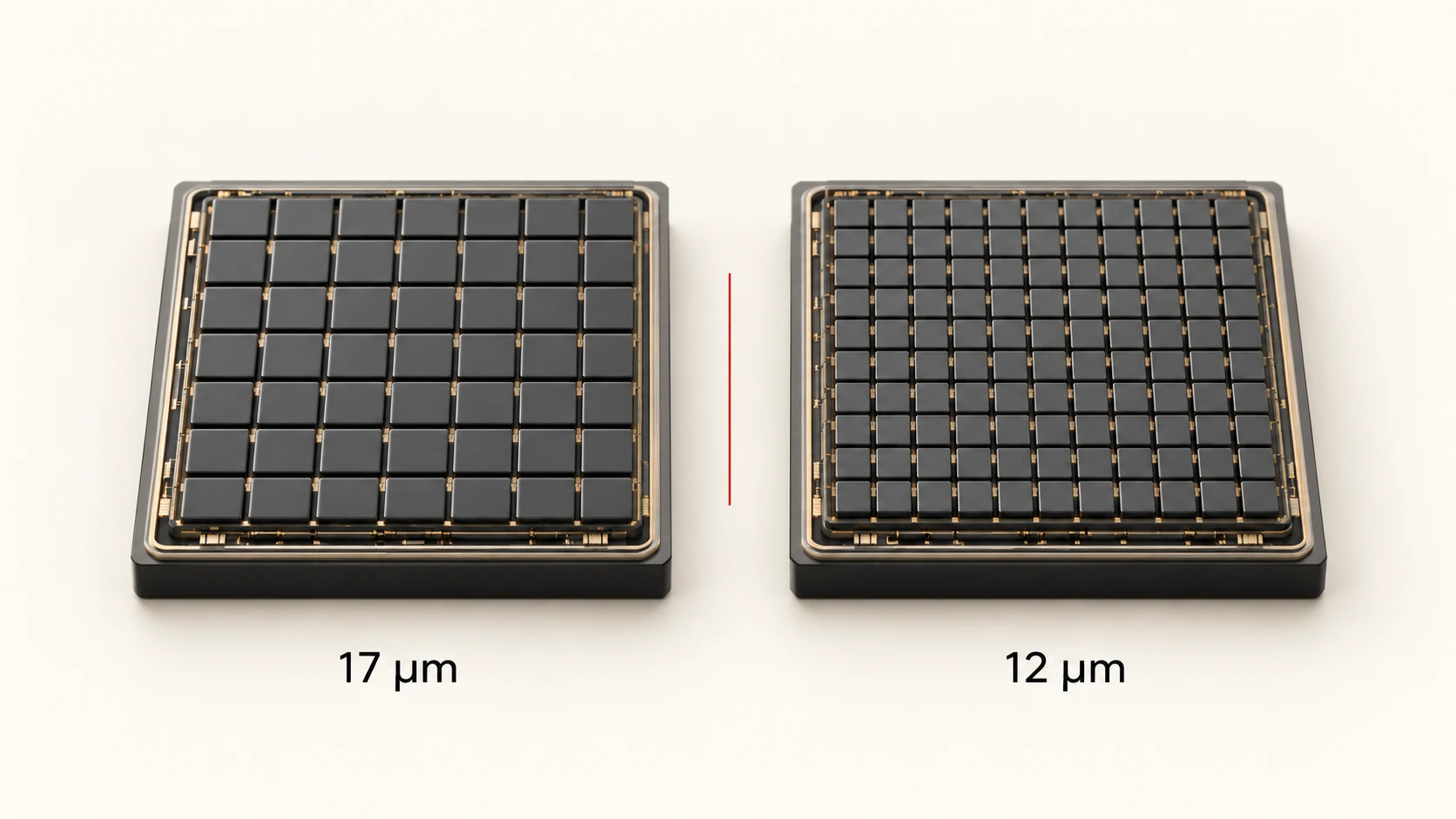
Pixel pitch is the center-to-center distance between neighboring detector elements in a focal plane array, or FPA.
A detector specified as having a 12μm pixel pitch places the centers of adjacent pixels 12 micrometers apart. A 17μm detector uses a 17-micrometer spacing.
That number describes physical geometry. It does not tell you how many pixels the detector contains.
For example, these are separate specifications:
- Detector resolution: 384 × 288, 640 × 512 or another array format
- Pixel pitch: 12μm, 17μm or another value
A detector can therefore have a small pixel pitch without having a high pixel count, and a larger-pitch detector can still have a higher total resolution.
Pixel Pitch and Detector Resolution Are Not the Same Thing
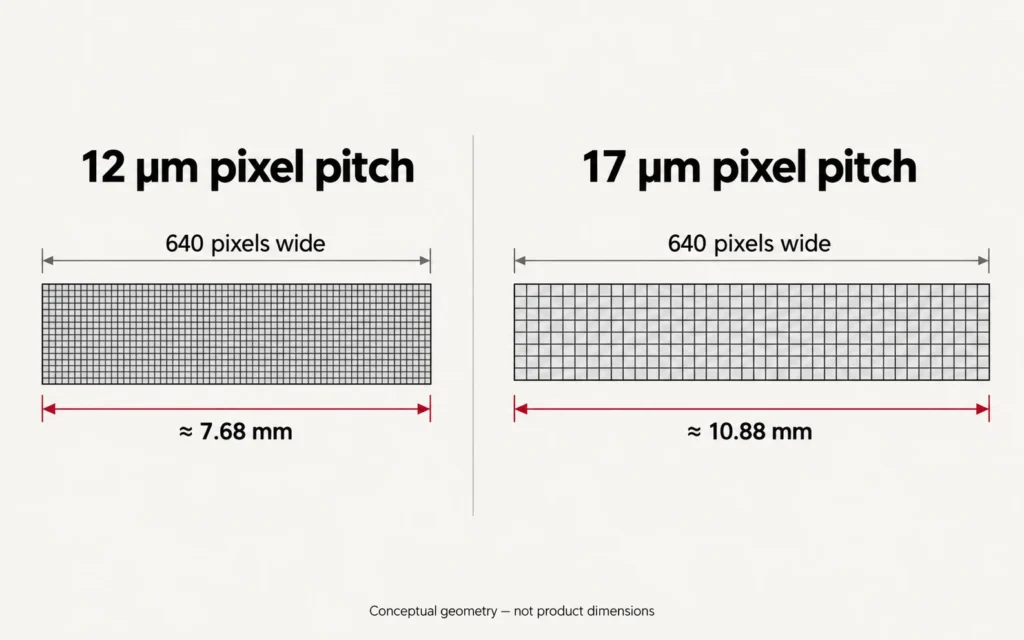
Consider two hypothetical detectors that are both 640 pixels wide.
With a 12μm pitch, the active width represented by those 640 pixel positions is approximately:
640 × 12μm = 7.68 mm
With a 17μm pitch:
640 × 17μm = 10.88 mm
This example does not say that one detector produces a better image. It shows that the same number of pixels can occupy a smaller physical area when the pixel pitch is reduced.
That difference has consequences for lens design, field of view and angular sampling.
How Pixel Pitch Affects IFOV
One of the most useful concepts for understanding pixel pitch is Instantaneous Field of View, or IFOV.
IFOV describes the angular portion of the scene represented by an individual detector pixel. In simplified optical geometry, pixel IFOV is approximately related to:
pixel pitch ÷ focal length
This means that pixel pitch cannot be evaluated independently from the lens.
For the same focal length, a smaller pixel pitch produces a smaller angular IFOV. Each pixel then covers a smaller angular portion of the scene.
A finer IFOV can place more sampling points across a distant target and improve the amount of spatial information available for interpreting that target. But the result still depends on the complete optical and detector system.
Same Lens, Different Pixel Pitch
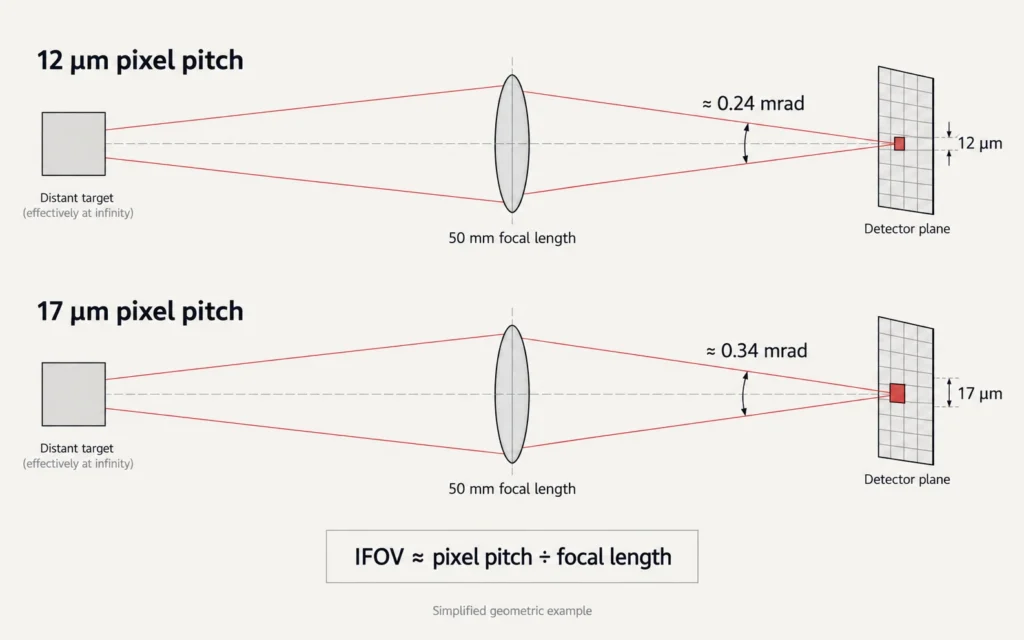
As a simplified example, imagine two detectors used behind the same 50 mm focal-length lens.
Ignoring other optical effects:
- 12μm ÷ 50 mm ≈ 0.24 mrad
- 17μm ÷ 50 mm ≈ 0.34 mrad
The 12μm configuration therefore has finer theoretical angular sampling.
However, if both detectors also have the same pixel count, the physically smaller 12μm array will normally produce a narrower field of view with that same lens.
That may be useful for longer-distance observation, but a wider field of view may be preferable in other applications.
There is no universally correct choice without considering the required viewing geometry.
Why Smaller Pixels Can Support More Compact Optical Designs
Another advantage of smaller pixel pitch appears when the goal is to maintain similar angular sampling while reducing optical size.
Because IFOV depends on both pixel pitch and focal length, a smaller pixel pitch can achieve similar per-pixel angular sampling with a shorter focal length than a larger-pitch detector.
Using only the pitch ratio:
12 ÷ 17 ≈ 0.71
In an idealized comparison, this means a 12μm detector could use roughly 71% of the focal length of a 17μm detector while maintaining similar pitch-to-focal-length angular sampling.
That does not mean every 12μm thermal device is 29% smaller. Housing design, aperture, lens diameter, focus mechanism, detector package, electronics and other components still determine the final product dimensions.
It does explain why smaller-pitch detectors give optical engineers more flexibility when balancing magnification, field of view and package size.
For a closer look at the relationship between focal length, field of view and apparent target size, see our guide to thermal scope magnification.
Does 12μm Mean Higher Thermal Resolution?
Not automatically.
Native thermal resolution is determined by the detector’s number of active pixels.
For example:
- 640 × 512 contains more detector pixels than 384 × 288
- 384 × 288 at 12μm does not become 640 × 512 simply because its pixels are smaller
- Pixel pitch and detector resolution should therefore always be listed separately
Smaller pitch can allow more pixels to fit into a given physical detector area, which is one reason detector technology has moved toward smaller pixel geometries.
But the actual resolution of a finished detector still depends on the array format selected by the manufacturer.
Does 12μm Automatically Mean Better NETD?
No.
NETD, or Noise Equivalent Temperature Difference, describes a thermal imaging system’s ability to distinguish small temperature differences under specified test conditions.
Pixel pitch is one factor in detector architecture, but NETD also depends on detector material, pixel structure, fill factor, readout electronics, integration conditions, optical f-number, calibration and signal processing.
There is also an engineering trade-off associated with reducing pixel size.
If square pixel geometry is compared directly, a 12μm × 12μm pixel has a geometric area of 144 square micrometers, while a 17μm × 17μm pixel has an area of 289 square micrometers.
The smaller pixel therefore has roughly half the geometric area.
That does not mean it must have poor thermal sensitivity. Modern detector engineering can compensate through improved materials, structures, readout circuits and image processing. Current commercial 12μm detectors can achieve very low NETD values.
But it does mean that 12μm itself is not a thermal-sensitivity specification.
Real commercial detector specifications demonstrate this clearly: both 12μm and 17μm detector families exist with different NETD ratings depending on the detector design.
When comparing thermal devices, NETD should therefore be read independently from pixel pitch.
Pixel Pitch, Field of View and Base Magnification
Pixel pitch also influences field of view when other variables are held constant.
If two detectors have:
- the same resolution,
- the same lens focal length,
- but different pixel pitches,
the smaller-pitch detector has a physically smaller array and therefore generally covers a narrower field of view.
A narrower field of view makes objects occupy a larger portion of the displayed image, which can feel like greater optical or base magnification.
This is why smaller-pitch detectors can be attractive in systems designed around longer-distance observation.
But the trade-off matters.
A narrow field of view can make scanning large areas more difficult, especially at shorter ranges. A wider field of view can make target acquisition and situational awareness easier.
Neither characteristic is universally better.
The correct configuration depends on the intended observation distance, target size and required scene coverage.
Does Smaller Pixel Pitch Increase Detection Range?
It can contribute to better spatial sampling, but it does not independently determine detection, recognition or identification range.
A smaller IFOV can put more pixels across a target at a given distance when the optical configuration supports it. In general, more useful pixels on a target can improve the spatial information available for detection and recognition.
However, real-world range also depends on:
- detector resolution,
- lens focal length,
- field of view,
- optical transmission,
- focus quality,
- NETD and signal-to-noise performance,
- target size,
- target-to-background thermal contrast,
- atmospheric conditions,
- image processing,
- display and viewing conditions.
This is why a statement such as “12μm can identify a target at a specific distance” is incomplete unless the entire test configuration and target criteria are defined.
Pixel pitch should be treated as one component of spatial performance, not as a standalone range rating.
What Happens During Digital Zoom?
Digital zoom does not change the physical pixel pitch of the detector.
It enlarges data that has already been captured.
If a target occupies only a small number of native detector pixels, digital zoom cannot create additional physical sensor measurements. Interpolation or AI-based super-resolution may improve presentation or reconstruction, but the native information still originates from the detector.
A smaller IFOV may help put more native samples across a target before digital zoom is applied, depending on the lens and detector configuration.
That can make the enlarged image more useful.
But saying that 12μm “does not pixelate under digital zoom” would still be inaccurate. Every finite-resolution detector eventually reaches a point where additional digital magnification mainly enlarges existing information.
For more on the distinction between detector data and computational enhancement, see AI processing in thermal scopes.
Does a 12μm Detector Use Less Power?
Pixel pitch alone does not determine total device power consumption.
A finished thermal device includes:
- the detector,
- readout electronics,
- processing hardware,
- display,
- storage,
- rangefinding hardware where fitted,
- wireless functions where fitted,
- and the power-management system.
Reducing detector geometry may contribute to more compact electronic designs, but it does not justify assuming that a 12μm device will have longer battery runtime than a 17μm device.
Battery runtime must be evaluated from complete product-level measurements.
The same principle applies to product weight: smaller detector geometry can enable more compact designs, but final weight is determined by the complete optical, mechanical and electronic system.
Why Lens Quality Still Matters
A detector cannot recover spatial detail that the lens fails to deliver.
Smaller pixels provide finer detector sampling, but the optical system must have sufficient resolving performance to take advantage of it.
Focal length, f-number, lens material, transmission, aberrations, focus accuracy and diffraction all influence the signal and spatial detail reaching the FPA.
FLIR’s optical guidance similarly treats focal length, FOV, IFOV and f-number as interconnected design parameters rather than independent specifications.
This is why comparing two thermal devices only by pixel pitch can be misleading.
A well-balanced 17μm system can outperform a poorly optimized 12μm system in areas that matter to the user.
Likewise, a well-designed 12μm system can combine fine spatial sampling with compact optics and strong thermal sensitivity.
The system matters more than the pitch number alone.
How to Compare 12μm and 17μm Thermal Systems
When evaluating two thermal devices, compare the specifications as a group.
- Check native detector resolution.
Do not confuse pixel pitch with the total number of detector pixels. - Compare pixel pitch.
Use it to understand detector geometry and possible spatial-sampling differences. - Check lens focal length and field of view together.
Pixel pitch without lens information does not tell you the viewing geometry. - Look at IFOV when available.
IFOV provides a more direct indication of angular sampling per detector pixel. - Compare NETD separately.
A smaller pixel pitch does not guarantee lower NETD. - Check the optical f-number.
It affects how much infrared energy reaches the detector and should be considered when comparing sensitivity specifications. - Compare refresh rate independently.
Pixel pitch does not determine motion smoothness. - Evaluate image processing separately.
Sharpening, denoising, contrast processing and super-resolution can influence the final appearance without changing the native detector geometry. - Compare real field performance.
Specifications describe components of the system; controlled image comparisons show how those components work together.
This system-level approach is also central to understanding what defines a high-end thermal scope.
Is 12μm the “New Standard”?
It is more accurate to say that 12μm has become a widely used pixel pitch in modern uncooled thermal detector designs.
Commercial thermal cores from major detector suppliers now use 12μm pixels across multiple resolutions and applications.
But “widely used” is different from saying every 12μm device is superior or that larger pixel pitches are obsolete.
A detector should be evaluated by the complete combination of:
- native resolution,
- pixel pitch,
- NETD,
- lens design,
- field of view,
- IFOV,
- refresh rate,
- image processing,
- and the requirements of the application.
The real advantage of 12μm technology is not that the number itself guarantees a better image. It is that smaller detector geometry gives designers additional options for achieving fine angular sampling, higher pixel density and more compact optical systems.
How well those possibilities are realized still depends on the complete thermal imaging platform.
FAQ
Does 12μm Pixel Pitch Mean Higher Resolution?
No. Pixel pitch describes the spacing between detector elements. Resolution describes the number of pixels in the detector array. A 12μm detector can have a lower or higher resolution depending on its array format.
Does 12μm Automatically Provide Better Detection Range?
No. Smaller pixel pitch can contribute to finer angular sampling when combined with an appropriate lens, but practical detection range also depends on resolution, focal length, sensitivity, target size, contrast, atmosphere and image processing.
Does 12μm Mean Lower NETD?
No. NETD and pixel pitch are separate specifications. Modern 12μm detectors can achieve strong thermal sensitivity, but the result depends on detector architecture, optics, electronics and processing.
Does 12μm Always Make a Thermal Device Smaller?
No. Smaller detector geometry can enable a more compact optical design, but final device size is also determined by the lens, housing, electronics, battery and mechanical architecture.
Is 17μm Pixel Pitch Obsolete?
No. Smaller pitches have become common in newer thermal detector designs, but 17μm remains a valid detector architecture. Performance should be judged from the complete imaging system rather than pixel pitch alone.