FFP vs SFP describes two different reticle-placement architectures, and the practical difference is how the reticle behaves as magnification changes.
That placement changes how the reticle appears as magnification changes—and, more importantly, how the reticle’s angular markings relate to the target.
The difference matters most when the reticle includes MIL, MOA, BDC, ranging, or holdover references.
Neither focal-plane design is universally better.
FFP can simplify the use of angular reticle references across different magnifications. SFP keeps the reticle at a constant apparent size, which can make a simple aiming point easier to see across the zoom range.
The right choice depends on how you use the reticle, not on which acronym sounds more advanced.
For the broader optical-scope selection process, see our guide to how to choose a riflescope.
What Does “Focal Plane” Mean in a Riflescope?
A variable-power scope contains an optical system that changes the apparent size of the target image as magnification is adjusted.
The reticle can be positioned on different sides of that magnification system.
That produces the two common designs:
- First Focal Plane, or FFP;
- Second Focal Plane, or SFP.
The important difference is not simply physical reticle location.
It is how the reticle behaves relative to the magnified target image.
How a First Focal Plane Reticle Behaves
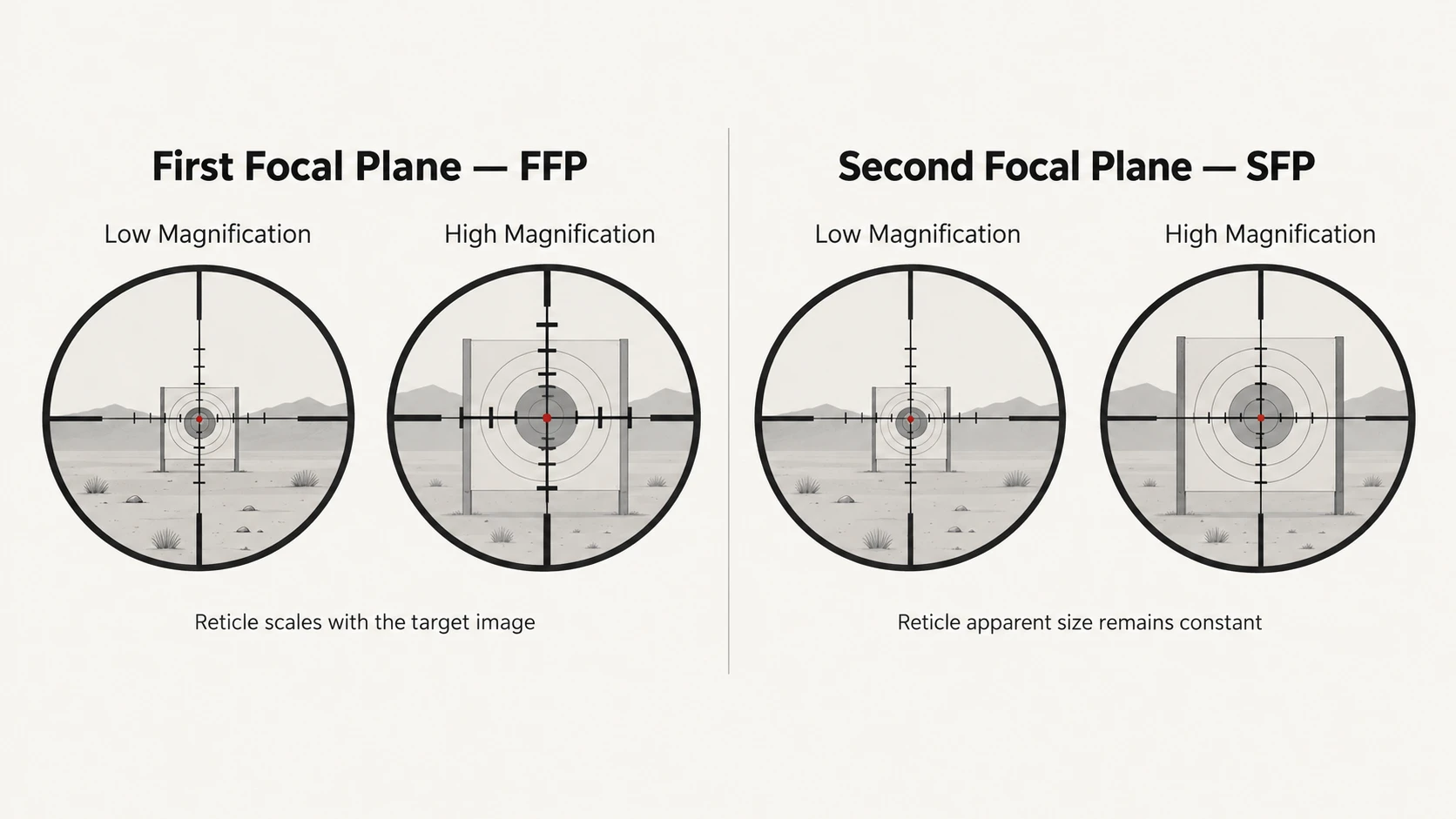
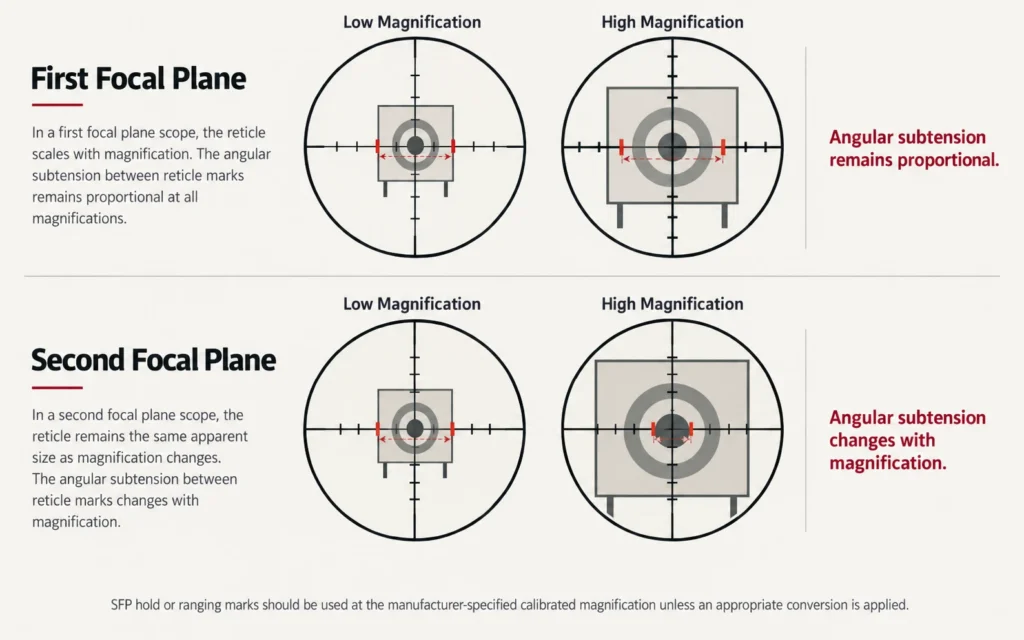
In an FFP scope, the reticle appears to scale together with the target image as magnification changes.
At low magnification, the reticle appears smaller and finer.
At higher magnification, it appears larger.
The important result is that the reticle’s angular subtensions remain proportional to the target across the magnification range.
For example, if two reticle marks represent a defined angular separation, that angular relationship does not change simply because magnification has changed.
This is the main technical reason FFP designs are often paired with reticles that contain:
- MIL references;
- MOA references;
- wind holds;
- elevation holds;
- ranging scales.
Leupold describes the same principle: placing a MIL- or MOA-based reticle in the first focal plane allows the specified spacing of the reticle features to remain usable across magnification settings.
How a Second Focal Plane Reticle Behaves
In an SFP scope, the reticle appears to remain the same size as magnification changes.
The target image becomes larger or smaller behind the visually fixed reticle.
That means the reticle’s angular relationship to the target changes as magnification changes.
A MIL, MOA, or BDC reference in an SFP reticle is therefore normally calibrated for a specific magnification specified by the manufacturer.
On many scopes that calibration point is the highest magnification.
But that should not be treated as a universal rule.
The exact calibrated magnification belongs to the reticle and scope design.
If an SFP reticle is used at another magnification, its hold or ranging references require the appropriate conversion rather than being assumed to retain their original value.
The Difference Is Easier to Understand Visually
Consider the same target viewed first at low power and then at higher power.
FFP
As the target image gets larger:
the reticle also appears larger.
The target and reticle remain proportionally linked.
SFP
As the target image gets larger:
the reticle appears to remain the same size.
The amount of target area represented between reticle marks therefore changes.
This is why focal-plane choice matters most when the reticle is being used as a measuring tool rather than only as a central aiming reference.
Reticle Subtension Is the Key Concept
Subtension describes the angular amount of the scene covered or represented by a reticle feature.
MIL and MOA are angular units.
A reticle designed around those units can be used for functions such as:
- holding for elevation;
- holding for wind;
- estimating size;
- estimating distance when target dimensions are known.
In an FFP design, the angular relationship between the reticle and target remains consistent as magnification changes.
In an SFP design, it changes with magnification.
That single distinction explains most of the practical difference between FFP and SFP.
Why FFP Works Well With Holdover Reticles
Suppose a reticle contains multiple elevation and wind references.
With an FFP system, those angular references remain proportional across the magnification range.
That means the user does not need to return to one particular magnification just to restore the reticle’s intended angular scale.
This can be useful when magnification changes frequently.
For example, a user may reduce magnification to obtain a wider field of view and then increase it when more visual detail is required.
The reticle’s angular structure remains consistent through those changes.
This does not make the ballistic solution automatically correct.
The reticle still depends on:
- correct zero;
- valid ballistic information;
- accurate target-distance information;
- appropriate environmental assumptions;
- correct interpretation by the user.
FFP preserves the reticle scale. It does not calculate the trajectory.
SFP Can Be Simpler to See Across the Zoom Range
An SFP reticle does not visually shrink as magnification is reduced.
This can make a relatively simple center aiming point remain easy to see at low magnification.
By contrast, a complex FFP reticle designed for high-power use may appear extremely fine when the scope is turned down.
Whether that matters depends strongly on reticle design.
A well-designed illuminated FFP reticle may remain very usable at low power.
A thin unilluminated SFP reticle may still be difficult to see against a dark background.
Therefore:
focal plane influences reticle behavior,
but:
reticle design and illumination determine much of the actual viewing experience.
Is FFP Better in Low Light?
Not automatically.
Low-light usability depends on more than focal plane.
Relevant factors include:
- reticle line thickness;
- illumination;
- brightness range;
- glass transmission;
- exit pupil;
- background contrast;
- magnification;
- eye position.
SFP can have a practical visibility advantage at low magnification because the reticle does not shrink with the target image.
But that does not make every SFP reticle more visible than every FFP reticle.
Low-light performance should be judged from the complete scope and reticle design.
Does an FFP Reticle Cover More of the Target at High Magnification?
Not in the simple way this is sometimes described.
An FFP reticle appears larger as magnification increases, but the target image also becomes larger.
Because they scale together, the angular subtension of a properly designed FFP reticle remains essentially constant.
The reticle does not suddenly cover a larger angular portion of the target just because magnification increased.
What does matter is the reticle’s actual line subtension.
A coarse FFP reticle can cover more fine target detail than a finer FFP reticle.
That is a reticle-design issue, not a general FFP limitation.
Does an SFP Reticle Become “More Precise” at High Magnification?
Visually, an SFP reticle appears thinner relative to the enlarged target as magnification increases.
That can make a fine central aiming point useful for small targets.
But this should not be confused with mechanical accuracy.
Higher magnification does not automatically make:
- the turrets track better;
- the zero more stable;
- the scope mechanically more precise.
It changes how the target appears relative to the reticle.
FFP vs. SFP for Ranging
Reticle-based ranging depends on knowing the angular size represented by the reticle markings.
For an FFP reticle with correctly defined subtensions:
the scale remains valid across magnification.
For an SFP reticle:
the stated scale is valid at the manufacturer’s calibrated magnification unless another conversion method is specified.
This makes FFP operationally simpler when reticle ranging is used frequently.
However, modern users may also rely on:
- laser rangefinders;
- external range data;
- known-distance targets.
If reticle ranging is rarely used, the advantage may matter less.
FFP vs. SFP for Elevation and Wind Holds
The same principle applies to holds.
In FFP:
angular hold references retain their intended scale across magnification.
In SFP:
the relationship changes with magnification unless the scope is set to the calibrated power or an appropriate conversion is used.
For a user who frequently changes magnification while using the reticle for wind and elevation, FFP can simplify the workflow.
For a user who normally dials turret adjustments and uses only the reticle center, the distinction may be less important.
Does Focal Plane Affect Turret Tracking?
No—not by itself.
Turret tracking describes how accurately the internal mechanism responds to adjustment.
Focal plane describes how the reticle relates to magnification.
A scope can have:
- an FFP reticle and poor mechanical tracking;
- an FFP reticle and excellent tracking;
- an SFP reticle and poor tracking;
- an SFP reticle and excellent tracking.
These are independent characteristics.
When evaluating turret performance, look at the mechanical design and verified scope specifications rather than assuming FFP or SFP determines tracking quality.
Focal Plane and Parallax Are Different Issues
Parallax adjustment is another feature that is often incorrectly mixed with focal-plane design.
A side-focus or adjustable-objective system is intended to help manage parallax and focus at different distances.
It does not:
- turn an SFP reticle into FFP;
- change the reticle’s angular scaling behavior;
- guarantee perfect alignment between point of aim and point of impact.
FFP/SFP and parallax correction solve different optical problems.
Focal Plane Does Not Determine Glass Quality
FFP and SFP also do not define optical quality.
The focal-plane choice does not tell you:
- glass type;
- resolution;
- contrast;
- chromatic correction;
- transmission;
- coatings;
- edge performance.
A premium SFP scope can have better optical performance than a lower-quality FFP scope, and the reverse can also be true.
This is why focal plane should be treated as one design choice within the complete optical system.
Magnification Range Changes How FFP and SFP Feel
The practical difference becomes more noticeable as the magnification range becomes wider.
At low magnification, an FFP reticle may appear quite small.
At high magnification, the same reticle becomes much easier to inspect.
An SFP reticle remains visually similar throughout the zoom range.
The useful question is therefore:
does the reticle design remain readable and functional at the magnifications you actually use?
For more on magnification itself, see how to select riflescope magnification.
What About LPVOs?
Low-power variable optics create a particularly demanding reticle-design problem.
At low magnification, the user often wants:
- fast acquisition;
- a bold center;
- a wide field of view.
At higher magnification, the same optic may need:
- finer aiming references;
- wind holds;
- elevation references;
- more precise target information.
FFP can support scale consistency across the range.
But the low-power appearance of the reticle must be designed carefully so that it does not become too fine to use efficiently.
SFP can keep the aiming reference visually consistent, but any subtension-based references remain magnification-dependent.
Neither architecture automatically solves every LPVO requirement.
What About High-Magnification Scopes?
High-magnification scopes can also use either design effectively.
FFP may be useful when:
- magnification changes frequently;
- reticle holds are used;
- ranging marks are important;
- MIL/MOA references need to remain consistent.
SFP may be appropriate when:
- the user prefers a constant apparent reticle;
- most aiming is done from the center;
- hold references are used only at one known magnification;
- turret dialing is the main correction method.
High magnification itself does not determine which focal plane is correct.
FFP vs. SFP: Practical Comparison
| Question | First Focal Plane | Second Focal Plane |
|---|---|---|
| Reticle apparent size | Changes with magnification | Appears constant |
| Target image | Changes with magnification | Changes with magnification |
| Reticle angular subtension | Remains proportional across magnification | Changes with magnification |
| MIL / MOA hold references | Usable across magnification when correctly designed | Use calibrated magnification or conversion |
| Reticle ranging | Simpler across magnification | Magnification-dependent |
| Low-power reticle appearance | Can become visually fine | Remains visually similar |
| High-power reticle appearance | Scales with target | Appears relatively finer against enlarged target |
| Turret tracking | Not determined by focal plane | Not determined by focal plane |
| Parallax behavior | Separate issue | Separate issue |
| Optical quality | Separate issue | Separate issue |
This table summarizes the optical behavior.
It does not rank one design above the other.
Do FFP and SFP Apply to Digital Thermal Reticles?
Not in the same physical sense. First Focal Plane and Second Focal Plane describe where a reticle is positioned relative to the magnification system in a conventional optical riflescope. In a digital thermal optic, the sensor forms an electronic image and the aiming reticle is typically rendered as a digital overlay on the display. For that reason, a digital reticle should not automatically be described as FFP or SFP unless the manufacturer explicitly defines comparable scaling behavior.
For a digital thermal optic, the more useful questions are how the reticle behaves as magnification changes, whether subtension or holdover values remain valid, how zero profiles are stored, and how digital zoom, ranging, or ballistic functions interact with the aiming display. These are different design questions from the physical focal-plane placement used in a conventional optical riflescope.
When FFP Usually Makes More Sense
FFP may be the better fit when:
- MIL or MOA reticle references are used frequently;
- magnification changes often;
- reticle-based wind or elevation holds are important;
- reticle-based ranging is part of the workflow;
- keeping the same angular reticle scale matters more than keeping the same apparent reticle size.
The exact reticle design still matters.
A poorly designed FFP reticle does not become useful simply because it is FFP.
When SFP Usually Makes More Sense
SFP may be the better fit when:
- the center aiming point is used more than the reticle scale;
- a constant apparent reticle size is preferred;
- hold references are used only at one known magnification;
- turret dialing is used instead of frequent reticle holds;
- simple reticle visibility is a priority.
Again, this is a workflow preference rather than a quality hierarchy.
A Real Optical Scope Should Be Evaluated as a Complete System
Focal plane is only one part of an optical scope.
A complete evaluation should also consider:
- magnification range;
- objective size;
- field of view;
- eye relief;
- exit pupil;
- glass and coatings;
- parallax adjustment;
- reticle design;
- illumination;
- turret system;
- zero-stop where applicable;
- mechanical durability;
- mounting compatibility.
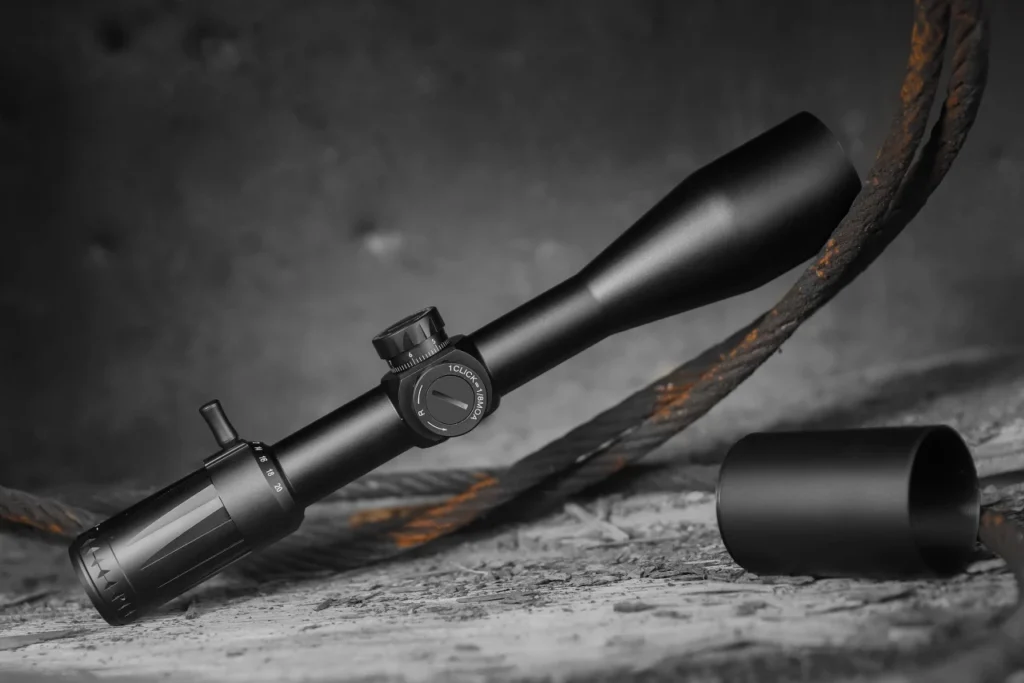
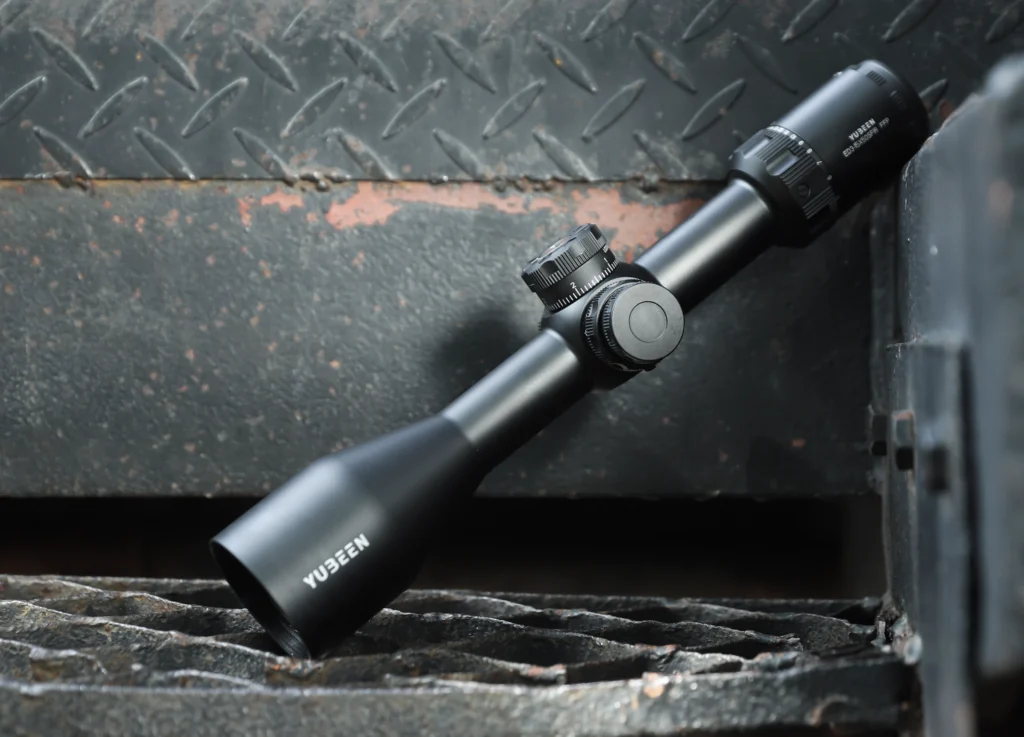
A current Yubeen optical riflescope can be used here as a real product example without turning this article into a single-model advertisement.
The focal plane, reticle, magnification, adjustment system, and other specifications should be taken from the current documentation for that exact model.
Proper initial setup is also important; see how to bore sight a riflescope before final zeroing.
How to Choose Between FFP and SFP
Use these questions:
- Do you use the reticle for MIL or MOA holds?
- Do you change magnification frequently?
- Do you use reticle-based ranging?
- Do you prefer dialing the turrets or holding with the reticle?
- How important is a bold reticle at low magnification?
- Does the reticle include illumination?
- What magnification range do you actually use?
- Does the SFP reticle have a clearly specified calibrated magnification?
- Is the reticle design appropriate for the target size and conditions?
- How does the complete optical system perform—not just the focal-plane label?
These questions are more useful than assuming that FFP is “professional” and SFP is “basic.”
FFP and SFP Are Different Tools, Not Quality Grades
FFP and SFP describe reticle behavior.
They are not product-quality classifications.
FFP offers consistent angular subtensions across magnification.
SFP offers a constant apparent reticle size.
Both can be used in high-quality optical scopes.
The right decision comes from matching the reticle behavior to the way the scope will actually be used.
FAQ
Does an FFP Reticle Stay Accurate at Every Magnification?
Its angular subtensions remain proportional across magnification when the reticle is correctly designed. That does not mean every ballistic hold is automatically correct; the ballistic inputs and zero still have to be valid.
Does an SFP Reticle Only Work at Maximum Magnification?
No. The reticle can be used at any magnification for normal aiming. However, its calibrated MIL, MOA, BDC, or ranging references are valid at the magnification specified by the manufacturer unless another conversion is used.
Is FFP Better for Long-Range Use?
FFP can simplify reticle-based holds and ranging across different magnifications, which is useful in many longer-distance applications. It is not automatically superior in optical quality, tracking, or precision.
Is SFP Better in Low Light?
Not automatically. SFP can keep the reticle visually prominent at low magnification, but actual low-light visibility also depends on reticle thickness, illumination, glass, exit pupil, magnification, and scene contrast.
Does Focal Plane Affect Turret Accuracy?
No. Focal plane affects reticle scaling relative to magnification. Turret tracking and click accuracy are separate mechanical characteristics.
Does FFP Cover More of the Target at High Magnification?
A properly designed FFP reticle maintains the same angular subtension as magnification changes. It appears larger, but the target image also becomes larger. Actual target coverage depends on the reticle line subtension.