


Decoding Thermal Scope Specs: What Resolution and Refresh Rate Actually Mean for Hunters
Thermal scope buyers often compare numbers first. Resolution, refresh rate, NETD, lens size, detection range, display type, battery life, recoil rating, and storage all appear on the same product page. The problem is simple: these specs do not carry the same weight. Some affect image detail. Some affect motion comfort. Some decide whether the scope can handle outdoor use for a full night.
This guide explains what resolution and refresh rate actually mean for hunters, then connects those specs with the real value of Y65L. The goal is not to chase the largest number on the page. The goal is to choose a thermal scope that helps you see more useful detail, react with better confidence, and avoid buying a device that looks strong on paper but feels limited outside.
Yubeen is an optics manufacturer focused on thermal imaging sights and optical scopes, with R&D, production, OEM/ODM support, and a full-unit two-year warranty. Its product style is practical: strong imaging hardware, useful ballistic functions, and rugged field design. For dealers and serious outdoor users, that balance matters more than a flashy spec list.
Why Do Thermal Scope Specs Confuse So Many Hunters?
Thermal scope specs can be confusing because every number seems important at first glance. A higher resolution sounds better. A higher refresh rate sounds smoother. A lower NETD sounds more sensitive. All of that may be true, but the full system decides the final viewing experience.
Resolution Is Not Just a Bigger Number
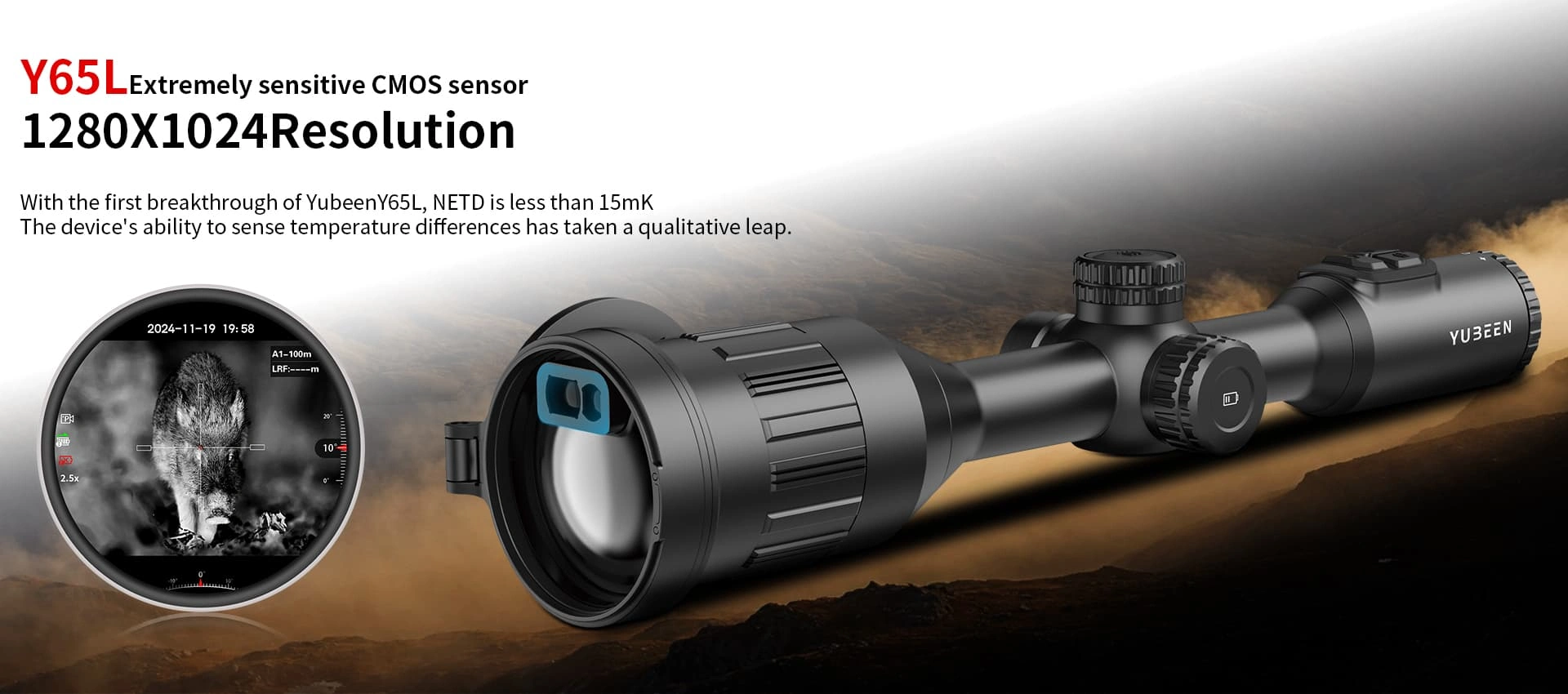
Thermal resolution tells you how many thermal pixels the sensor uses to build the image. A 1280×1024 sensor has far more image data than common 640×512 or 384×288 options. More pixels can make target edges, background layers, and small heat differences easier to read.
For hunters, this matters when distance, grass, branches, rocks, or uneven ground reduce visual clarity. A larger thermal array does not magically solve every field condition, but it gives the processor more real data to work with. That is why high resolution is a core buying point for premium thermal scopes.
Refresh Rate Affects Motion Smoothness
Refresh rate tells you how many times the image updates each second. A 25Hz refresh rate means the image refreshes 25 times per second. When you scan slowly or observe at longer range, this can be comfortable if the sensor, processor, and display work well together.
The key point is balance. A scope with very high resolution has more data to process. That data load affects refresh rate, power use, and system heat. So, when you see 1280×1024 at 25Hz, you should read it as a high-detail image system designed with controlled motion performance.
Real Field Value Comes from the Whole System
A thermal scope is not just a sensor. It has an optical system, a detection system, signal processing, and a display system. The lens collects thermal radiation. The detector turns it into electrical data. The processor builds the image. The display shows what your eye finally reads.
That is why you should compare resolution, NETD, lens, display, detection range, battery, and housing together. One good number cannot save a weak system.
What Does Thermal Resolution Actually Tell You?
Thermal resolution is one of the first specs hunters notice because it sounds easy to compare. Bigger sensor, better image. Usually, yes, but there is more to it. Resolution works best when it is supported by the right pixel pitch, sensitivity, lens, and display.
More Pixels for Finer Target Edges
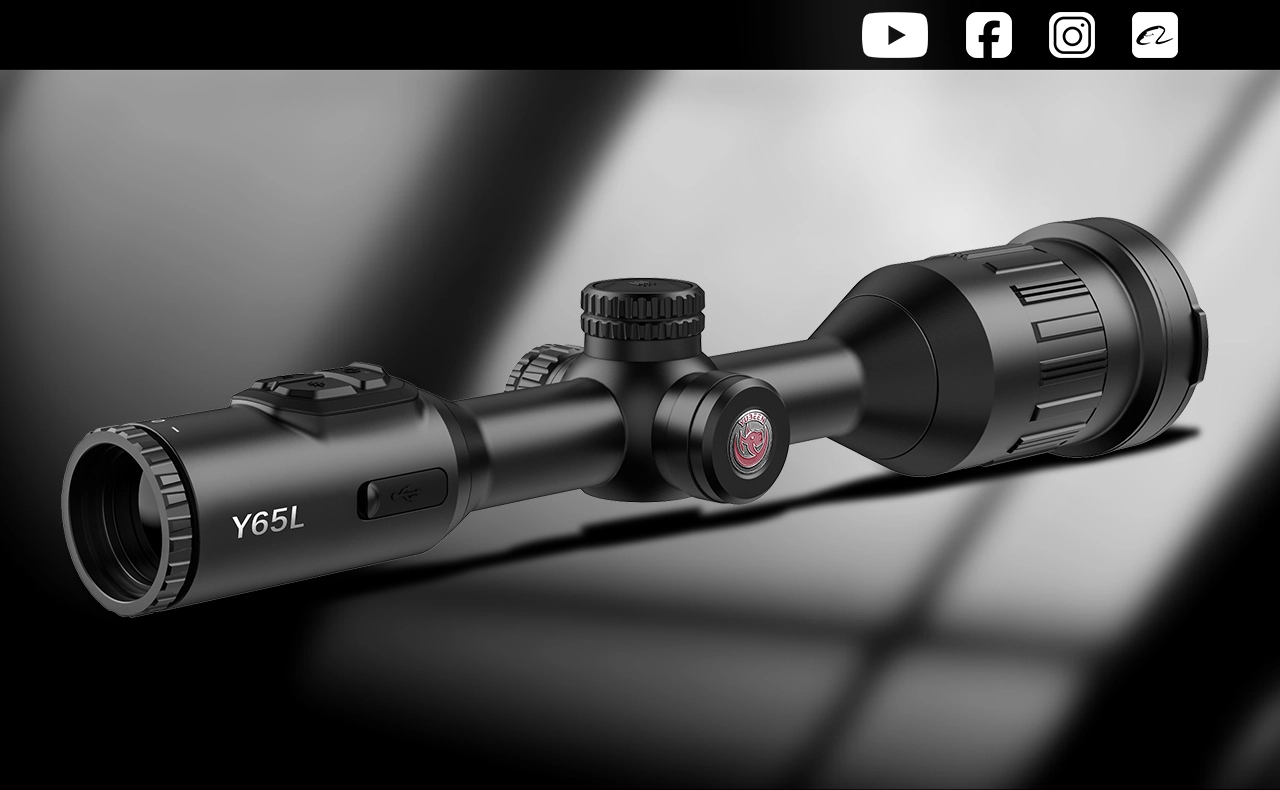
The Y65L | YUBEEN uses a 1280×1024 thermal resolution. This is the main reason it is positioned as a high-end thermal scope. With more pixels, the image can hold more edge detail and more separation between the target and background.
This is useful when the animal is partly covered by brush or when the background temperature is close to the target temperature. You are not just seeing a white or black shape. You are reading outline, movement, posture, and the relationship between the target and its surroundings.
12μm Pixel Pitch and Image Detail
Pixel pitch is the distance between pixels on the detector. Y65L uses a 12μm pixel interval. Smaller pixel pitch can help build a more compact high-resolution sensor while keeping strong detail output.
Resolution and pixel pitch should be read together. A large resolution number is useful, but pixel layout also affects image sharpness, lens matching, and field performance. It is a small spec line, but not a small detail.
NETD and Subtle Heat Difference
NETD measures how well a thermal device detects small temperature differences. Lower NETD means better sensitivity. Y65L lists NETD less than 15mK at 25°C, F#=1.0. For hunters, this matters in damp weather, cold mornings, shaded areas, or low-contrast terrain.
When the background and target have similar heat levels, low NETD helps the scope separate detail more clearly. It is not as easy to explain as resolution, but in the field it can be just as important.
| Spec | Y65L Data | What It Means for Hunters |
|---|---|---|
| Thermal Resolution | 1280×1024 | More thermal pixels for finer image detail |
| Pixel Interval | 12μm | Supports detailed imaging in a compact detector layout |
| NETD | Less than 15mK | Better sensitivity to subtle heat differences |
| Response Waveband | 8μm to 14μm | Works in the common long-wave infrared range |
| Lens | 60mm F1.0 | Helps collect more thermal energy for long-range use |
How Does Refresh Rate Change the Hunting Experience?
Refresh rate affects how natural the image feels when you move the scope or follow movement. It is not only about comfort. It also affects how easy it is to keep visual contact with what you are watching.
Smoother Scanning During Movement
A higher refresh rate usually feels smoother during fast scanning. Y65L uses 25Hz. For a high-resolution thermal system, that setting supports a balance between image detail, power use, and stable output.
If your hunting style involves slow scanning across fields, tree lines, or open ground, 25Hz can be enough when the image has strong detail. If you swing the scope very fast, you may notice motion differently. So, again, match the spec with the way you actually use the device.
Balanced Performance with High Resolution
The 1280×1024 sensor creates a large data stream. Processing that many thermal pixels takes power and computing work. Y65L’s 25Hz refresh rate should be viewed in that context. It is designed to keep image quality high rather than trade too much detail for speed.
For long-range observation, this makes sense. Hunters often need a clear outline and reliable contrast more than an ultra-fast image. Sharp detail helps when you pause, confirm, and decide.
OLED Display for Clearer Output
A strong sensor still needs a strong display. Y65L uses a 1.03-inch OLED display with 2560×2560 resolution. That matters because the display is where all sensor and processing work finally becomes visible.
The round display also supports a more familiar scope-style viewing feel. A good display will not create data that the sensor did not capture, but it can prevent good sensor data from being wasted. This is one of those specs buyers often skip, then regret later.
Which Y65L Features Matter Beyond Resolution and Refresh Rate?
Resolution and refresh rate are important, but they are not the full story. For hunting, the best thermal scope also needs range support, recording, recoil resistance, weather protection, and enough battery life.
3100m Detection Range and 60mm F1.0 Lens
Y65L lists a 3100m detection range with a 60mm F1.0 lens. Detection range tells you how far the system can detect a heat source under stated conditions. It does not mean every target will be clearly identified at that distance. Weather, target size, background, humidity, and user skill still matter.
The 60mm F1.0 lens supports long-range thermal energy collection. Combined with high resolution and low NETD, it gives Y65L a strong base for hunters who want more reach and more detail.
1000m LRF and Ballistic Calculation
Y65L includes a built-in 1000m laser rangefinder with ±1m accuracy. It also supports ballistic calculation. This matters because distance data is often one of the most important inputs before making a decision.
Ballistic calculation can use factors such as bullet weight, temperature, altitude, and distance reference. Having ranging and calculation functions in one device reduces gear switching. Less switching means less delay. In real outdoor use, that can feel very practical.
64GB Storage and Recoil-Activated Recording
Y65L includes built-in 64GB storage, on-board video recording, snapshot capture, audio recording, and recoil-activated recording. This is useful when you want to review what happened later without manually recording every moment.
The scope is also rated for 1000g/0.4ms recoil and has five zeroing profiles. These details matter for repeat use. A thermal scope should not only capture a clean image once. It should stay stable after mounting, use, adjustment, and transport.
How Should Hunters Compare Specs Before Buying?
Before buying, compare the specs by field concern. Do not read a product page from top to bottom and hope the right choice appears. Start with image clarity, then field use, then support.
Image Clarity Checklist
For image clarity, check resolution, NETD, pixel pitch, lens, display, image modes, and zoom behavior. Y65L gives you 1280×1024 resolution, 12μm pixel interval, NETD less than 15mK, 60mm F1.0 lens, and a 2560×2560 OLED display.
It also includes several palettes: Black Hot, White Hot, Red Hot, Fusion, Red Monochrome, and Green Monochrome. Palette choice is personal, but it helps you adapt to different backgrounds and viewing habits.
Field Use Checklist
Field use is where many buying mistakes happen. A scope may have great image specs but weak battery life, poor sealing, or limited recording. Y65L has IP67 protection, a working temperature range from -30°C to 55°C, and 9 hours of continuous running at 25°C with LRF on.
| Field Concern | Y65L Specification | Buying Value |
|---|---|---|
| Weather Protection | IP67 | Better resistance to dust and water |
| Working Temperature | -30°C to 55°C | Suitable for harsh outdoor conditions |
| Battery Operating Time | 9 hours at 25°C, LRF on | Supports long field sessions |
| Weight | 1000g without external battery | Premium build with manageable carry weight |
| Max Recoil | 1000g/0.4ms | Helps maintain stability after repeated use |
| Storage | Built-in EMMC 64GB | Supports video, snapshots, and review |
| Laser Rangefinder | 1000m, ±1m | Provides reliable distance data |
Buying Decision Based on Real Priorities
If your priority is image detail, long detection range, lower temperature sensitivity, built-in ranging, and full system functions, Y65L is a strong recommendation. It is not an entry-level lightweight unit. It is a high-spec thermal scope for buyers who want a more complete package.
If you mainly need short-range use or a lower budget, a smaller model may be enough. But if you want premium thermal detail and integrated tools, Y65L makes the decision easier.
Why Choose Yubeen for Thermal Scope Products and Support?
A thermal scope purchase is not only about the device. It is also about supply stability, warranty, sample testing, and cooperation support. This becomes even more important for dealers, outdoor product channels, and professional buyers.
Thermal Imaging R&D and Product Manufacturing
Yubeen focuses on optical scopes and thermal imaging sights, with a modern R&D center and production base in Yiwu, China. The company brings together optics, electronics, and image processing knowledge. That background supports products like Y65L, where sensor, lens, software, display, power, and housing must work as one system.
OEM, ODM, and Market-Fit Cooperation
Yubeen supports OEM and ODM cooperation. It also supports exclusive agency and national-level agency models. For importers and distributors, this is useful because each market has different price levels, feature preferences, and after-sales expectations.
The company also has both high-technology products and cost-effective product lines. That gives buyers room to build a broader catalog rather than depend on one product tier.
Warranty, Service, and Contact Path
Yubeen offers a two-year warranty for the whole unit. For quality issues, the policy supports replacement rather than repair. The cooperation process is clear: sample delivery, sample confirmation, bulk order, and factory visit for deeper cooperation.
If you are comparing thermal scope specs in 2026, Y65L deserves attention because it connects high resolution, low NETD, 25Hz refresh rate LRF and so on. For serious hunting optics buyers, the full-system balance is the point.
FAQ
Q: Is Thermal Resolution More Important Than Refresh Rate?
A: Thermal resolution and refresh rate affect different things. Resolution affects image detail, while refresh rate affects motion smoothness. For long-range hunting observation, high resolution with stable refresh performance is often more useful than looking at refresh rate alone.
Q: Why Does NETD Matter When Choosing a Thermal Scope?
A: NETD shows how well the device can detect small temperature differences. A lower NETD helps the scope show clearer detail when the target and background have similar heat levels.
Q: Is Y65L a Good Choice for Hunters Who Want Long-Range Thermal Detail?
A: Yes. Y65L is suitable for hunters who value 1280×1024 thermal resolution, NETD less than 15mK, 3100m detection range, 1000m laser rangefinder, 2560×2560 OLED display, and integrated ballistic functions.
