Airgun vs rimfire scopes can share similar optical specifications, but mechanical compatibility depends on recoil behavior, parallax, mounting, and the exact optic design.
The real answer depends on the exact platform.
A spring-piston airgun can expose an optic to a very different mechanical impulse from a PCP airgun or a rimfire rifle. At the same time, airgun use often places more emphasis on close-range parallax adjustment and mounting stability.
So the right question is not simply:
“Is a 4–16×44 scope rated for airgun and rimfire?”
It is:
“Has this exact scope been designed and tested for the recoil, mounting system, focus distance, and use conditions of this exact platform?”
For a broader optical-scope selection framework, see how to choose a riflescope.
Airgun Is Not One Recoil Environment
The word “airgun” covers several very different power systems.
That distinction matters when choosing an optic.
Spring-Piston and Gas-Ram Airguns
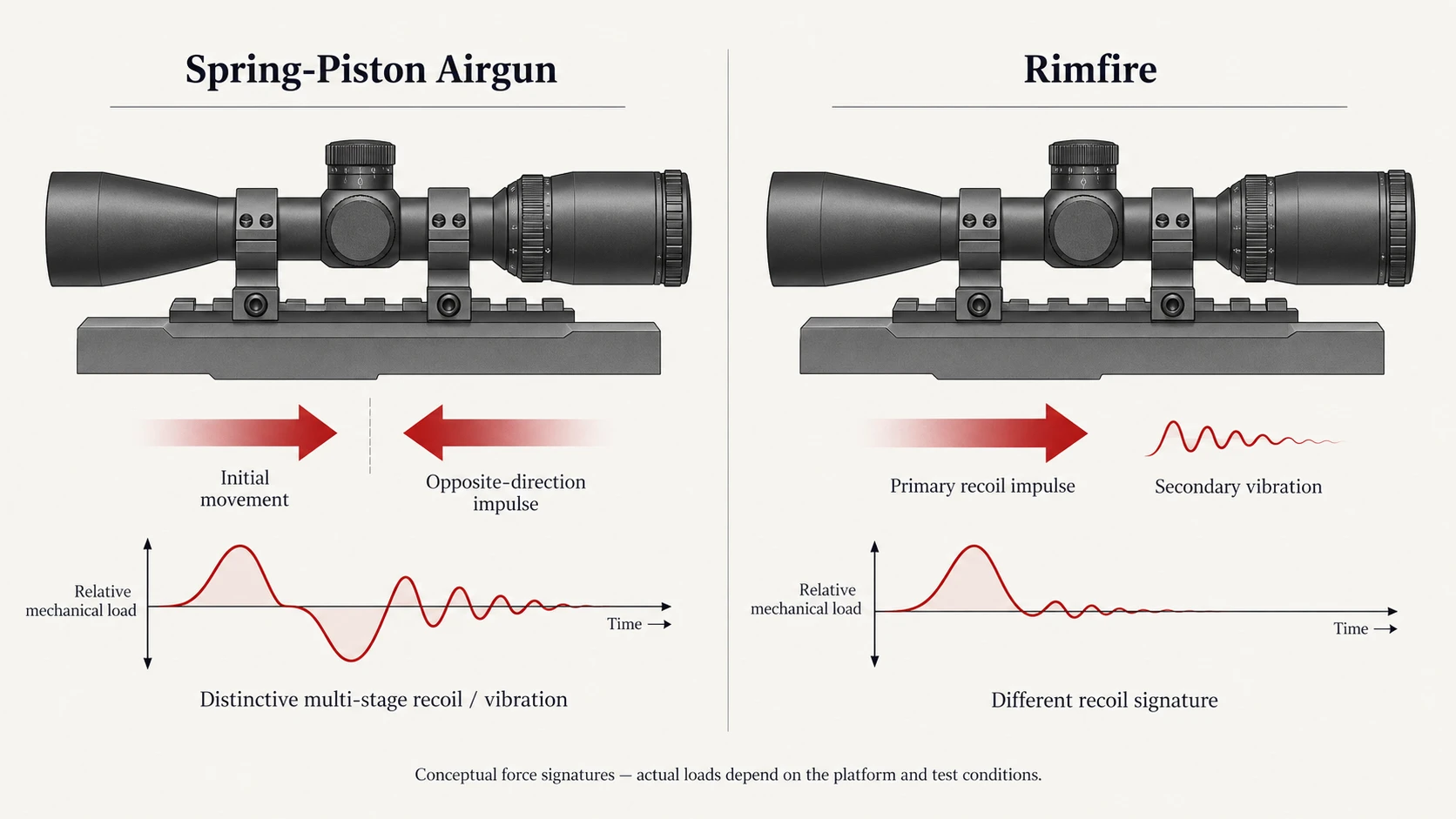
Spring-piston systems use a moving piston to compress air during the firing cycle.
The motion and sudden deceleration of that internal mass can produce a recoil and vibration pattern that differs significantly from conventional firearm recoil.
Depending on the design, the scope may experience forces in more than one direction during the firing cycle.
This is why spring-piston airguns have historically been difficult on scopes that were not designed for them.
Gas-ram systems replace the conventional spring with a gas spring, but they can still produce a sharp mechanical firing cycle.
The exact load varies by platform.
Therefore:
a scope that works well on one springer should not automatically be assumed suitable for every spring-piston or gas-ram airgun.
PCP Airguns
Pre-charged pneumatic airguns use stored compressed air and do not have the same heavy spring-and-piston cycle.
Their mechanical impulse is therefore different from that of a spring-piston system.
This does not mean every optic is automatically compatible with every PCP.
Mounting, vibration, weight, rail type, and intended use still matter.
But “airgun recoil” should never be treated as one universal mechanical condition.
Rimfire Creates a Different Mechanical Requirement
Rimfire platforms also generate recoil and vibration.
However, the mechanical impulse is generally different from the distinctive firing cycle associated with spring-piston airguns.
For the optic, that means compatibility should still be checked through:
- mechanical durability;
- mount stability;
- ring compatibility;
- turret repeatability;
- internal erector stability;
- eye relief;
- intended operating conditions.
A scope being suitable for rimfire does not automatically prove that it is spring-piston-airgun rated.
The reverse is also not something that should be assumed without the manufacturer’s specification.
What Does 4–16×44 Actually Tell You?
A designation such as:
4–16×44
normally describes two optical parameters.
4–16×
The magnification can be adjusted from approximately 4× to 16×.
44 mm
The objective lens has a nominal diameter of 44 mm.
These values tell you something about optical configuration.
They do not tell you:
- recoil rating;
- spring-piston compatibility;
- minimum parallax distance;
- mount type;
- reticle durability;
- turret durability;
- waterproof rating;
- return-to-zero performance.
This is why two 4–16×44 scopes can have very different intended applications.
Recoil Direction Matters, Not Just Recoil Magnitude
Scope durability is sometimes reduced to a single question:
“How much recoil can it handle?”
That is incomplete.
The internal optical system includes components such as:
- erector assembly;
- reticle support;
- adjustment mechanisms;
- lens retention;
- turret system.
These components experience acceleration during the firing cycle.
A spring-piston system can impose a different sequence of forces from a conventional rearward recoil impulse.
Therefore, an optic intended for heavy conventional recoil is not automatically proven suitable for every springer merely because the recoil “feels stronger” or “weaker” to the shooter.
The relevant question is:
what type of shock and vibration was the optic actually designed and tested to withstand?
Why a Shock Rating Alone Is Not Enough
A published shock specification can be useful.
But the number should not be interpreted without test context.
For example, a statement such as:
1000G
does not independently tell the reader:
- pulse duration;
- number of cycles;
- direction;
- frequency content;
- fixture;
- acceptance criteria.
A high shock number may demonstrate robust construction under a stated test.
It does not automatically create a universal compatibility rating for every airgun powerplant.
This article therefore does not classify a Yubeen scope as spring-piston compatible solely from a shock-resistance number.
Parallax Matters More Than Many Buyers Expect
Mechanical compatibility is only one part of the problem.
Airgun use frequently occurs at shorter distances than many centerfire-oriented scope setups.
At shorter target distances, parallax error can become noticeable if the scope is optimized for a much longer fixed distance.
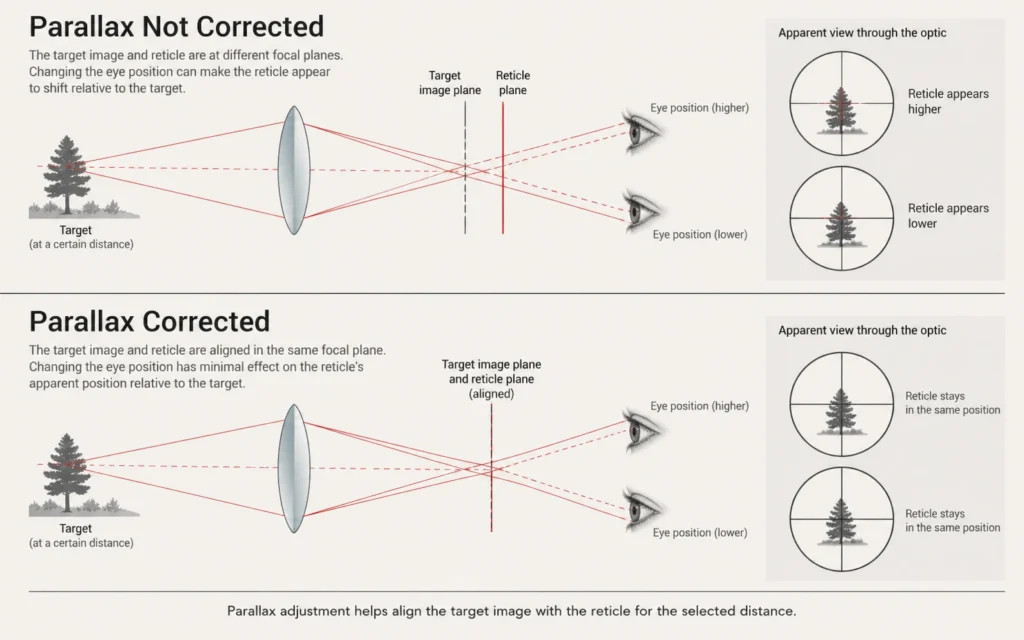
Parallax occurs when the target image and reticle are not effectively aligned in the same optical plane from the shooter’s viewing position.
If the eye moves behind the scope, the reticle can appear to shift relative to the target.
That apparent shift can affect aiming consistency.
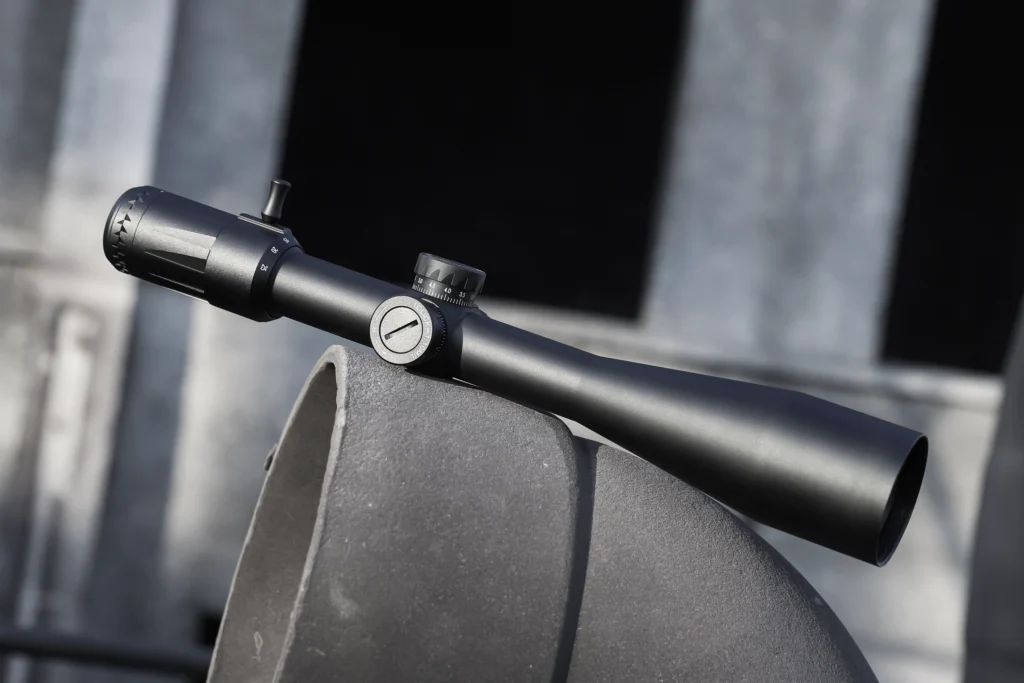
Adjustable Objective and Side Focus
Two common methods of managing parallax are:
- Adjustable Objective — AO;
- Side Focus — SF.
Both can allow the optical system to be adjusted for different target distances.
The difference is mainly in where the control is located and how the optical mechanism is operated.
Adjustable Objective
An AO system uses a rotating adjustment around the objective section.
Side Focus
A side-focus system places the adjustment on a turret-like side control.
Neither architecture is inherently more accurate simply because of where the control is located.
What matters is:
- actual adjustment range;
- minimum usable distance;
- calibration;
- optical quality;
- repeatability.
For an airgun used at short distances, a close minimum parallax distance can be more important than the words AO or SF alone.
A 100-Yard Parallax Specification May Not Suit Every Airgun Use
If a scope has fixed parallax at approximately 100 yards, that may be perfectly reasonable for some applications.
It may be less convenient for a user working regularly at much shorter distances.
A scope with adjustable parallax may therefore offer greater flexibility.
But the exact minimum distance must be taken from the specification for that model.
Do not assume:
side focus = 10-yard minimum.
Some scopes focus much closer than others.
Magnification Has to Match the Actual Distance
A 4–16× magnification range provides substantial flexibility, but it is not automatically ideal for every airgun or rimfire use.
At 4×:
- field of view is wider;
- target acquisition is generally easier;
- eye position may be less demanding.
At 16×:
- a smaller portion of the scene is visible;
- target detail appears larger;
- movement and eye-position errors become more noticeable;
- parallax and stability become more important.
For very close-range use, even 4× may be more magnification than some users prefer.
For more distant precision work, 16× may be useful.
The correct range depends on target size, distance, field of view, and use case.
For a deeper explanation, see how to select riflescope magnification.
The 44 mm Objective Does Not Determine Compatibility
A 44 mm objective affects the optical and physical design of the scope.
It can influence:
- objective housing size;
- mounting height;
- exit pupil at a given magnification;
- overall dimensions.
It does not determine whether the scope is airgun-rated or rimfire-rated.
Likewise:
a larger objective does not automatically mean a brighter image in every condition.
Image quality also depends on:
- optical coatings;
- glass quality;
- magnification;
- exit pupil;
- stray-light control;
- transmission;
- eye position.
Mounting Can Be as Important as the Scope
Even a mechanically robust optic can perform poorly if the mounting system moves.
Airguns and rimfire platforms can use different interfaces, including:
- 11 mm dovetail;
- 3/8-inch dovetail;
- Picatinny-style rails;
- Weaver-style interfaces;
- proprietary adapters.
The exact rail and ring system must match the platform.
On some spring-piston airguns, scope movement can be significant enough that the mounting system incorporates a stop pin or another mechanical recoil-stop feature.
The correct solution depends on the platform.
Do not solve mount movement simply by overtightening rings or clamps beyond their specified torque.
Ring Height and Objective Clearance
A 44 mm objective normally requires enough ring height to clear:
- the barrel;
- receiver;
- rail;
- rear sight;
- other hardware.
But “higher is safer” is not a good universal rule.
Excessive mounting height can make eye alignment and cheek position less natural.
The goal is usually:
adequate mechanical clearance with a comfortable and repeatable eye position.
Exact ring height depends on the actual scope body, rail, rings, and platform geometry.
Eye Relief Still Matters
Eye relief describes the distance between the rear optical system and the user’s eye at which the full image can be viewed.
For a 4–16× scope, check eye relief across the magnification range rather than only at one setting.
A good mounting position should allow:
- consistent head position;
- full field of view;
- comfortable eye placement.
The scope should not be positioned merely to make the objective bell fit.
Optical alignment with the user matters too.
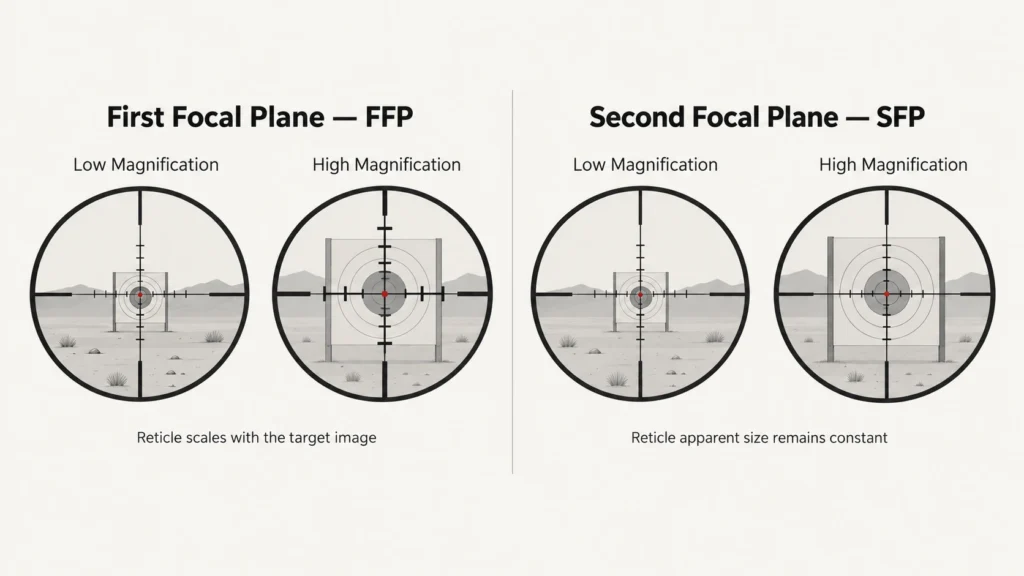
FFP or SFP Is a Separate Decision
A 4–16×44 optic may use:
- First Focal Plane;
- Second Focal Plane.
That has nothing to do with whether the optic is airgun-rated.
Focal plane determines how reticle subtension behaves when magnification changes.
Recoil compatibility is a mechanical question.
For the complete distinction, see FFP vs SFP riflescopes.
Turret Repeatability Is Also Independent
Likewise, turret design is separate from airgun or rimfire classification.
Important characteristics can include:
- click consistency;
- tracking;
- adjustment range;
- zero reset;
- zero stop where applicable;
- mechanical repeatability.
A scope can survive recoil but still have poor adjustment behavior.
Or it can have excellent turrets but be unsuitable for a specific recoil environment.
The system must be evaluated as a whole.
What About Reticle Type?
Reticle choice should follow how the optic is used.
A simple reticle may be adequate when the primary need is a clear central aiming reference.
A MIL or MOA reticle may provide:
- hold references;
- wind references;
- ranging information.
An illuminated reticle may improve visibility under some lighting conditions.
None of these features proves platform compatibility.
They affect usability, not mechanical rating.
Airgun vs. Rimfire: Practical Scope Requirements
| Factor | Spring-Piston / Gas-Ram Airgun | PCP Airgun | Rimfire |
|---|---|---|---|
| Mechanical impulse | Distinctive multi-stage / bidirectional behavior can matter | Different, generally less springer-like | Conventional recoil pattern |
| Scope compatibility | Must verify exact rating | Verify exact product/platform | Verify exact product/platform |
| Parallax / close focus | Often especially important | Often important | Depends on distance |
| AO / Side Focus | Frequently useful | Frequently useful | Useful where distance varies |
| Mount movement | Can be a major issue on some platforms | Platform-dependent | Platform-dependent |
| Recoil-stop hardware | May be relevant | Depends on rail/system | Usually system-dependent |
| 4–16× usefulness | Distance-dependent | Distance-dependent | Distance-dependent |
| 44 mm objective | Optical/mounting factor | Optical/mounting factor | Optical/mounting factor |
| FFP / SFP | Separate reticle decision | Separate reticle decision | Separate reticle decision |
| Shock number alone | Not enough to prove compatibility | Not enough | Not enough |
The important message is that the scope specification should be matched to the powerplant and use case, not merely to the word “airgun” or “rimfire.”
Can the Same Scope Work on Both?
Yes—if the manufacturer has designed or approved the exact scope for both applications.
There is no optical law preventing one scope from working on both an airgun and a rimfire platform.
The issue is engineering qualification.
Before transferring a scope between platforms, confirm:
- recoil / shock compatibility;
- whether spring-piston use is explicitly supported;
- rail and ring compatibility;
- required parallax range;
- eye-relief position;
- objective clearance;
- mounting instructions.
Do not infer those points simply from the magnification and objective diameter.
How to Evaluate a Yubeen 4–16×44 Scope
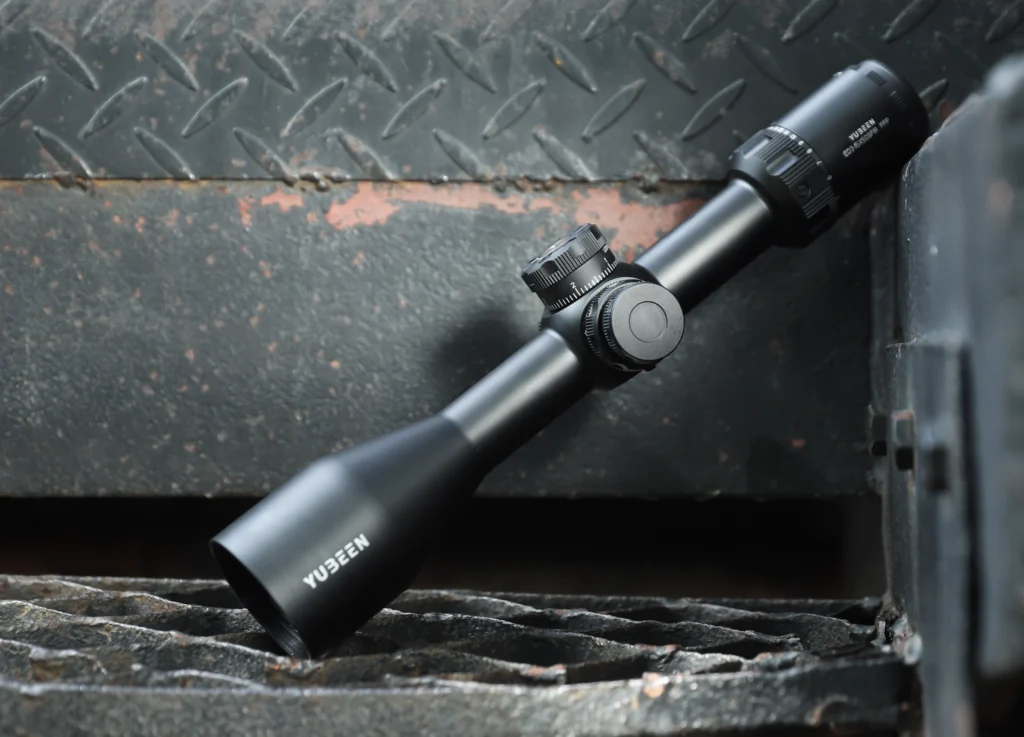
Yubeen has current optical products in the 4–16×44 class, but this article should not turn a general optical specification into an unsupported application rating.
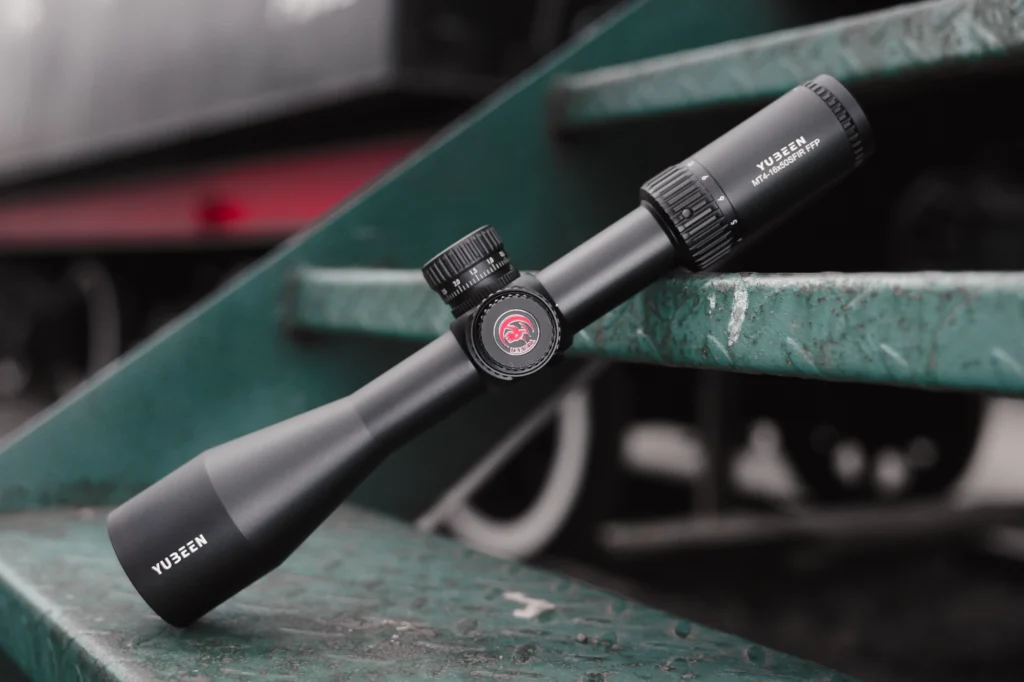
For the exact product shown, confirm from the current documentation:
- exact model name;
- magnification;
- objective diameter;
- focal plane;
- main-tube diameter;
- parallax / focus system;
- click value;
- eye relief;
- shock specification;
- dimensions and weight;
- approved platform compatibility.
A published shock value should remain a shock specification.
It should not be rewritten as:
“spring-piston rated”
unless Yubeen has explicitly validated that application for the exact model.
This distinction protects both technical accuracy and long-term product content.
What Matters More Than “4–16×44”
If you are choosing one optic for an airgun or rimfire platform, prioritize:
- confirmed platform compatibility;
- appropriate parallax / focus range;
- correct mounting interface;
- stable rings and mounting hardware;
- useful magnification and field of view;
- suitable reticle;
- adequate eye relief;
- mechanical adjustment quality;
- objective clearance;
- verified product-specific durability data.
Only after those points are clear does the 4–16×44 label become truly meaningful.
A Format Is Not a Rating
The most important conclusion is simple:
4–16×44 describes an optical configuration. It does not certify a platform.
A well-designed 4–16×44 scope can potentially serve both airgun and rimfire applications.
But compatibility must come from the exact product specification or manufacturer’s validation.
For spring-piston and gas-ram airguns, that distinction is particularly important because their firing cycle can stress optics differently from other platforms.
Choose the scope from the actual platform, mounting system, focus distance, and verified durability—not from magnification numbers alone.
FAQ
Can Any Rimfire Scope Be Used on a Spring-Piston Airgun?
No. A scope suitable for rimfire use should not automatically be assumed suitable for spring-piston recoil. Check whether the exact optic is approved for springer use.
Are PCP Airguns as Hard on Scopes as Spring-Piston Airguns?
They have a different firing cycle. PCP systems do not use the same spring-and-piston movement, so they should not be treated as mechanically identical to spring-piston airguns.
Does 1000G Mean a Scope Is Springer Rated?
Not automatically. A shock number requires test context, including pulse duration, direction, cycle count, and test method. Use explicit manufacturer compatibility guidance.
Is Side Focus Better Than Adjustable Objective for Airguns?
Not inherently. Both can manage focus and parallax. The more important question is the actual adjustment range and whether it reaches the distances you use.
Is 4–16× Too Much Magnification for an Airgun?
Not necessarily. It depends on target size, distance, field of view, and application. At very short distance, some users may prefer a lower minimum magnification.
Is a 44 mm Objective Good for Rimfire?
It can be. Objective diameter alone does not determine suitability. Mount height, optical quality, magnification, exit pupil, weight, and use distance also matter.
Can One 4–16×44 Scope Be Used on Both Platforms?
Yes, if the exact scope is mechanically compatible with both and its mounting and parallax requirements suit both platforms.