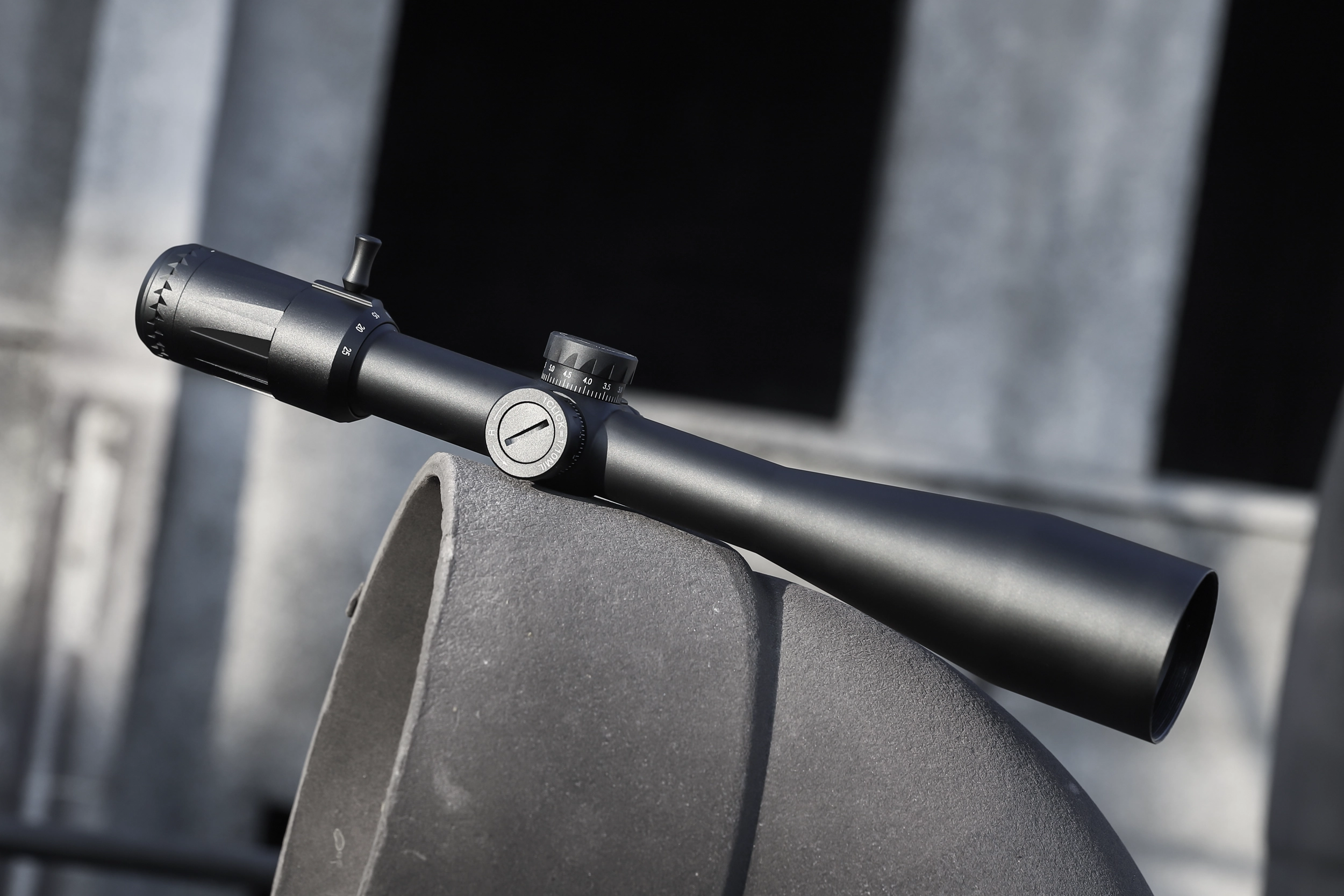
How to choose an optical scope for long-range hunting depends on balancing magnification, field of view, reticle design, parallax, eye relief, and mechanical reliability.
A scope is a complete optical and mechanical system.
Magnification, field of view, reticle design, focal plane, parallax adjustment, eye relief, glass quality, turret behavior, mounting geometry, weight and mechanical reliability all affect how the optic performs in real use.
That means there is no single specification that defines a “long-range scope.”
The better approach is to identify the distances, terrain, light conditions and reticle workflow you actually expect to use, then evaluate how the complete scope supports those requirements.
For a broader overview of riflescope selection, see our guide to how to choose a riflescope.
Start With the Actual Use Case, Not the Maximum Specification
Before comparing scopes, define the problem the optic needs to solve.
Useful questions include:
- What distances are realistically expected?
- How large is the subject being observed?
- Is the terrain open or visually cluttered?
- Will the scope often be used at dawn or dusk?
- Is rapid scanning important?
- Will the reticle be used for angular holds?
- Will adjustments normally be dialed on the turrets?
- How much weight is acceptable?
- How much magnification can actually be used from the expected shooting position?
A specification that looks impressive on a product page may add little practical value if it does not match the actual conditions.
More Magnification Is Not Automatically Better
Magnification makes a distant subject appear larger in the image.
That can help when more visual detail is needed.
But increasing magnification also changes the viewing experience.
At higher power:
- field of view becomes narrower;
- apparent movement becomes more noticeable;
- eye position can become more demanding;
- atmospheric disturbance becomes easier to see;
- exit pupil becomes smaller for the same objective diameter.
This is why maximum magnification should not be confused with useful magnification.
A scope that reaches 30× is not automatically more useful than one that reaches 20× or 25×.
The relevant question is:
At what magnification does the complete optical system still provide the field of view, image quality and handling needed for the task?
For the full discussion, see how to select riflescope magnification.
Field of View Matters More Than It First Appears
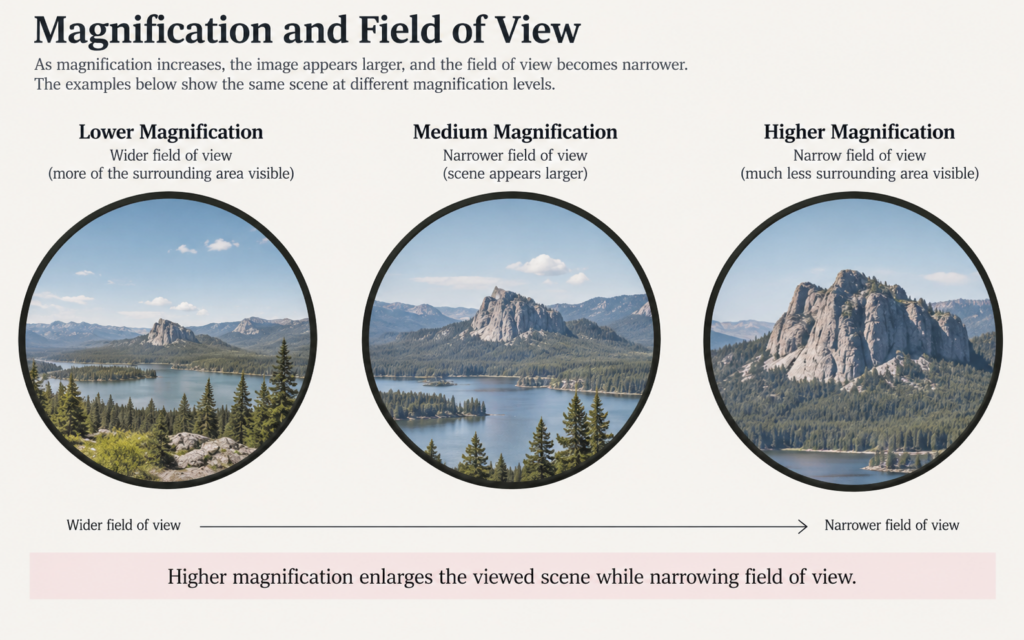
Higher magnification normally narrows the visible angular field.
A narrower field of view can make it harder to:
- locate a subject initially;
- maintain situational awareness;
- follow movement;
- understand surrounding terrain.
Lower magnification usually provides a wider view and easier acquisition.
That creates a basic trade-off:
lower magnification → wider scene coverage
while:
higher magnification → larger apparent target image.
A useful long-range scope therefore needs more than a large top-end number.
The lower end of the magnification range can be just as important.
Magnification Cannot Recover Detail the Optics Never Resolved
Magnification enlarges the image produced by the optical system.
It does not guarantee that the image contains additional useful information.
If the image is already limited by:
- poor focus;
- atmospheric mirage;
- low contrast;
- optical aberration;
- insufficient resolution;
increasing magnification may simply make those limitations more visible.
This is why optical resolution and contrast remain important even on a high-magnification scope.
Atmospheric Mirage Can Become the Limiting Factor
At longer distances, the atmosphere becomes part of the optical path.
Temperature gradients can distort the apparent image.
This is often seen as shimmer or mirage.
More magnification does not remove atmospheric distortion.
In some conditions, reducing magnification can actually make the image easier to interpret because the viewer is no longer enlarging the atmospheric disturbance as aggressively.
This is another reason not to choose an optic solely from its maximum magnification.
Objective Diameter Is Only One Part of Low-Light Performance
A larger objective can allow a larger light bundle into the optical system.
But objective diameter alone does not determine how bright the viewed image appears.
Other factors include:
- magnification;
- exit pupil;
- glass transmission;
- lens coatings;
- internal stray-light control;
- observer pupil size;
- ambient conditions.
A 56 mm objective is therefore not automatically “brighter” than every 50 mm objective under every condition.
The complete optical system matters.
Exit Pupil Helps Explain the Relationship
A useful simplified relationship is:
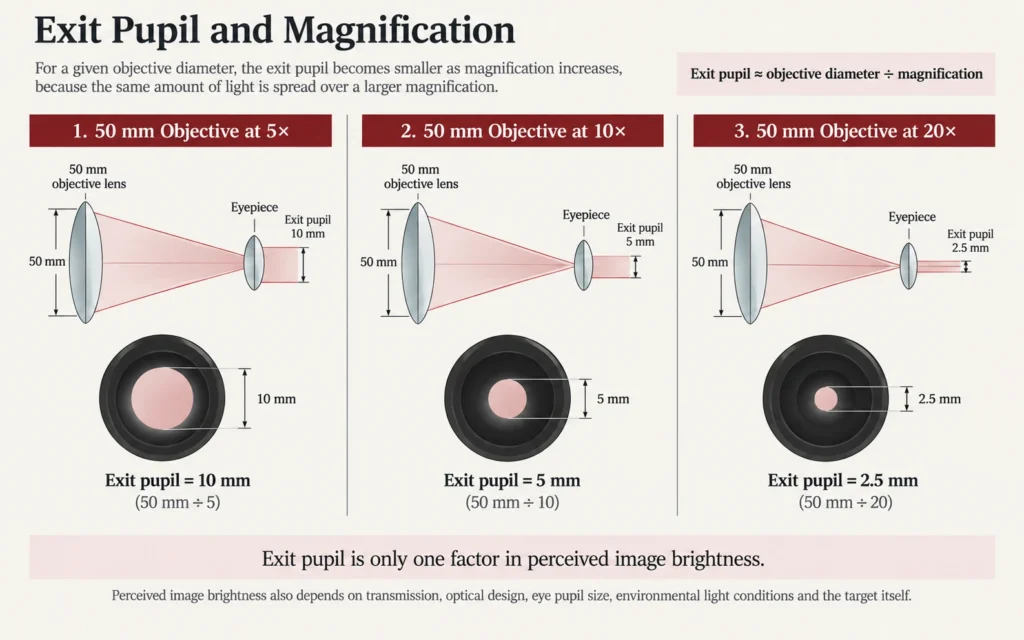
Exit pupil ≈ objective diameter ÷ magnification
For example, the same 50 mm objective produces a larger exit pupil at 5× than it does at 20×.
That does not mean exit pupil alone determines image quality.
It helps explain why increasing magnification reduces the diameter of the light bundle leaving the eyepiece.
Once the exit pupil becomes smaller than the observer’s pupil, the scope itself can become the limiting aperture.
Actual perceived brightness still depends on transmission, contrast and viewing conditions.
A Larger Objective Also Changes the Physical Scope
Objective size affects more than image formation.
A larger objective can also increase:
- housing diameter;
- mounting height;
- overall weight;
- forward mass.
A higher mounting position can influence cheek position and eye alignment.
So the correct question is not:
“What is the biggest objective available?”
It is:
“What objective size provides an appropriate optical and mechanical balance for the platform?”
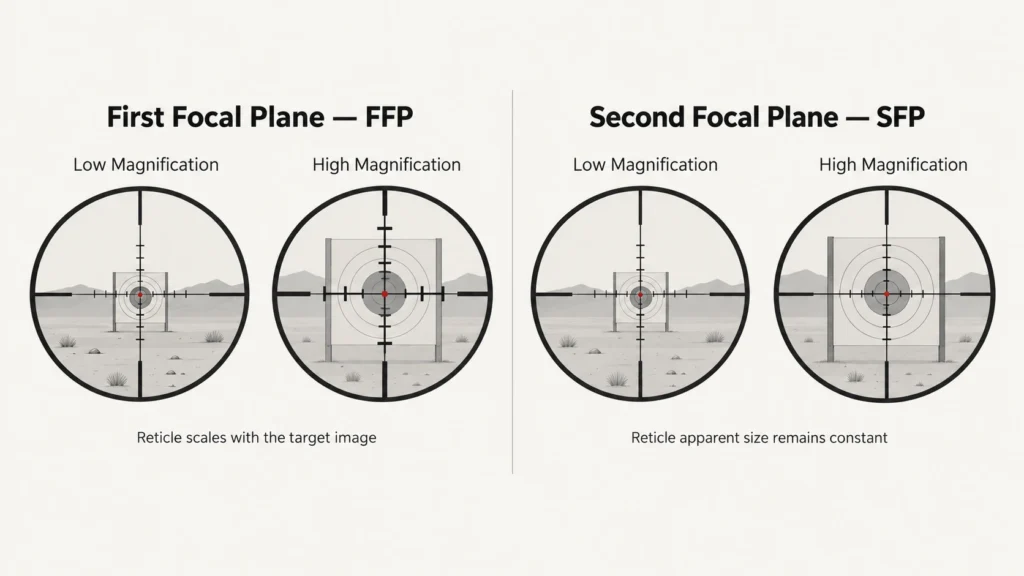
First Focal Plane and Second Focal Plane Solve Different Reticle Problems
Focal plane affects how the reticle behaves when magnification changes.
First Focal Plane
In an FFP scope, the reticle appears to scale with the target image.
Its angular subtensions remain proportional across the magnification range.
That can simplify the use of:
- MIL references;
- MOA references;
- elevation holds;
- wind holds;
- reticle-based ranging.
Second Focal Plane
In an SFP scope, the reticle appears to remain the same size while the target image changes.
That means angular reticle references are magnification-dependent.
If MIL, MOA or BDC markings are used for measurement or holding, they should be used at the manufacturer’s calibrated magnification or with the correct conversion.
Neither architecture is inherently more accurate.
For the detailed comparison, see FFP vs SFP riflescopes.
Reticle Design Matters as Much as Focal Plane
Two FFP scopes can have very different reticle usability.
The same is true of SFP scopes.
Important reticle characteristics include:
- central aiming-point visibility;
- line subtension;
- number of hold references;
- clutter;
- low-power visibility;
- high-power precision;
- illumination where provided.
A very fine reticle may work well against a bright, high-contrast background but become difficult to see in low light.
A very heavy reticle may remain highly visible but obscure more fine detail.
The useful reticle is the one that matches the intended magnification range and observation conditions.
Illuminated Reticles Need Appropriate Brightness Control
Illumination can improve reticle visibility against dark or complex backgrounds.
But brighter is not always better.
If illumination is excessive, the glowing reticle can dominate the image and reduce the viewer’s ability to see fine scene detail.
A practical illumination system should provide enough adjustment to match changing ambient conditions.
Illumination does not increase the optical transmission or resolution of the scope.
It only changes the visibility of the illuminated reticle elements.
Turret Tracking Is a Mechanical Requirement
A scope intended for repeated adjustment must do more than display a precise click value on the turret.
The internal adjustment mechanism should respond consistently to:
- elevation input;
- windage input;
- repeated movement;
- return toward the original setting.
Important concepts include:
- click value;
- adjustment range;
- tracking consistency;
- repeatability;
- zero reset;
- zero stop where provided.
These characteristics belong to the mechanical system.
They are not determined by whether the reticle is FFP or SFP.
Zero Stop and Return to Zero Are Related but Different
A zero stop provides a mechanical reference that can help prevent the elevation turret from being dialed below a configured zero position.
Return-to-zero performance is a broader repeatability question.
It asks whether the system returns to the expected optical position after adjustments.
A scope can include a zero-stop feature without that feature alone proving perfect tracking.
Likewise, return-to-zero performance depends on the complete mechanical system.
Avoid treating either term as a guarantee of impact placement.
Adjustment Range Should Be Evaluated With the Mounting System
Total internal elevation travel matters in longer-distance optical setups.
But published total travel does not automatically equal usable travel in both directions after zeroing.
The final available adjustment depends on:
- where the optical system sits within its mechanical range;
- mounting geometry;
- rail inclination where used;
- zero position.
This is why adjustment range should be considered together with the actual mounting system rather than as an isolated catalog number.
Parallax Becomes More Important as Precision Requirements Increase
Parallax can cause the reticle to appear to move relative to the target when the eye changes position behind the optic.
Adjustable parallax systems are commonly implemented through:
- side focus;
- adjustable objective.
The goal is to bring the target image into the appropriate optical relationship with the reticle for the selected distance.
Side focus does not make a scope inherently more mechanically accurate.
It provides a convenient method of adjusting the optical system.
Focus and Parallax Adjustment Are Related but Not Identical Ideas
A parallax control often also changes apparent target focus.
That can make the control feel like a simple focus knob.
But the reason it matters for aiming consistency is the relationship between the target image and reticle planes.
A visually sharp target does not by itself prove that parallax has been completely eliminated.
Likewise, a printed distance marking on a side-focus control should be treated as a reference rather than a substitute for checking the actual image.
Eye Relief Needs to Work Across the Magnification Range
Eye relief describes the distance from the rear of the optical system at which the viewer can see the complete image.
The important issue is not only the published number.
The scope also needs to allow:
- repeatable head position;
- comfortable eye alignment;
- a usable eye box;
- appropriate mounting position.
A scope that produces a technically sharp image but requires an awkward head position is not well matched to the user or platform.
Eye Box Becomes More Noticeable at Higher Magnification
The eye box is the three-dimensional region in which the eye can remain while still seeing a usable image.
At higher magnification, eye position often becomes more demanding.
This is especially noticeable when:
- viewing from an unstable position;
- changing magnification;
- acquiring the image quickly.
That does not mean a high-magnification optic necessarily has a poor eye box.
It means eye-box behavior should be evaluated as part of the complete design.
Glass Quality Is More Than a Marketing Label
Terms such as:
- HD;
- ED;
- premium glass;
- high definition
can describe real design features, but the label alone does not tell you the complete optical result.
Relevant image characteristics include:
- resolution;
- contrast;
- chromatic aberration control;
- flare control;
- edge performance;
- transmission;
- color neutrality.
ED glass can help control chromatic aberration in an appropriate optical design.
It does not by itself guarantee superior performance in every other optical characteristic.
Lens Coatings Matter Throughout the Optical System
A riflescope contains multiple air-to-glass surfaces.
Coatings can help manage:
- reflection;
- transmission;
- glare;
- contrast.
But statements such as “fully multi-coated” should not be treated as enough information to rank all optical systems.
Coating formulation, application quality, lens design and internal baffling all contribute to the final image.
Main-Tube Diameter Does Not Directly Determine Brightness
Common variable scopes may use different main-tube diameters.
A larger tube can provide more physical room for:
- adjustment mechanisms;
- erector movement;
- structural design.
It also affects:
- weight;
- ring compatibility;
- overall size.
But a 34 mm main tube does not automatically gather more light than a 30 mm tube.
The objective and optical system determine the incoming light path.
Tube diameter should be evaluated primarily as a mechanical and adjustment-system parameter.
Mounting Height Should Be Only as High as Necessary
The scope needs enough clearance for:
- objective housing;
- rail;
- barrel or receiver;
- other hardware.
But excessive height can make eye alignment less natural.
A useful mounting position normally aims for:
adequate physical clearance plus a comfortable, repeatable head position.
Exact ring height depends on the scope, mount and platform geometry.
Do not select ring height from objective diameter alone without checking the actual housing dimensions.
Ring and Rail Compatibility Must Be Exact
Before installing the scope, verify:
- main-tube diameter;
- ring diameter;
- rail/interface type;
- ring spacing;
- mounting instructions.
A mechanically mismatched ring or rail can create problems that no optical specification can solve.
Do not compensate for an incorrect interface by excessive clamping force.
After the scope is mounted correctly, see how to bore sight a riflescope before final zeroing for the initial alignment workflow.
Weight and Balance Matter in the Field
Large objectives, larger tubes, high magnification and complex turret systems can increase weight.
That may be acceptable in a stable setup.
It may be less desirable when equipment has to be carried for long periods.
A heavier scope can also shift system balance.
The useful question is:
Does the optical capability justify the additional size and mass for the intended field use?
There is no universal answer.
Reliability Should Be Read From Product-Specific Testing
Mechanical durability may be described using shock or recoil testing.
Environmental protection may be described with an IP rating.
Temperature capability may also be specified.
Those values must stay tied to the exact model.
Do not assume that every scope in a product family has:
- the same shock qualification;
- the same IP rating;
- the same operating temperature;
- the same zero-stop system.
Likewise, a single high shock number does not independently prove every form of mechanical reliability.
Long-Range Scope Selection: Practical Comparison
| Factor | Why It Matters | Common Mistake |
|---|---|---|
| Magnification range | Determines image scale and FOV flexibility | Choosing only by maximum power |
| Field of view | Affects scanning and acquisition | Ignoring the low end of the zoom range |
| Objective size | Affects exit pupil and physical geometry | Assuming larger is always brighter |
| Exit pupil | Helps explain brightness at different magnifications | Treating it as the only image-quality metric |
| FFP / SFP | Determines reticle scaling behavior | Treating FFP as automatically superior |
| Reticle design | Controls visibility and hold usability | Choosing more markings than needed |
| Illumination | Helps reticle visibility | Using excessive brightness |
| Turret system | Controls adjustment workflow | Assuming click labels prove tracking |
| Parallax adjustment | Helps manage reticle/target alignment | Treating side focus as automatic accuracy |
| Eye relief / eye box | Affects mounting and usability | Checking only one magnification |
| Main tube | Affects mechanics and ring compatibility | Assuming wider tube means brighter image |
| Mounting | Connects optic to platform | Ignoring ring height and interface |
| Weight | Affects balance and carrying | Assuming heavier always means stronger |
| Reliability | Important for repeated field use | Generalizing one model’s test data |
The goal is not to maximize every specification.
It is to create a balanced optical system.
When Higher Magnification Makes Sense
Higher magnification can be useful when:
- the subject is small in the field of view;
- atmospheric conditions are stable enough;
- the viewing position is sufficiently steady;
- optical resolution remains useful;
- field of view is still adequate.
Higher magnification becomes less useful when:
- mirage dominates the image;
- the field of view becomes too narrow;
- image shake becomes distracting;
- exit pupil becomes too small for the conditions;
- eye position becomes excessively demanding.
When a Wider Magnification Range Helps
A broader zoom range can provide flexibility when the same scope needs to handle:
- relatively closer observation;
- wide-area scanning;
- more distant inspection.
But zoom ratio alone does not determine optical quality.
A wide-range scope still needs acceptable performance throughout:
- focus;
- resolution;
- eye relief;
- reticle usability;
- mechanical repeatability.
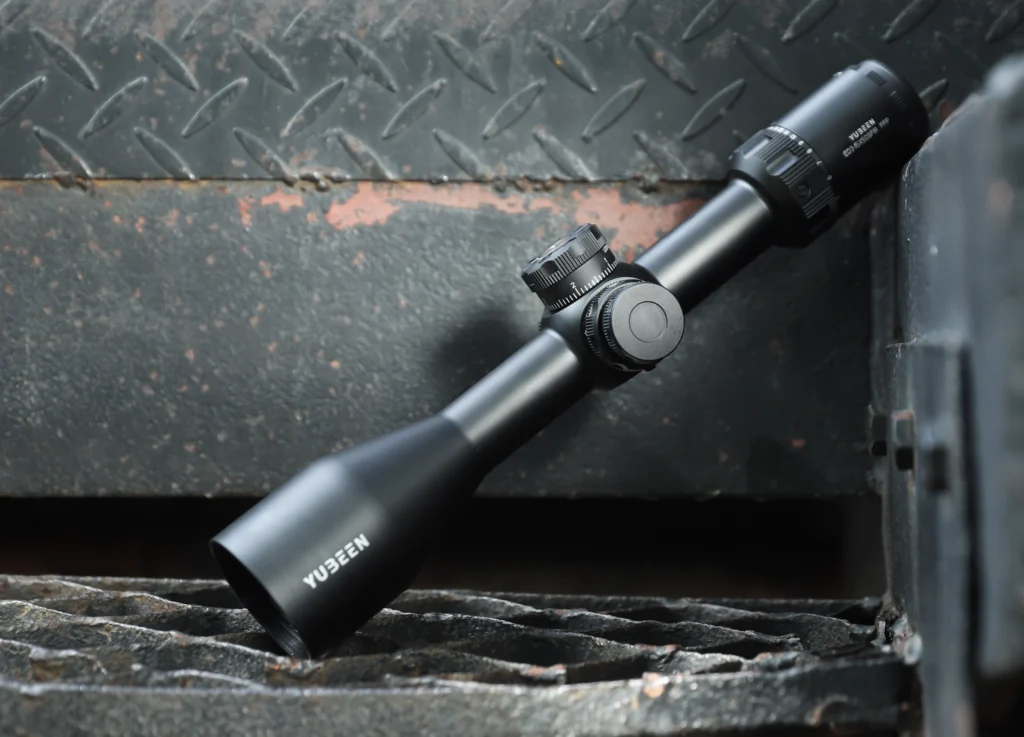
A Current Yubeen Optical Scope Should Be Evaluated as a Complete System
Yubeen’s current optical range includes variable-power scopes with different combinations of magnification, focal plane, reticle, objective size, main-tube diameter and adjustment system.
[REAL CURRENT YUBEEN OPTICAL PRODUCT IMAGE HERE]
The exact specifications for the pictured model should be taken only from its current product documentation.
Do not transfer:
- magnification;
- objective diameter;
- FFP or SFP;
- click value;
- parallax range;
- tube diameter;
- zero stop;
- shock rating;
- IP rating;
- operating temperature
from another Yubeen model simply because the products look similar.
For current model information, review the current Yubeen optical scope range.
How to Choose a Long-Range Optical Scope
Use the following sequence:
- Define the realistic observation and hunting distances.
- Decide how much low-end field of view is required.
- Select a useful magnification range rather than the largest available number.
- Choose FFP or SFP according to reticle use.
- Select a reticle that remains usable at the magnifications you actually use.
- Decide whether reticle illumination is necessary.
- Confirm parallax-adjustment range.
- Evaluate eye relief and eye-box behavior.
- Check objective size against mounting height and weight.
- Confirm turret type and adjustment workflow.
- Verify ring and rail compatibility.
- Check exact model-specific durability and environmental specifications.
This sequence keeps the decision focused on the complete system rather than a single headline specification.
The Best Long-Range Scope Is a Balanced Scope
There is no universal optical specification that defines the best long-range hunting scope.
Maximum magnification alone is not enough.
Objective diameter alone is not enough.
FFP alone is not enough.
ED glass alone is not enough.
A useful scope combines:
- appropriate magnification;
- usable field of view;
- sufficient optical resolution and contrast;
- suitable reticle behavior;
- appropriate parallax control;
- reliable adjustments;
- comfortable eye positioning;
- correct mounting;
- verified mechanical durability.
The correct choice is therefore the scope whose complete optical and mechanical design fits the intended use—not the model with the largest number on the specification sheet.
FAQ
How Much Magnification Do I Need for Long-Range Hunting?
There is no universal number. Useful magnification depends on target size, distance, atmospheric conditions, field of view, optical quality and viewing stability. More magnification is not automatically more useful.
Is FFP Better Than SFP for Long Range?
Not universally. FFP keeps angular reticle subtensions proportional across magnification, which can simplify reticle-based holds and ranging. SFP maintains a constant apparent reticle size. The better choice depends on workflow and reticle use.
Is a 56 mm Objective Better Than a 50 mm Objective?
Not automatically. A larger objective can support a larger exit pupil at the same magnification, but image quality also depends on transmission, coatings, glass, magnification and observer pupil size. A larger objective also adds size and mounting considerations.
Does a 34 mm Tube Give a Brighter Image Than a 30 mm Tube?
Not simply because it is wider. Main-tube diameter mainly affects mechanical packaging, adjustment space, weight and ring compatibility rather than directly determining light gathering.
Does Higher Magnification Improve Accuracy?
Higher magnification makes the target appear larger. It does not automatically improve turret tracking, zero stability, optical resolution or mechanical accuracy.
Do I Need Side Focus for Long-Range Use?
Adjustable parallax is useful when observation distance varies and precise reticle alignment matters. Side focus is one convenient implementation; adjustable objective is another.
Is ED Glass Necessary for a Long-Range Scope?
Not universally. ED glass can help control chromatic aberration, but the final image depends on the complete optical design, coatings, lens quality and manufacturing.
Is a Zero Stop Necessary?
No. A zero stop can make turret workflow more convenient, especially when elevation is adjusted frequently, but it is not required for every use case and does not by itself prove tracking quality.