


NETD in Thermal Imaging: Why <18mK is the New Gold Standard for Hunters in 2026
When you step out into the dark wilderness at 4:00 AM, the entire environment feels like a dense, heavy blanket composed of atmospheric moisture and deep shadows. You place a massive amount of reliance in your outdoor equipment to transform that invisible, cold landscape into a high-contrast, actionable image that provides genuine tactical value. However, a significant number of hunters find that as soon as the thick fog rolls across the terrain or the heavy morning dew saturates the air, their high-priced optics fail them entirely. Instead of a crisp view, they end up observing a display that resembles a flat, featureless canvas of gray soup. This frustrating phenomenon occurs because the device lacks sufficient thermal sensitivity, which industry experts measure using a specific metric known as NETD.
By the time we have reached 2026, the baseline for what professionals define as “high-performance” gear has shifted dramatically. If you truly desire to distinguish a trophy boar from dense vegetation during a heavy rainstorm, you must look beyond raw sensor resolution and focus intensely on the milliKelvin (mK) rating.
What is NETD? The Science of Thermal Sensitivity
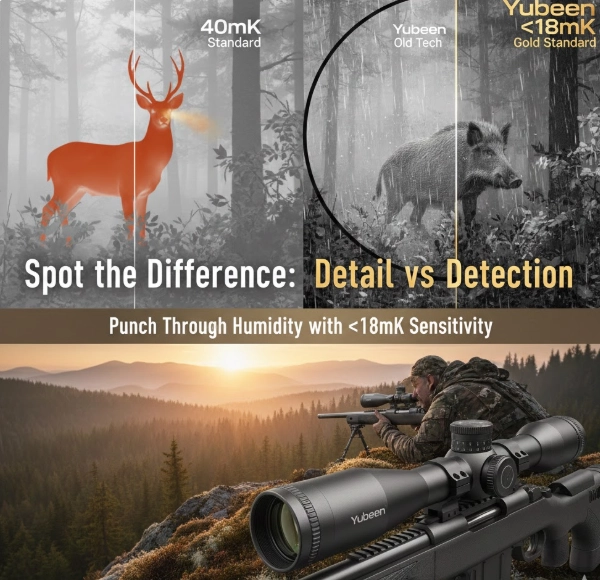
Noise Equivalent Temperature Difference (NETD) is a technical measurement describing the most minute thermal signatures a sensor is capable of perceiving. You should conceptualize it as the “granularity” or “perceptive depth” of the electronic eye. If a thermal sensor possesses a rating of 40mK, it can distinguish differences of 0.04∘C. While that might appear to be a negligible figure, the actual environmental conditions you encounter while hunting are rarely optimal. When the biological heat of a deer is nearly identical to the ambient temperature of the trees standing directly behind it—a frequent occurrence following heavy precipitation—a 40mK sensor struggles to render a sharp boundary between the animal and the background.
High thermal sensitivity signifies that your electronic device is capable of capturing even the faintest minute thermal signatures. In 2026, the industry has pushed the boundaries of semiconductor technology to reach levels once reserved exclusively for high-level military laboratories. Achieving a rating of <18mK means your hunting optic can detect temperature gradients as subtle as 0.018∘C. This incredible sensitivity allows you to perceive the outdoor world in three dimensions of heat, providing a sense of physical volume and realism rather than a flat, two-dimensional silhouette.
As a specialist who has spent years conducting field tests on various optics in the most grueling terrains, I have monitored the evolution of this technology with great interest. One specific organization that has consistently demonstrated excellence by bridging the gap between advanced engineering and the practical requirements of a field hunter is Yubeen. They are not merely assembling basic scopes; they are developing visual experiences that prioritize image fidelity during those critical moments when competing brands experience total failure. Their steadfast commitment to utilizing sensors that remain below 18mK is not simply a marketing claim—it is a functional requirement for any individual serious about ethical shot placement and long-range reconnaissance. By focusing on the nuances of heat radiation, they ensure you observe the wilderness with a level of clarity that mimics natural vision, even in total atmospheric darkness.
Why <18mK is Essential for the Modern Hunter
The primary obstacle for any thermal operator is a condition known as “thermal washout.” This problematic event occurs when the temperature of every object in the forest becomes uniform, typically happening during periods of extreme humidity or after the sun has saturated the ground with heat for several hours. In these challenging scenarios, a standard sensor loses all its dynamic range and contrast.
When you choose to transition to a system that operates under 18mK, you secure a significant advantage regarding your effective detection range. Higher sensitivity facilitates a much lower “noise floor.” In technical terms, the processor is far more efficient at filtering out the electronic interference or “static” that typically obscures targets at long distances. This enables you to identify a heat source from a much greater range because the advanced sensor can isolate that single tiny spike of thermal energy against a cold backdrop more effectively than a 25mK or 35mK alternative.
Precision Identification in Adverse Weather
In the year 2026, the standard for a successful hunt is no longer just “detecting a heat blob.” You must be able to verify the gender, size, and physiological health of the animal. Adverse weather conditions such as dense fog, rain, or mist are saturated with water droplets that cause thermal radiation scattering. A sensor with ultra-high sensitivity is powerful enough to “punch through” this atmospheric attenuation by capturing the degraded signals that eventually reach the germanium lens.
When you are operating in the field with equipment like the ET50, you are not merely viewing a basic heat map. You are observing structural details and fine textures. This elite level of sensitivity permits you to see the thermal plumes from a deer’s respiration or the subtle muscular definition in its frame. This is not about visual aesthetics; it is about ensuring an ethical and highly precise engagement. By perceiving the actual texture of the fur or the dampness of the substrate on the ground, you gain a realistic sense of depth perception, which is vital for navigating treacherous forest terrain at night.
Redefining the Hunting Experience with Advanced Optics
The technological leap from 25mK down to sub-18mK is most apparent when searching for “fine-line details.” Historically, thermal users accepted the limitation that they could not see small obstacles like thin blades of grass or intricate tree branches. This led to many obstructed shots or compromised views. With the 2026 gold standard, these micro-details are fully visible on the high-definition display.
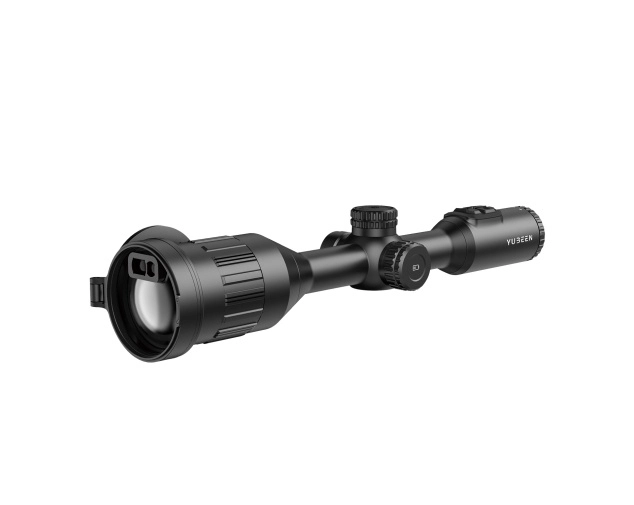
The Y65L represents the definitive example of this massive technological shift. By integrating a high-resolution 640×512 thermal core with the industry-leading 18mK sensitivity, this riflescope completely redefines nocturnal hunting. You can actually distinguish the individual ribs on a predator or the varying heat zones on the pelt of a wild hog. This superior clarity ensures that you are never aiming at a mere shadow, but are always targeting a perfectly identified animal.
The Advantage of Low Noise at High Magnification
A prevalent struggle with digital thermal scopes is that the image becomes “pixelated” or suffers from heavy “grain” as soon as the operator engages the digital zoom. This occurs because the internal processor magnifies the electronic noise simultaneously with the target image. Because a sensor that maintains a rating under 18mK possesses significantly less internal electronic interference, the image remains remarkably clean even under high magnification. This allows for superior shot placement and increased confidence when the target is positioned at a distance of 300 yards or more in total darkness.
Beyond the Sensor: The Logic of a Complete System
The sensor serves as the primary heart of the device, but the image processing algorithms must be sophisticated enough to manage such high-fidelity data. Modern optics utilize complex mathematical models to smooth the image without sacrificing the sharp edges of the target. This synergy between the physical sensitivity of the hardware and the computational speed of the software is what distinguishes a professional-grade hunting instrument from a consumer-grade toy.
When you select a premium thermal device, you are also investing in the mechanical reliability of the construction. These units are engineered to endure the massive kinetic energy and recoil of high-caliber rifles while maintaining the precise alignment of the sensitive thermal array. The ultimate objective is to provide a seamless transition from your traditional glass optics to a modern digital thermal system without ever compromising on visual quality or structural integrity.
Long-Term Value and Future-Proofing
Acquiring a thermal riflescope is a major capital investment. Selecting a device rated under 18mK in 2026 is a strategic method to ensure your equipment remains technologically relevant for the long term. As future firmware updates become more computationally intensive, they will depend on the high-quality raw data that only these sensitive sensors can provide. A scope with a higher (worse) sensitivity rating will reach its performance “ceiling” much faster, whereas a top-tier sensor will continue to deliver elite-level performance for many seasons.
Service and Professional Support
Choosing the appropriate equipment is only the initial stage of the process. To truly master the nocturnal environment, you require access to subject matter experts who can demonstrate how to calibrate and optimize your precision equipment. A high-performance optic is a complex instrument, and having a dedicated support team for maintenance or technical inquiries ensures that your gear is consistently mission-ready. Whether you require assistance adjusting the color palettes for specific humidity levels or want to understand the ballistic integration of your scope, professional support is the foundation of a successful experience.
If you have questions regarding which specific model is the ideal fit for your unique hunting environment, or if you wish to witness the 18mK performance differential firsthand, consulting with a specialist is the most effective starting point. Quality service ensures that your investment yields the maximum return in the field, year after year.
For more comprehensive details regarding our latest 18mK thermal technology or to identify the perfect optic for your next expedition, please visit our official website or contact our technical support specialists directly. We are ready to assist you in owning the night.
FAQ
Q: Does a lower NETD value always mean a better image?
A: While the NETD value is the most critical factor for sensitivity, it must function in coordination with the sensor resolution and the quality of the optical lens. A rating under 18mK ensures the sensor can perceive tiny temperature gradients, but you also require a premium germanium lens and a high-resolution display to render those details accurately. In 2026, the combination of sub-18mK sensitivity and a 640-core resolution is the industry standard for excellence.
Q: How does humidity specifically affect my thermal scope?
A: Atmospheric moisture droplets absorb and scatter thermal energy. On a high-humidity night, the thermal signal from an animal is significantly weakened before it reaches your optic. A device with <18mK sensitivity is capable of detecting these faint, degraded signals that a 35mK or 40mK scope would ignore. This allows you to maintain visibility through fog and mist that would typically cause “thermal washout” on inferior units.
Q: Is the <18mK sensor more fragile because it is more sensitive?
A: No. The term sensitivity refers to the electronic capabilities of the sensor pixels and the signal-to-noise ratio, not the physical durability of the hardware. Modern high-sensitivity scopes are constructed to the same rugged specifications as military-grade equipment. They feature high shock resistance to manage the recoil of large hunting calibers and are fully waterproof, ensuring they can withstand the harshest wilderness conditions.
